White Supremacy Threatens South Africa’s Sovereignty, But What About America?

By Tim Cocks (Reuters)
Blog Commentary & Call to Action

South African President Cyril Ramaphosa recently sounded the alarm: ideas of white racial superiority are not only a threat to South Africa’s post-apartheid unity, but also to its sovereignty and international relations. Speaking at an ANC conference, Ramaphosa condemned false narratives of “white persecution” that continue to circulate in far-right spaces globally. These myths, he warned, have real consequences for diplomacy and national security.

Yet while Ramaphosa calls for global efforts to debunk these lies, U.S. President Donald Trump has chosen to amplify them. Trump boycotted the G20 summit in Johannesburg, alleging without evidence that South Africa mistreats its white minority. He claimed white farmers were being “slaughtered” and their land “illegally confiscated.” These claims have been widely debunked, but they continue to fuel white supremacist rhetoric worldwide.

Here’s the hypocrisy: Trump accuses South Africa of racism against whites yet remains silent on the systemic racism and repression of Black people in America. In South Africa, a wrong was made right, apartheid was dismantled, and the nation continues to strive for unity. In America, however, racism remains deeply entrenched. Black men are killed at alarming rates, the justice system turns a blind eye, and the trauma of racial injustice grows worse every day.

Before the pot calls the kettle black, America must look inward. Stop throwing stones when you live in a glass house. The U.S. government cannot credibly lecture others on racial justice while ignoring the oppression within its own borders.

Black people in America continue to face systemic racism and deadly police violence at rates far higher than other groups, making Donald Trump’s accusations against South Africa not only hypocritical but deeply offensive.

Police Violence Against Black Americans

  • In 2024 alone, U.S. police killed 1,365 people — the deadliest year on record campaignzero.org.
  • Of those, 248 were Black, despite Black Americans making up only about 13% of the population Statista.
  • The rate of fatal police shootings among Black Americans stood at 6.1 per million per year (2015–2024), more than double that of white Americans Statista.
  • Even after the global outcry following George Floyd’s murder in 2020, police killings of Black people have actually increased in recent years NBC News.
  • Data shows that unarmed Black men are disproportionately killed by police, highlighting systemic bias in law enforcement factually.co.

Examples of Systemic Racism in America

Systemic racism is not limited to policing, it permeates nearly every aspect of American life:

  • Education: Black students are more likely to attend underfunded schools and face harsher disciplinary actions Human Rights Careers.
  • Housing: Redlining and discriminatory lending practices have left Black families with far less generational wealth Human Rights Careers.
  • Employment: Black workers earn less on average and face higher unemployment rates than white counterparts Robert F. Smith News.
  • Healthcare: Black Americans experience worse health outcomes, higher maternal mortality rates, and less access to quality care Human Rights Careers.
  • Criminal Justice: Black people are incarcerated at nearly five times the rate of white people, often for similar offenses Human Rights Careers.

Taken together, these examples show that racism in America is not incidental, it is systemic, structural, and ongoing.

Blog Post Framing

South Africa, under Ramaphosa, is working to dismantle the legacy of apartheid and build unity. Meanwhile, America continues to deny or downplay its own racial injustices. For Donald Trump to accuse South Africa of racism against whites while ignoring the daily trauma of Black Americans is the ultimate hypocrisy.

Before the pot calls the kettle black, America must confront its own house of glass. Stop throwing stones abroad while ignoring the shattered lives at home.

Sources: Statista factually.co NBC News campaignzero.org Human Rights Careers Robert F. Smith News

Call to Action

It’s time to:

  • Expose and dismantle white supremacist lies globally.
  • Hold U.S. leaders accountable for systemic racism and police violence.
  • Unite Black communities worldwide in solidarity and resistance.

So I ask again: Should Donald Trump and the U.S. government be called out for this hypocrisy? The answer seems clear, yes, loudly and globally.

Rallying Cry

No more silence, no more lies, 

We see the truth with open eyes. 

From Soweto to Harlem streets, 

Black voices rise, we won’t retreat. 

Justice delayed is justice denied, 

Too many brothers have already died. 

Glass houses crack when stones are thrown, 

America fix the rot in your own. 

Unite the people, across the land, 

Together in strength, we take a stand. 

From Cape Town’s shore to Detroit’s fight, 

Black power united will set things right. 

Dr. Keyimani Alford: Reclaiming Narratives, Empowering Voices

Dr. Keyimani Alford is more than a leader; he is a storyteller, healer, and advocate whose life’s work bridges the worlds of education, authorship, and empowerment. Born in Oakland, California, and raised in Milwaukee, Wisconsin, Dr. Alford grew up navigating instability, poverty, and family absence. Those early challenges shaped his belief that education is not only a pathway to freedom but also a tool for rewriting one’s story.

As a first-generation college graduate who went on to earn his Ph.D. in Education, Dr. Alford understands the barriers faced by students from marginalized backgrounds. His research focuses on retention and persistence for first-generation and minority male students at predominantly White institutions, emphasizing that relationships and belonging are critical to success. Today, as Associate Vice President of Student Access & Success at Madison College, he leads initiatives that help students overcome financial, systemic, and personal obstacles so they can thrive. His leadership is rooted in empathy, accountability, and the conviction that systems should serve students, not the other way around.

Championing Underserved Communities

Dr. Alford’s commitment extends far beyond campus walls. Through his involvement in organizations such as WASFAA, College Goal Wisconsin, and MASFAA (where he serves as President-Elect), he advocates for policies that expand access and equity in higher education. His work ensures that underserved students, veterans, first-generation learners, and minority communities, have the support they need to persist and graduate.

He also founded Keywords Unlocked, LLC, a publishing and coaching company designed to amplify everyday voices, particularly Black and underrepresented authors. By equipping writers with tools and strategies to move from manuscript to marketplace, Dr. Alford is dismantling barriers in the publishing industry and ensuring that marginalized stories are not only told but celebrated.

Author and Storyteller

Dr. Alford’s own catalog of books reflects the power of storytelling as a tool for healing and leadership:

Oakland Hills, Milwaukee Rivers: A Memoir of Survival, Identity, and Purpose

In Oakland Hills, Milwaukee Rivers, I invite readers into the quiet rooms, crowded churches, and complicated family moments that shaped me as a Black boy learning to survive, belong, and believe in his own worth. This memoir walks through childhood trauma, father loss, religious shame, identity questions, and the hidden weight of silence, while tracing how grace kept showing up in unexpected people and places. It reads like sitting across from a friend who is finally telling the whole story, not the edited version.

Readers will see their own questions on these pages. The book helps them name what hurt, grieve what was taken, and begin to reclaim their voice with honesty and dignity. They walk away with language for things they have carried for years, a deeper understanding of how identity and faith can coexist with pain, and a renewed belief that their story is not over. This memoir becomes a mirror and a map for anyone who has ever felt unseen, misunderstood, or afraid to be fully themselves.

Unshaken Leadership: A Practical Blueprint for Overcoming Challenges, Learning from Mistakes, and Growing in Confidence

Unshaken Leadership pulls back the curtain on what leadership really feels like when the title sounds good, but the pressure is heavy. Drawing from more than two decades in higher education, community, and faith-based spaces, I walk readers through the unspoken realities of leading people, managing politics, navigating conflict, and making hard decisions when you still feel like you are figuring it out yourself. Each chapter blends story, reflection, and practical strategy so readers see the lessons in real situations, not just theory on a page.

This book is written for new and growing leaders who are tired of pretending they have it all together and are ready to lead with honesty, courage, and emotional intelligence. Readers gain language for the challenges they are facing, tools for balancing vision and boundaries, and frameworks they can immediately apply with their teams. The goal is simple: to help leaders stand firm when things shake around them, learn from their missteps without shame, and grow into a version of leadership that feels both effective and authentic.

Self-Publishing from Scratch: A Practical Guide for Authors to Publish Successfully with Insights for Black Voices

Self-Publishing from Scratch is a step-by-step roadmap for everyday people who feel called to write a book and have no idea where to start. I walk readers through the full journey from idea to published book in plain language, breaking down what to write, how to edit, how to find a cover, how ISBNs work, what platforms to choose, and how to price and promote their work. Along the way, I share real stories, checklists, and behind-the-scenes lessons from my own publishing journey so readers avoid costly mistakes and gain the confidence to hit “publish” with clarity.

This book especially centers Black and underrepresented voices who have been told their stories are “too much,” “too specific,” or “too risky” for traditional publishing. Readers come away with practical tools, a realistic plan, and the encouragement that they do not have to wait for permission to become an author. By the end, they understand the business and the heart of self-publishing, and they know exactly what to do next to turn a manuscript, a journal, or even a set of notes on their phone into a book in readers’ hands.

Mile Markers of Life: A 100-Day Christian Devotional for Direction and Strength

Mile Markers of Life is a 100-day devotional born from years of driving Wisconsin highways and noticing how the mile markers along the road mirrored the seasons of my own life. Each entry starts with a real-life scene and then connects it to Scripture, reflection, and a short prayer, helping readers see that God has been present in both the ordinary and painful parts of their journey. The readings are honest and accessible, designed for people who are carrying a lot and need encouragement that fits into real schedules and real emotions.

Readers will experience a devotional that speaks to fatigue, grief, uncertainty, hope, and new beginnings with gentle clarity. Every day offers direction for the heart and a small step they can take to move forward, whether that is letting something go, forgiving themselves, or daring to dream again. By the time they reach Day 100, they have traced their own “mile markers,” recognized how far they have come, and rediscovered that even in detours and delays, God has been guiding them toward healing and purpose.

A Voice of Hope and Action

Whether speaking in lecture halls, boardrooms, sanctuaries, or behind a microphone, Dr. Alford blends truth-telling with practical tools. His keynote themes, leadership with integrity, healing from trauma, equity in higher education, and empowering everyday voices, resonate because they are lived experiences, not abstract theories. Audiences leave not only inspired but equipped with frameworks and next steps to move forward.

Across every platform, Dr. Alford reminds people that their story still has chapters left and that hope is always within reach. His work as an author and advocate continues to light the way for underserved communities, proving that beginnings do not define destinies.

Connect with Dr. Keyimani Alford

Name: Dr. Keyimani Alford

Email: drkeyspeaks@gmail.com

Speaking & Books: www.drkeyspeaks.com

Publishing Company: www.keywordsunlocked.com

Social Media:

  • YouTube: @drkeyspeaks
  • Instagram: @drkeyspeaks
  • TikTok: @drkeyspeaks
  • Facebook: @drkeyspeaks
  • LinkedIn: Dr. Keyimani Alford (search on LinkedIn by name)

Georgia’s Taxpayers May Soon Bankroll Trump’s Defense

Georgia recently passed a law that could force Fulton County taxpayers to reimburse Donald Trump and his co-defendants for millions in legal fees after the election-interference case was dismissed. Estimates suggest claims could reach $10 million or more, though no payouts have been finalized yet CBS News The Hill san.com.

Case Collapse, Costly Consequences

Fulton County’s election‑interference case against Donald Trump and 18 co‑defendants was dismissed after DA Fani Willis was disqualified. That dismissal triggered Georgia’s new SB 244 law, which allows defendants to demand reimbursement of “reasonable attorney’s fees and costs.”

What’s Happening

  • Case dismissed: The sprawling Georgia election-interference case against Trump and 18 co-defendants was dropped in late November 2025 after Fulton County DA Fani Willis was disqualified due to a conflict of interest san.com.
  • New law (SB 244 / GA Code §17-11-6): Passed earlier this year, it allows defendants to seek reimbursement of “reasonable attorney’s fees and costs” if a prosecutor is disqualified and charges are dismissed The Hill san.com.
  • Potential claims: Trump’s legal team alone spent more than $5.5 million in Georgia since 2021. Co-defendants collectively spent millions more, with some raising funds through crowdfunding CBS News.
  • Taxpayer impact: Fulton County could be liable for millions, possibly tens of millions, depending on how many defendants file claims and what a judge approves CBS News The Hill.

The Price Tag

  • Trump: $5.5M+ in Georgia legal fees
  • GOP “fake electors”: $2.3M
  • Harrison Floyd: $363K (crowdfunded)
  • John Eastman: $937K (crowdfunded)
  • Jeff Clark: $153K (crowdfunded)
  • Total exposure: $10M+ and counting

Taxpayer Impact

Defendants have 45 days to file claims. Judge Scott McAfee will decide payouts. While Trump’s attorney insists reimbursements come from the DA’s budget, critics argue taxpayers ultimately foot the bill.

Risks & Fallout

  • Unprecedented precedent: Rarely are criminal defendants reimbursed.
  • Political fallout: Though bipartisan, the law is widely seen as Trump‑specific.
  • Budget strain: Fulton County faces millions in potential payouts.

Risks & Considerations

  • Unprecedented law: Reimbursing criminal defendants is rare in U.S. law, raising questions about fairness and precedent san.com.
  • Political fallout: The measure was passed with bipartisan support but is widely seen as tailored to Trump’s case The Hill san.com.
  • Uncertain totals: No official accounting yet of Fulton County’s own prosecution costs, which could add significantly to taxpayer exposure CBS News.

In short: Georgia’s dismissal of the Trump case has opened the door for Trump and co-defendants to demand millions back in legal fees. Whether taxpayers ultimately foot the bill depends on how judges interpret the new law and the claims filed in the coming weeks.

Sources: CBS News The Hill san.com

Advocacy Framing

This is more than a budget issue, it’s a democracy issue. Georgia’s taxpayers may soon bankroll the defense of those accused of undermining democratic institutions. Communities must mobilize to demand transparency, fiscal responsibility, and ethical leadership.

Call to Action:
Share this story. Demand accountability. Ask why public funds should defend those accused of attacking democracy.

Lenacapavir: A Breakthrough HIV Prevention Tool Held Back by Global Funding Cuts

Adapted from reporting by Rachel Schraer, The Independent (Rethinking Global Aid Project)

The closest thing we have to an HIV vaccine has finally arrived. Lenacapavir, a long-acting injectable medication that can prevent nearly 100% of HIV infections when administered twice yearly, is being hailed as revolutionary. Yet despite its promise, only a fraction of the people who need it will gain access.

The Numbers Behind the Breakthrough

  • Current plans by Gilead and international funders will provide lenacapavir to 2 million people over three years, about 666,000 annually.
  • Research by Dr. Andrew Hill (University of Liverpool) shows this rollout could avert 165,000 infections, but scaling up to 10 million people annually could prevent half a million infections and put us on track to ending HIV transmission.
  • The challenge: funding cuts, particularly from the U.S. under President Donald Trump, have left prevention efforts severely under-resourced.

The Cost and Access Challenge

  • In the U.S., a course of lenacapavir costs $28,000.
  • Thanks to advocacy and licensing agreements, the drug will be sold at no profit in low-income countries, with costs reduced to around $40 per person per year.
  • Gilead’s plan to reach 2 million people by 2028 is described as an “initial step,” with hopes that generic manufacturers will expand access further.

Why This Matters Globally

Anne Aslett, CEO of the Elton John AIDS Foundation, called the rollout “unprecedented,” noting that doses are arriving in Eswatini at the same time as in the U.S., a sharp contrast to the early AIDS crisis, when African nations waited more than a decade for antiretroviral drugs.

Still, she warns that funding gaps threaten progress. Vulnerable populations, young women, LGBTQ communities, sex workers, and people who use drugs, are often excluded from prevention services. Without reaching these groups, the epidemic cannot be contained.

Innovation in Delivery

  • Foundations are experimenting with drone deliveries of drugs and testing kits.
  • Digital pilots in London are making PrEP accessible directly to consumers, by passing traditional clinics.
  • Sub-Saharan Africa is now pioneering models of care that are more advanced than those in parts of the Global North.

🇬🇧 The UK’s Role

Mike Podmore, CEO of STOPAIDS, emphasizes that UK contributions are not just charity, they fuel domestic research and innovation. Agencies like Unitaid have invested £250m into UK universities over the past decade, strengthening both global and local HIV responses.

The UK has set a goal to end new HIV transmissions by 2030, and expanding access to lenacapavir will be critical to achieving it.

The Call to Action

Ending HIV is within reach, but only if global leaders step up. Dr. Hill and advocates worldwide are urging wealthy nations to contribute to a proposed $400m fund to expand access without undermining existing HIV programs.

This is a pivotal moment: decades of research and advocacy have brought us closer than ever to a cure. But without adequate funding, only 7% of those who need lenacapavir will receive it.

What you can do:

  • Sign petitions demanding governments protect and expand HIV funding.
  • Share this story widely to raise awareness.
  • Pressure policymakers to prioritize vulnerable populations in prevention programs.

Together, we can ensure that this breakthrough doesn’t stall at the starting line. Let’s end HIV and make life better for all.

Original reporting by Rachel Schraer, The Independent, as part of the “Rethinking Global Aid” project.

Seventh HIV Remission Sparks Hope, and Raises Questions About U.S. LeadershipOriginal reporting by Michelle Starr, Nature

A German man known as “Berlin 2 (B2)” has remained in remission from HIV for six years after a stem cell transplant to treat leukemia. This marks the seventh known case of long-term HIV remission worldwide. Unlike earlier cases, B2’s donor carried only one copy of the CCR5 Δ32 mutation, previously thought insufficient for durable resistance. His remission challenges assumptions and opens new pathways for understanding how HIV reservoirs can be eliminated.

Globally, 40.8 million people were living with HIV in 2024, with 1.3 million new infections and 630,000 AIDS-related deaths. In the U.S., 39,201 new diagnoses were reported in 2023, disproportionately impacting Black and Latino communities, especially in the South.

These breakthroughs abroad raise urgent questions:

  • Why are Germany and Switzerland leading in remission cases, while the U.S. lags behind?
  • Why does America, supposedly the global leader in R&D, appear to be playing second fiddle in HIV cure research?
  • Is the lack of universal healthcare in the U.S. a factor in limiting access to experimental treatments?
  • Why does Big Pharma continue to prioritize lifelong drug regimens over potential cures?

For those living with HIV/AIDS, these questions are not abstract, they are about survival. If you are reading this and living with HIV, ask your doctor about the current status of cure research. Demand transparency.

Stem cell transplants are not scalable cures, but they prove that reservoir reduction, graft-versus-reservoir responses, and partial CCR5 protection can lead to remission. The challenge now is whether America will invest in replicating these mechanisms through gene editing and pharmaceutical innovation or continue to let others lead while its citizens wait.

World AIDS Day is more than a commemoration, it is a call to action, reflection, and hope. Observed every year on December 1, it reminds us of the lives lost, the progress made, and the work still ahead in ending HIV/AIDS.

The Meaning of World AIDS Day

World AIDS Day was first established in 1988 by the World Health Organization (WHO) and UNAIDS, making it the first-ever global health day Wikipedia Britannica. Its purpose is to raise awareness about HIV/AIDS, show solidarity with people living with HIV, and honor the millions who have died from AIDS-related illnesses. The red ribbon, adopted in 1991, remains the universal symbol of support and remembrance Britannica.

Each year, the day carries a theme. In 2025, the theme is “Overcoming disruption, transforming the AIDS response”, a reminder that funding cuts, stigma, and inequality threaten decades of progress Moneycontrol.

Historical Context and Data

  • In the 1980s and 1990s, HIV/AIDS was a rapidly escalating crisis. By 1997, new infections peaked at 3.3 million annually, and AIDS-related deaths peaked in 2004 at 2.1 million per year Britannica.
  • Since then, antiretroviral therapy (ART) transformed HIV from a fatal disease into a manageable chronic condition, reducing deaths by more than 64% since 2004 Wikipedia.
  • As of 2024, an estimated 40.8 million people worldwide were living with HIV, with 1.3 million new infections and 630,000 AIDS-related deaths that year Business Standard Moneycontrol.
  • In the U.S., about 1.2 million people live with HIV, with ongoing disparities in testing and treatment Las Vegas Sun.

Strides in Treatment and Prevention

The fight against HIV/AIDS has seen remarkable progress:

  • ART advancements: From early AZT in 1987 to today’s single-pill regimens and long-acting injectables, treatment now allows near-normal lifespans Las Vegas Sun.
  • Prevention tools: Pre-exposure prophylaxis (PrEP) and post-exposure prophylaxis (PEP) have proven highly effective in preventing infection Business Standard.
  • U=U (Undetectable = Untransmittable): People on effective ART who maintain undetectable viral loads cannot sexually transmit HIV Business Standard.
  • Mother-to-child transmission: Once a major concern, it has been drastically reduced through targeted interventions Las Vegas Sun.

The Future Outlook

While progress is undeniable, challenges remain:

  • Funding cuts and inequality threaten to reverse gains, especially in vulnerable communities Moneycontrol.
  • Late diagnoses continue to hinder progress, with over half of new cases in Europe detected too late for optimal treatment News-Medical.Net.
  • Research breakthroughs offer hope: trials with engineered antibodies, CRISPR gene editing, and long-acting injectables like lenacapavir suggest that a functional cure may be within reach Smithsonian Magazine AIDS.ORG.
  • The global goal remains clear: end AIDS as a public health threat by 2030, a target set by UNAIDS and the UN Sustainable Development Goals Britannica UNAIDS.

Closing Reflection

World AIDS Day is not just about remembrance, it is about renewed commitment. We have turned HIV from a death sentence into a chronic condition, but stigma, inequity, and funding gaps still stand in the way of ending the epidemic. The future depends on global solidarity, scientific innovation, and community-led action.

Ending AIDS is possible but only if we choose compassion, equity, and sustained investment.

Sources: Wikipedia Britannica Business Standard Las Vegas Sun Smithsonian Magazine AIDS.ORG UNAIDS Moneycontrol

Epstein’s Accountant, JPMorgan, and the Two Justice Systems in America

Credit: Original reporting by Jacob Shamsian (Business Insider)

For 22 years, Harry Beller served as Jeffrey Epstein’s personal accountant. He wasn’t one of the boldfaced names splashed across Epstein’s social calendar, not a Jes Staley, Bill Clinton, Donald Trump, or Prince Andrew. But Beller was entrusted with managing some of the most delicate parts of Epstein’s financial life.

Court records and Suspicious Activity Reports (SARs) filed by JPMorgan Chase reveal that Beller personally withdrew tens of thousands of dollars in cash from Epstein’s accounts, sometimes in structured amounts just under the $10,000 reporting threshold. These withdrawals raised alarms inside JPMorgan as early as 2002, long before Epstein’s abuse of girls was publicly investigated. Yet, despite repeated red flags, Epstein continued to bank with JPMorgan until 2013.

Congressional investigators now want answers. Democrats on the House Oversight Committee are seeking subpoenas for bank records tied to Beller and others in Epstein’s orbit. Senator Ron Wyden has demanded records from the Treasury Department and JPMorgan CEO Jamie Dimon. Civil lawsuits have already revealed that HBRK, a company managed by Beller and Epstein’s top accountant Richard Kahn, facilitated Epstein’s trafficking operation.

Here’s a Sidebar Timeline of Epstein’s Financial Enablers that you can integrate into your blog post. It highlights the network of individuals and institutions who sustained Epstein’s empire, showing readers how deep this goes.

Sidebar Timeline: Epstein’s Financial Enablers

1990s – Early Foundations

  • Richard Kahn – Epstein’s top in-house accountant. Oversaw financial structures and directed Harry Beller’s work.
  • Harry Beller – Personal accountant for 22 years. Managed cash withdrawals, corporate filings, and tax documents tied to Epstein and Ghislaine Maxwell.

2000s – Banking Relationships

  • JPMorgan Chase – Epstein’s primary bank until 2013. Filed multiple Suspicious Activity Reports (SARs) over large cash withdrawals but continued servicing his accounts.
  • Jes Staley – Former Barclays CEO and senior JPMorgan executive. Maintained close ties with Epstein, exchanging hundreds of emails, some with disturbing undertones.

2008 – First Conviction

  • Epstein pleads guilty to sex crimes in Florida. Despite this, financial institutions and associates continue to work with him.
  • HBRK Company – Managed by Beller and Kahn. Allegedly facilitated Epstein’s trafficking operation through financial structures.

2010s – Continued Influence

  • Ghislaine Maxwell – Partner and enabler. Her tax forms and corporate records repeatedly list Beller’s involvement. Convicted in 2021 of trafficking girls to Epstein.
  • Political & Social Connections – Names like Bill Clinton, Donald Trump, and Prince Andrew appear in Epstein’s social calendar and flight logs, raising questions about proximity and influence.

2013 – JPMorgan Breaks Ties

  • JPMorgan finally severs its relationship with Epstein, citing concerns over frequent cash withdrawals.
  • By then, Epstein had already built a vast network of companies and accounts, many tied to Beller’s management.

2019 – Epstein’s Death

  • Epstein dies in jail while awaiting trial on sex-trafficking charges.
  • Investigations intensify into his financial enablers, but many remain shielded from prosecution.

2020s – Ongoing Investigations

  • Congressional Oversight – Lawmakers demand records from JPMorgan and the Treasury Department related to Epstein’s accounts.
  • Civil Lawsuits – The US Virgin Islands and survivors push for accountability, exposing more of Epstein’s financial network.
  • Harry Beller – Though not charged, his role as Epstein’s accountant is now under scrutiny for enabling decades of suspicious financial activity.

What This Timeline Shows

  • Epstein’s empire was not sustained alone it required accountants, bankers, executives, and institutions.
  • Red flags were raised repeatedly, yet ignored, showing how wealth and influence shield predators.
  • Accountability has been partial at best, with many enablers still untouched by the justice system.

What This Reveals

This story is not just about one accountant. It is about the top 1 percent of America’s wealth pyramid, men with power, influence, and connections, who are implicated in a child trafficking ring yet shielded from accountability.

  • Two justice systems: When crimes are committed by the wealthy and connected, banks, institutions, and even governments look the other way. When crimes are committed by the poor or marginalized, punishment is swift and unforgiving.
  • Blindfold removed: Lady Justice is supposed to be blind. But in America, she peeks beneath the blindfold when the accused are billionaires, politicians, or royalty.
  • Hypocrisy exposed: The same voices that went “bizirk” over the baseless PizzaGate conspiracy, claiming Democrats were eating children in a pizza shop basement, are silent when real evidence of trafficking emerges among the wealthy elite. This shows they don’t care about children; they care about weaponizing lies for political gain.

The Questions We Must Ask

  • Why are these files being hidden from the public?
  • Why are banks like JPMorgan not held accountable for enabling Epstein’s financial crimes?
  • Why are politicians fighting so hard to avoid releasing records that could expose the depth of this trafficking network?
  • How deep does this go, and how many powerful names are being protected?

A Call for Accountability

If these individuals are not prosecuted, then every official who obstructs justice should be relieved of their duties and jailed for dereliction of duty. The protection of predators at the highest levels of wealth and power is not just corruption, it is complicity.

This is not about partisan politics. It is about human rights, justice, and the protection of children. If America cannot hold its wealthiest accountable, then the very foundation of justice collapses.

Closing Thought

Harry Beller may not be a household name, but his role in Epstein’s financial empire reveals the machinery that allowed trafficking to flourish unchecked. The question is not whether Epstein was guilty, that is settled. The question is: Will America finally confront the powerful men who enabled him, or will the blindfold of justice continue to slip when wealth and influence are involved?

When Moderates Break Ranks: Shutdown Politics and the Eight Senators Who Crossed the Aisle

Shutdown Politics: Eight Senators, One Decision, and the Fallout for Millions

On November 10th, 2025, history was written in the most painful way. Eight Democratic-aligned senators broke ranks, joined Republicans, and ended a 40-day government shutdown, but in doing so, they may have jeopardized healthcare for more than 60 million Americans. For weeks, people believed Democrats were fighting for them, holding the line until the Midterms. Instead, what unfolded was a compromise that restored paychecks and food assistance but sacrificed the Affordable Care Act subsidies that millions depend on. This post lays out the facts, the charts, the history, and the names, so you can see for yourself, make your own assessment, and decide what this moment means for our future.

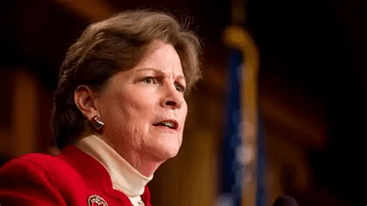
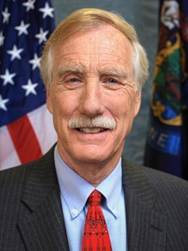
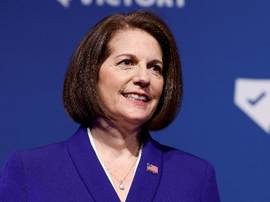
The 8 Democratic Senators that Defected and caused Millions to lose Healthcare:

The Context

In November 2025, eight Democratic-aligned senators joined Republicans to end a 40-day government shutdown. Their decision reopened government services, restored pay for federal workers, and ensured SNAP food assistance continued, but it came at the cost of losing guaranteed leverage on Affordable Care Act (ACA) subsidies.

Context of the Vote

  • The Senate voted 60–40 to advance a short-term funding bill that reopened the government through January 30, 2026.
  • The compromise included full funding for SNAP food assistance, reversal of federal worker layoffs, and back pay for affected employees.
  • However, it did not guarantee an extension of Affordable Care Act (ACA) subsidies, which had been a major demand of Democratic leadership.

Who They Were

SenatorStateJustificationPolitical Reaction
Jeanne ShaheenNHUrgency of reopening services; pragmatic choiceProgressives criticized; Republicans praised
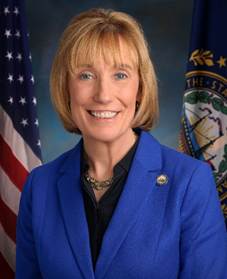
Maggie HassanNHEconomic disruption in NH; compromise to protect jobsModerate pragmatism; progressive backlash
Catherine Cortez MastoNVProtecting SNAP recipients and familiesLocal praise; national criticism
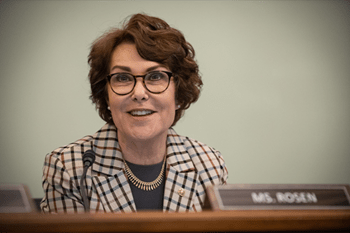
Jacky RosenNVFamilies shouldn’t be collateral damageModerate approval; progressive disappointment
Dick DurbinILImperfect deal but reopening was prioritySeen as statesmanlike exit
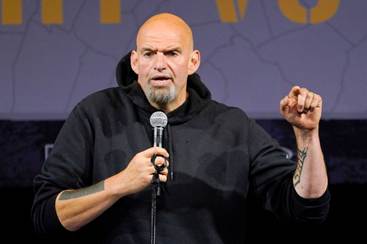
John FettermanPA“Stop playing games with paychecks”Worker focus respected, but seen as cave-in
Tim KaineVAShutdown devastating for federal workforceConstituents relieved; progressives frustrated
Angus King (I)MEShutdown “senseless”; pragmatism over leverageConsistent with independent brand
SenatorStatus 2026Outlook
ShaheenRetiringLegacy-driven pragmatism
HassanVulnerablePurple-state risk
Cortez MastoSafe until 2028No immediate risk
RosenVulnerableNevada swing state
DurbinRetiringStatesmanlike exit
FettermanSafe until 2028Worker-first shield
KaineVulnerableFederal workforce priority
KingVulnerableIndependent pragmatism

Here’s a breakdown of the eight senators:

  • Jeanne Shaheen (D-NH) – Retiring; helped lead negotiations.
  • Maggie Hassan (D-NH) – Former governor, moderate voice.
  • Catherine Cortez Masto (D-NV) – Consistently opposed shutdowns, emphasized working families.
  • Jacky Rosen (D-NV) – Moderate Democrat, joined compromise.
  • Dick Durbin (D-IL) – Senate Democratic Whip, announced retirement in 2026.
  • John Fetterman (D-PA) – Vocal about ending shutdown harm to workers.
  • Tim Kaine (D-VA) – Stressed SNAP funding and guaranteed vote on ACA subsidies.
  • Angus King (I-ME) – Independent caucusing with Democrats, pragmatic stance.

Why They Did It

  • Motivation: To stop the harm caused by the shutdown, unpaid federal workers, SNAP recipients at risk, and disruptions to air travel and public services.
  • Concession: They accepted only a promise of a future vote on ACA subsidies, not a guaranteed extension.
  • Political Positioning: Most of these senators are moderates, former governors, or retiring, meaning they faced less electoral pressure in 2026.

Reaction

  • Democratic Leadership: Criticized the move as a betrayal of leverage on health care subsidies.
  • Progressives: Figures like Sen. Bernie Sanders and Rep. Ro Khanna condemned the vote as “pathetic” and called for stronger resistance.
  • Republicans: Praised the defectors for “putting principle over politics”.

Sources:

NBC News

Senate passes bill to reopen the government as 8 Democrats join with Republicans to send it to the House

 Individual Justifications

  • Jeanne Shaheen (NH) – Emphasized the urgency of reopening government services for families and federal workers in New Hampshire. She framed it as a pragmatic choice to stop harm immediately.
  • Maggie Hassan (NH) – Pointed to the economic disruption in her state, especially for airports and federal contractors. She argued that compromise was necessary to protect jobs.
  • Catherine Cortez Masto (NV) – Highlighted the impact on working families and SNAP recipients in Nevada. She said ending the shutdown was about “keeping food on the table.”
  • Jacky Rosen (NV) – Echoed Masto’s concerns, stressing that families shouldn’t be collateral damage in partisan fights.
  • Dick Durbin (IL) – As Democratic Whip, he acknowledged the deal was imperfect but insisted that reopening government was the priority. He noted his retirement gave him freedom to act pragmatically.
  • John Fetterman (PA) – Spoke bluntly about the harm to federal workers and the need to “stop playing games with people’s paychecks.” He wanted to end the pain quickly.
  • Tim Kaine (VA) – Representing a state with a huge federal workforce, he argued that the shutdown was devastating for Virginians. He accepted the promise of a future ACA subsidy vote as a workable compromise.
  • Angus King (ME, Independent) – True to his independent streak, he said the shutdown was “senseless” and that ending it was more important than partisan leverage.

Common Themes

  • Immediate harm prevention: All eight cited the damage to federal workers, SNAP recipients, and public services.
  • Pragmatism over leverage: They accepted a weaker deal (no guaranteed ACA subsidy extension) in exchange for reopening government.
  • Moderate/independent positioning: Most are moderates, former governors, or retiring  less bound by progressive pressure.

Political Fallout

  • Progressives blasted them for giving up leverage, calling it a “pathetic cave-in.”
  • Republicans praised them for “putting country over party.”

Leadership tension: Their votes exposed a rift between pragmatists and progressives

SenatorStateJustification for VotePolitical Reaction
Jeanne ShaheenNHUrgency of reopening services for families and federal workers; pragmatic choiceProgressives criticized as surrender; Republicans praised pragmatism
Maggie HassanNHEconomic disruption in NH (airports, contractors); compromise needed to protect jobsSeen as moderate pragmatism; backlash from progressive activists
Catherine Cortez MastoNVProtecting SNAP recipients and working families; “keeping food on the table”Praised locally for family focus; criticized nationally for weakening leverage
Jacky RosenNVFamilies shouldn’t be collateral damage in partisan fightsSimilar to Masto; moderate approval, progressive disappointment
Dick DurbinILImperfect deal but reopening government was priority; retirement gave freedomLeadership tension noted; Republicans welcomed his pragmatism
John FettermanPAFederal workers’ paychecks at risk; blunt call to “stop playing games”Progressives split (some respected his worker focus, others saw cave-in)
Tim KaineVAShutdown devastating for federal workforce in VA; accepted promise of ACA voteConstituents appreciated relief; progressives saw weak bargaining
Angus King (I)MEShutdown “senseless”; ending it more important than partisan leverageConsistent with independent streak; Republicans praised, progressives frustrated

Key Takeaways

  • Shared Theme: All eight emphasized immediate harm prevention (workers, SNAP, public services).
  • Political Positioning: Moderates, independents, or retiring senators less bound by progressive pressure.
  • Fallout: Progressives condemned the move as weakening leverage; Republicans praised it as bipartisan pragmatism.

Here’s a 2026 electoral outlook table for the eight senators who broke ranks, showing whether they’re retiring, safe, or vulnerable in reelection:

SenatorStateStatus for 2026Electoral Outlook
Jeanne ShaheenNHRetiringNo reelection pressure; vote seen as legacy-driven pragmatism
Maggie HassanNHUp for reelectionNH is purple; could face GOP challenge, but incumbency helps. Vulnerable if progressives stay cold
Catherine Cortez MastoNVNot up until 2028Safe for now; Nevada is swingy, but no immediate electoral risk
Jacky RosenNVUp for reelectionVulnerable; Nevada is competitive. Her pragmatism may appeal to moderates but risks progressive backlash
Dick DurbinILRetiring in 2026No reelection pressure; vote framed as statesmanlike exit
John FettermanPANot up until 2028Safe for now; Pennsylvania is swingy, but his blunt worker-first justification shields him
Tim KaineVAUp for reelectionVirginia leans blue but has large federal workforce; his vote may resonate locally. Moderate vulnerability
Angus King (I)MEUp for reelectionIndependent brand helps; Maine voters value pragmatism. Moderate but not high vulnerability

Key Insights

  • Retiring Senators (Shaheen, Durbin): Free to vote pragmatically without electoral consequences.
  • Safe Senators (Cortez Masto, Fetterman): Not facing voters until 2028, so little immediate risk.
  • Vulnerable Senators (Hassan, Rosen, Kaine, King): Facing reelection in 2026. Their votes could be framed as bipartisan pragmatism or as betrayal, depending on the narrative in their states.

Political Calculus

  • Moderates in swing states (Hassan, Rosen, Kaine, King) likely judged that ending the shutdown would resonate with independents and moderates, even if progressives were upset.
  • Retirees (Shaheen, Durbin) acted with legacy in mind, prioritizing governance over party leverage.
  • Safe-term senators (Cortez Masto, Fetterman) could afford to take the hit, betting that the immediate worker relief would outweigh progressive anger by 2028.

This shows how electoral timing shaped their willingness to break ranks. Those not facing voters soon or retiring had more freedom, while those up in 2026 took calculated risks.

political identities alongside electoral timing so you can see how ideology + reelection pressure shaped their decisions:

SenatorStateIdeological Identity2026 StatusHow Identity + Timing Shaped Vote
Jeanne ShaheenNHModerate Democrat, pragmatic dealmakerRetiringFree to act pragmatically without electoral risk; legacy-driven choice
Maggie HassanNHCentrist, former governor, consensus-builderUp for reelectionPurple-state vulnerability pushed her toward bipartisan pragmatism to appeal to independents
Catherine Cortez MastoNVModerate liberal, strong on family/economic issuesSafe until 2028Could afford to prioritize immediate harm prevention without fear of electoral backlash
Jacky RosenNVCentrist, business-friendly DemocratUp for reelectionNevada swing state forced her to balance progressive anger with moderate appeal
Dick DurbinILEstablishment Democrat, leadership figureRetiringLegacy vote; framed as statesmanlike pragmatism, no reelection pressure
John FettermanPAPopulist-progressive style, blunt worker-first messagingSafe until 2028His worker-centered justification shielded him from progressive anger despite breaking ranks
Tim KaineVAModerate Democrat, pragmatic, federal workforce advocateUp for reelectionVirginia’s large federal workforce made ending shutdown a local priority; moderate positioning helped
Angus King (I)MEIndependent centrist, pragmatic problem-solverUp for reelectionMaine voters value independence; his brand made bipartisan pragmatism consistent with identity

Patterns

  • Moderates & centrists (Hassan, Rosen, Kaine, King): Their votes aligned with their brand of pragmatism, but electoral timing made them more vulnerable to progressive backlash.
  • Retirees (Shaheen, Durbin): Legacy-driven, free to act without electoral consequences.
  • Safe-term senators (Cortez Masto, Fetterman): Could afford to take the hit, betting that worker/family justification would resonate long-term.

Big Picture

This wasn’t just about ending the shutdown, it was a collision of ideology and timing:

  • Moderates leaned into pragmatism to appeal to swing voters.
  • Progressives saw it as surrender.
  • Retirees and safe-term senators had freedom to prioritize governance over leverage.

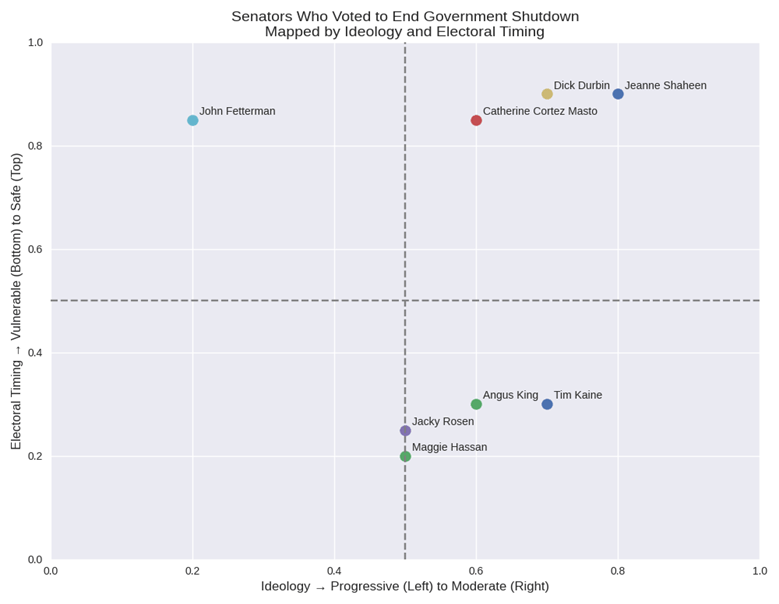
quadrant chart maps the eight senators by ideology (Progressive ↔ Moderate) and electoral timing (Safe ↔ Vulnerable).

How to Read the Chart

  • Horizontal Axis (Ideology): Progressive voices are on the left, moderates on the right.
  • Vertical Axis (Electoral Timing): Senators safe from reelection pressure are toward the top, while those vulnerable in 2026 are toward the bottom.

Key Observations

  • Safe Progressives: John Fetterman sits in the upper-left quadrant — progressive style, but safe until 2028.
  • Safe Moderates: Shaheen and Durbin (both retiring) plus Cortez Masto (safe until 2028) cluster in the upper-right quadrant. They had freedom to act pragmatically.
  • Vulnerable Moderates: Hassan, Rosen, Kaine, and King fall into the lower-right quadrant. Their centrist identities plus reelection pressure pushed them toward compromise, but they risk progressive backlash.

Big Picture

This visualization shows the collision of ideology and timing:

  • Retirees and safe-term senators had freedom to prioritize governance.
  • Vulnerable moderates leaned into pragmatism to appeal to swing voters, even at the cost of party unity.
  • Progressives safe from reelection could afford to take risks without immediate electoral consequences.

quadrant chart visualization it maps the eight senators by Ideology (Progressive ↔ Moderate) and Electoral Timing (Safe ↔ Vulnerable).

Quadrant Chart: Senators by Ideology & Timing

QuadrantSenatorsWhy They’re Here
Safe + ProgressiveJohn Fetterman (PA)Populist-progressive style, safe until 2028. His worker-first justification shields him from backlash.
Safe + ModerateJeanne Shaheen (NH), Dick Durbin (IL), Catherine Cortez Masto (NV)Retirees (Shaheen, Durbin) free to act pragmatically; Cortez Masto safe until 2028, moderate liberal.
Vulnerable + ModerateMaggie Hassan (NH), Jacky Rosen (NV), Tim Kaine (VA), Angus King (ME, I)Facing reelection in 2026. Centrist identities pushed them toward compromise, but risked progressive backlash.
Vulnerable + Progressive(None)No progressive senators broke ranks; only moderates and independents did.

Insights

  • Retirees & Safe-term senators had freedom to prioritize governance over leverage.
  • Vulnerable moderates leaned into pragmatism to appeal to swing voters, even at the cost of party unity.
  • Progressives safe from reelection (Fetterman) could afford to take risks without immediate electoral consequences.

 historical comparison: moderates breaking ranks in shutdown votes has been a recurring theme, in 2013, 2018, and now 2025.

Historical Parallels

2013 Shutdown (Affordable Care Act fight)

  • Context: Republicans demanded defunding of the ACA; Democrats resisted.
  • Defections: A handful of moderate Democrats signaled willingness to negotiate, though most stayed unified.
  • Pattern: Even then, moderates in purple states emphasized ending harm to workers and families over holding firm on leverage.

2018 Shutdown (Immigration/DACA fight)

  • Context: The shutdown centered on immigration and DACA protections.
  • Defections: Several centrist Democrats joined Republicans to reopen government after just three days.
  • Justification: They argued that prolonged shutdowns hurt federal workers and services, and promised to fight immigration battles separately.
  • Reaction: Progressives accused them of “caving” and weakening bargaining power.

2025 Shutdown (ACA subsidies fight)

  • Context: Democrats demanded extension of ACA subsidies; Republicans resisted.
  • Defections: Eight Democratic-aligned senators (Shaheen, Hassan, Cortez Masto, Rosen, Durbin, Fetterman, Kaine, King) broke ranks to end the 40-day shutdown.
  • Justification: Immediate harm prevention (SNAP, federal workers, air travel).
  • Reaction: Progressives furious, Republicans praised them as pragmatic.

Big Picture

Across 2013, 2018, and 2025, the same pattern repeats:

  • Moderates in swing states or retiring senators are most likely to defect.
  • Justification is always pragmatic: ending harm to workers, families, and services.
  • Progressive backlash is consistent: defectors are accused of weakening leverage.
  • Republican praise is consistent: defectors are hailed as bipartisan problem-solvers.

Why This Matters

  • Shutdowns create immediate pain (workers unpaid, SNAP disrupted, air travel chaos).
  • Moderates calculate that voters will reward them for ending pain quickly, even if their party base is angry.
  • Progressives calculate that leverage is lost once defectors break ranks, weakening long-term bargaining power.

chart these three shutdowns side-by-side in a timeline graphic, showing the issue, defectors, and fallout

Sources:

Fox News

Eight Senate Democrats break ranks with party leadership to end historic government shutdown

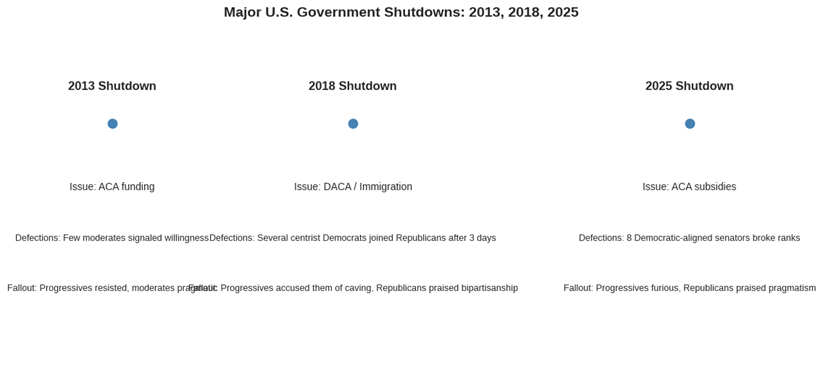
 visualization comparing the 2013, 2018, and 2025 shutdowns — showing the issues, defections, and fallout.

Timeline Highlights

  • 2013 Shutdown (ACA funding):
    • Issue: Republicans demanded ACA defunding.
    • Defections: A few moderates signaled willingness to negotiate.
    • Fallout: Progressives resisted; moderates framed as pragmatic.
  • 2018 Shutdown (DACA/Immigration):
    • Issue: Immigration and DACA protections.
    • Defections: Several centrist Democrats joined Republicans after 3 days.
    • Fallout: Progressives accused them of caving; Republicans praised bipartisanship.
  • 2025 Shutdown (ACA subsidies):
    • Issue: Extension of ACA subsidies.
    • Defections: Eight Democratic-aligned senators broke ranks.
    • Fallout: Progressives furious; Republicans praised pragmatism.

Big Picture

This timeline shows a recurring pattern:

  • Moderates under electoral pressure or with freedom (retiring/safe) consistently defect to end shutdowns.
  • Progressives condemn these moves as weakening leverage.
  • Republicans consistently praise defectors as bipartisan problem-solvers.

Timeline of Democratic Defections in Shutdowns

YearIssue at StakeDemocratic DefectionsPolitical Fallout
2013Funding for the Affordable Care Act (ACA)A few moderates signaled willingness to negotiate, though most stayed unifiedProgressives resisted compromise; moderates framed as pragmatic voices
2018Immigration & DACA protectionsSeveral centrist Democrats joined Republicans after 3 days to reopen governmentProgressives accused them of “caving”; Republicans praised bipartisanship
2025Extension of ACA subsidiesEight Democratic-aligned senators (Shaheen, Hassan, Cortez Masto, Rosen, Durbin, Fetterman, Kaine, King) broke ranksProgressives furious at loss of leverage; Republicans praised pragmatism

Patterns Across Eras

  • Moderates under pressure consistently defect to end shutdowns.
  • Justification repeats: ending harm to workers, families, and services.
  • Fallout is consistent: progressives condemn, Republicans praise.
  • Retirees or safe-term senators have freedom to act pragmatically.

Forward-Looking Projection

Based on these parallels, Democratic leadership may:

  • Tighten discipline in future shutdowns, trying to prevent defections by offering stronger internal incentives.
  • Accept defections as inevitable, focusing instead on shaping the narrative so moderates are seen as protecting families rather than weakening leverage.
  • Strategically plan messaging so progressives maintain pressure while moderates provide cover for ending shutdown harm.

Strategic Playbook for Shutdown Politics (For Democrats)

1. Pre‑Shutdown Discipline

  • Unified Messaging: Leadership should set clear red lines early (e.g., ACA subsidies, DACA, SNAP) so moderates know the stakes.
  • Whip Team Engagement: Assign senior figures (like the Whip or retiring senators) to privately reassure moderates that their concerns will be addressed.
  • Constituent Framing: Provide moderates with talking points that emphasize protecting families and workers while still holding firm on leverage.

2. During the Shutdown

  • Dual Track Strategy:
    • Progressives: Apply maximum pressure, frame the fight as moral and urgent.
    • Moderates: Emphasize harm prevention, but stay aligned with leadership until a compromise is truly necessary.
  • Visible Unity: Publicly, Democrats should appear unified. Internal debates should be kept behind closed doors to avoid signaling weakness.
  • Targeted Relief Messaging: Highlight the real-world impact (workers unpaid, SNAP disruption, air travel chaos) to build public support for ending the shutdown on Democratic terms.

3. Managing Defections

  • Controlled Breaks: If moderates defect, leadership should frame it as part of a broader strategy rather than betrayal.
  • Narrative Control: Position defectors as “protecting families” rather than “weakening leverage.”
  • Progressive Counterbalance: Progressives should continue pushing for long-term gains, ensuring the party base sees resistance even if moderates compromise.

4. Post‑Shutdown Strategy

  • Leverage Wins: Even if concessions are lost, highlight what was gained (worker pay restored, SNAP funded).
  • Promise Future Fights: Assure progressives that unresolved issues (like ACA subsidies) will be revisited in standalone legislation.
  • Electoral Shielding: Provide vulnerable moderates with campaign support to protect them from GOP attacks and progressive primary challenges.

Big Picture

This playbook balances progressive leverage (to keep pressure on Republicans) with moderate pragmatism (to end harm quickly). The key is framing defections as family-first pragmatism while ensuring progressives maintain momentum for long-term goals.

Your Turn

So what do you think?

  • Were these senators protecting families or weakening leverage?
  • Should Democrats tighten discipline next time, or accept defections as inevitable?
  • How should progressives and moderates balance each other in future fights?

Drop your thoughts in the comments. Let’s make this a conversation.

California’s Proposition 50: Redistricting as a Defense of Democracy

By Charles Zackary King
Source: Reporting from The Associated Press

Why Proposition 50 Matters

On Election Day 2025, California voters approved Proposition 50, a measure that redraws congressional district boundaries in favor of Democrats. This wasn’t just about maps, it was about the future of American democracy.

The measure gives Democrats a chance to win as many as five additional House seats in 2026, directly countering Republican-led gerrymandering efforts in Texas. With Republicans currently holding a slim majority (219–213), those seats could determine control of the U.S. House, and with it, the ability to advance or block President Donald Trump’s agenda.

The Reason and the Why

Redistricting is often seen as a technical process, but in reality, it’s about power and representation. Texas Republicans, at Trump’s urging, moved to redraw their maps to secure five new GOP seats. California’s Proposition 50 was a direct response, a way to blunt that move and ensure Democrats remain competitive in the fight for the House.

Governor Gavin Newsom framed the measure as essential to saving democracy. He argued that without action, Trump and his allies would continue to manipulate electoral maps to entrench their power. Newsom’s words were clear: “If Democrats win the House majority, they can end Donald Trump’s presidency as we know it. It is all on the line, a bright line, in 2026.”

The Who

  • Governor Gavin Newsom spearheaded the campaign, throwing the full weight of his political operation behind it. His leadership made the measure possible, and his success here is seen as a test of his national viability ahead of a potential 2028 presidential run.
  • Former President Barack Obama lent his voice, urging Californians to stop Republicans “in their tracks” and warning against unchecked power.
  • California voters themselves made the decisive choice, approving the measure despite criticism that it undermines the independent commission created in 2008.

Critics like former Governor Arnold Schwarzenegger argued that fighting Trump by adopting partisan maps “takes the power away from the people.” But supporters countered that failing to act would allow Trump and GOP-led states to rig the system unchecked.

Why This Was Possible

California is deeply blue, with strong Democratic infrastructure and voter turnout. Opponents of Proposition 50 struggled to raise money in one of the nation’s most expensive media markets, leaving Newsom and his allies to dominate the airwaves. Republican congressmen whose districts will be reshaped largely stayed silent, further weakening opposition.

The result was a lopsided campaign that foreshadowed the vote: a decisive victory for Democrats and a symbolic rejection of Trump’s attempts to manipulate democracy.

Saving Democracy

Proposition 50 is more than a state-level measure. It represents a broader national rejection of Trumpism and a commitment to protecting democratic institutions. Newsom appears to be one of the few governors willing to take bold, structural action to stop Trump from bending the rules to his advantage.

This fight is not over. The 2026 midterms will determine whether Democrats can seize control of the House and block Trump’s agenda. California’s move shows that when leaders act decisively, and when voters recognize the stakes, democracy can be defended.

Call to Action

This is a moment for reflection and action. Are we ready to defend democracy from manipulation? Are we ready to support leaders who take bold steps to protect fairness and representation?

 Subscribe to the blog for updates.
 Comment below to share your perspective.
 Let it be known: America can and will come together when people think, organize, and vote.

The Blue Wave is rising. Let’s make sure it carries us into 2026 and beyond.

Timeline Concept: Defending Democracy

Stage 1: Texas Redraw (2025)
Republicans, at Trump’s urging, redraw maps to secure 5 new GOP seats.
Theme: Manipulation of democracy.

Stage 2: California Response (2025)
Voters approve Proposition 50, giving Democrats a chance to win 5 seats.
Theme: Counteraction, protecting representation.

Stage 3: 2026 Midterms
Control of the U.S. House is on the line.
Theme: Choice between democracy and authoritarianism.

Stage 4: House Control
Democrats can seize majority, block Trump’s agenda, and restore balance.
Theme: Power shifts toward accountability.

Stage 5: Democracy at Stake
The fight is bigger than maps — it’s about saving democracy itself.
Theme: The Blue Wave rising.

Zohran Mamdani, BDS, and the Fight for Accountability

By Charles Zackary King
Source: Reporting by Gabriel Hays, Fox News

Mamdani’s Stand on BDS

In a recent interview on MSNBC’s Morning Joe, New York City mayor-elect Zohran Mamdani defended his support for the Boycott, Divestment, and Sanctions (BDS) movement. Mamdani explained that his support is rooted in the belief that BDS is a non-violent way to pressure Israel to comply with international law.

“I support BDS because this is a movement that is looking for that kind of compliance. We haven’t seen it,” Mamdani said.

When asked how he could reconcile his support for BDS with his promise to represent Jewish New Yorkers, Mamdani clarified: “Critiques of the state of Israel are critiques of a government, as opposed to critiques of a people and of a faith. My job is to represent every single New Yorker.”

The Debate Over Accountability

Jewish leaders in New York, including Rabbi Elliot Cosgrove of Park Avenue Synagogue, have expressed concern that Mamdani’s positions pose a threat to the city’s Jewish community. His opponents, Andrew Cuomo and Curtis Sliwa, echoed those concerns during the campaign.

But Mamdani’s supporters argue that his stance is about holding governments accountable, not targeting communities. They see his position as part of a broader call to end displacement, violence, and policies that perpetuate inequality.

This debate reflects a larger tension: communities want protection and safety, but there must also be space to question policies that contribute to suffering in places like Gaza. Mamdani’s insistence on representing all New Yorkers, regardless of their views on Israel and Palestine, is a reminder that leadership requires nuance, courage, and a commitment to fairness.

A Larger Context

The controversy surrounding Mamdani is not just about New York City politics. It’s about how America engages with global issues of justice, displacement, and human rights. Critics argue that U.S. support for Israeli policies has enabled ongoing harm in Gaza. Supporters of BDS see it as a way to demand accountability without violence.

Mamdani’s election signals that many New Yorkers are ready for leadership that challenges entrenched interests and gatekeepers. His open-minded approach is exactly what democracy needs: a willingness to confront uncomfortable truths while promising to serve every constituent.

Call to Action

This is a moment for reflection. Are we ready to hold governments accountable for displacement and violence? Are we ready to support leaders who promise to represent everyone — even when their positions challenge powerful interests?

 Subscribe to the blog for updates.
 Comment below to share your perspective.
 Let’s keep the conversation alive about justice, accountability, and democracy.