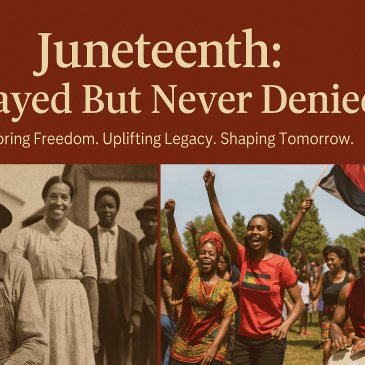
Juneteenth: The Freedom That Echoed Late, but Never Lost Power

On June 19, 1865, Union troops arrived in Galveston, Texas, delivering a message that should have been old news: enslaved Black Americans were free. That message—long delayed—was not simply a declaration. It was liberation, finally delivered by force, not goodwill. And so, Juneteenth was born—not from celebration, but from necessity.

More than two years after Lincoln signed the Emancipation Proclamation, justice still hadn’t reached the last corners of this country. But when it did, it came with the force of righteous reckoning. Since then, Juneteenth has become a symbol not just of emancipation, but of resilience, delayed justice, and the unshakable spirit of a people who dared to dream of freedom in the shadow of slavery.

Today, we’re still reckoning. We’re still pushing against systems that delay freedom in more subtle forms—economic injustice, generational trauma, educational disparity. But just as our ancestors gathered to sing, feast, and speak names out loud that history tried to forget, we gather today not just to remember—but to reclaim.

So what does Juneteenth mean now, in this era of shifting cultural narratives and historical erasure? It means we double down on truth-telling. We turn platforms into pulpits. We ensure our stories aren’t just told—they’re owned.

At Changing Trends and Times, we aren’t simply observing a holiday—we’re honoring a movement. And through America in Black and White, we continue to highlight the voices, victories, and visions shaping our shared legacy.

This is not just history. These are the instructions. This is the blueprint. This is us.

This Juneteenth, the work continues. Through Changing Trends and Times and America in Black and White, we’re committed to remembering boldly, speaking truthfully, and uplifting relentlessly.

Subscribe to stay engaged. Listen to the stories that shape our struggle and celebrate our strength.

Share this post. Share the history. Share the torch.

Because freedom delayed… is a story still being written.

#Juneteenth #ChangingTrendsAndTimes #LegacyOfLiberation #AmericaInBlackAndWhite #TruthTellers #BlackHistory365

[🔗 Link to Podcast Episode]

June 19, 2025, @6PM EST PT1 Just click to join the show live

June 20, 2025, @6PM EST PT2 Just click to join the show live

[🔗 Link to Subscribe]

Please follow/subscribe/get all notifications on our YouTube Channels:

Each Channel broadcasts the show live

@americainblackandwhite8299

@ChangingTrendsandTimes-zx8te

@CKStoriesFromTheHeart

The Enduring Truth: Black Lives Matter and the Resilience of Black Culture

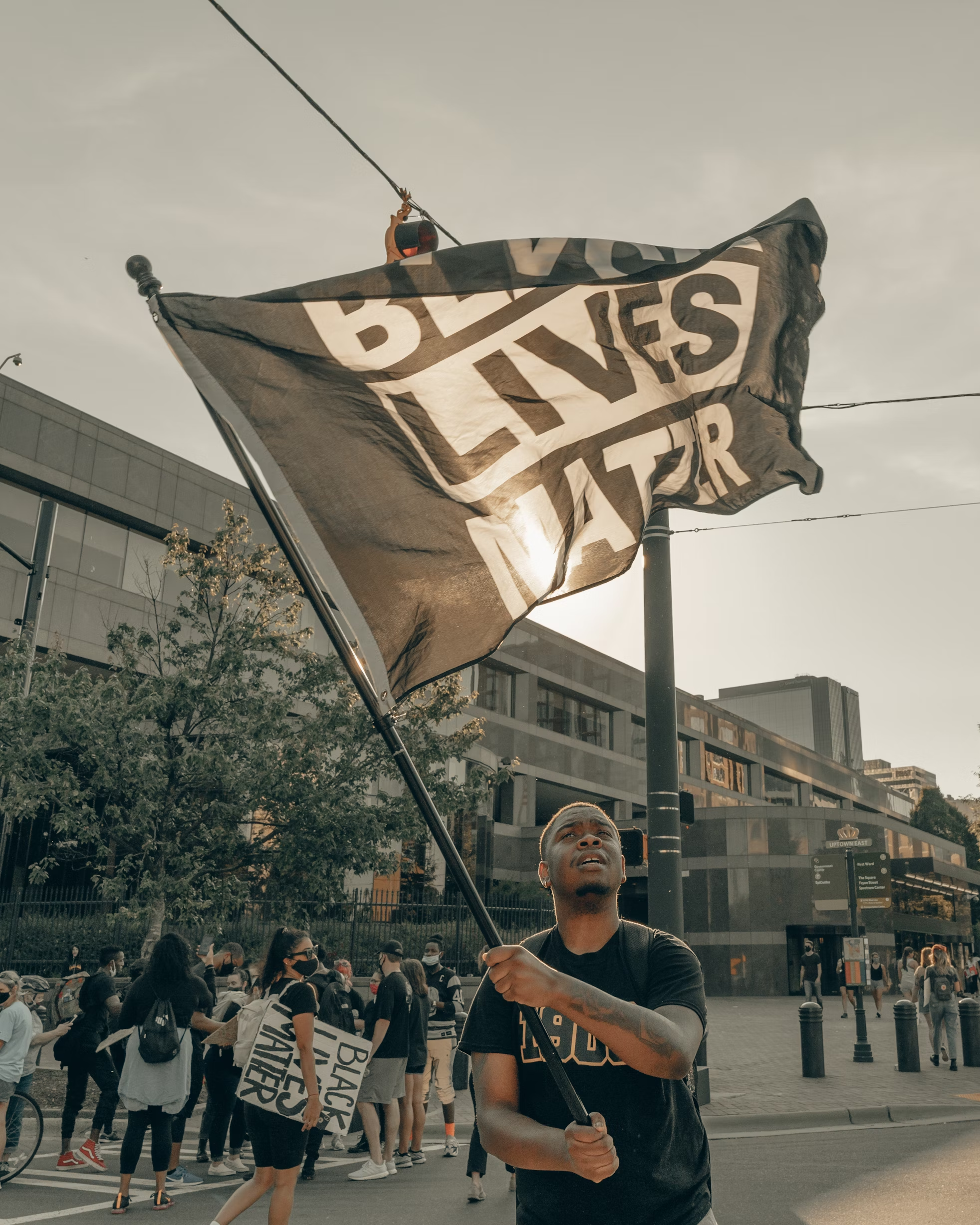
In the tapestry of American history, the struggles and triumphs of Black people are woven with threads of resilience, pain, and unmatched creativity. The journey began with the brutal enslavement of our ancestors, who were forcibly ripped from their homes and subjected to unimaginable horrors. Ever since, the legacy of those struggles has echoed through generations, shaping an identity that is rich, vibrant, and unyielding. Today, as we navigate the complexities of modern life, we stand in solidarity under the banner that Black Lives Matter—a reminder that our lives, our stories, and our culture deserve recognition and respect.

The Historical Context of the Black Struggle

The fight for Black liberation is a long and arduous road paved with countless sacrifices. From the shackles of slavery to the civil rights movement and the ongoing battles against systemic racism, we have witnessed a relentless cycle of oppression. Yet, in the face of such adversity, we have consistently demonstrated our capability to persevere. Many in our community juggle multiple jobs, often working 3-4 simultaneously, to provide for families under the constant pressure of financial insecurity and societal expectations. All while knowing that we remain targets of systemic injustice and violence.

An Ongoing Attack from Within and Without

Sadly, this struggle is not just against systemic barriers. It extends into the interactions with other minority groups. Whether it is Hispanic/Latino, Jewish, Asian, Haitian, Jamaican, or African communities, there exists a troubling tendency to overlook the unique narratives of Black history. Instead of solidarity, we often face competition and misunderstanding, sometimes leading to divisive rhetoric that exacerbates tensions. It’s a complex dynamic that needs addressing, but it is imperative to remind everyone that the Black narrative is rooted in struggle and resilience, not a commodity to be traded for convenience or perceived social capital.

Cultural Appropriation: The Theft of Black Creativity

The irony of our resilience is often overshadowed by a painful truth: the cultural contributions of Black Americans have been widely appropriated and capitalist entities have profited from our struggles. From the soul of Southern cooking to the rhythms of jazz, hip-hop, and R&B, our innovations have been co-opted by others who capitalize on our creativity while ignoring our struggles. The Hispanic/Latino community has, at points, engaged in this appropriation as well, often taking cultural elements like music, dance, and language styles from Black culture while not recognizing or acknowledging the original sources. Many popular artists and cultural icons have benefited from styles pioneered by Black entertainers without giving appropriate credit. Additionally, the adoption of Black slang, dance, and fashion trends by various groups often occurs without acknowledgment of their origins, leading to a sense of cultural dissonance.

The Political Landscape: A Fractured Community

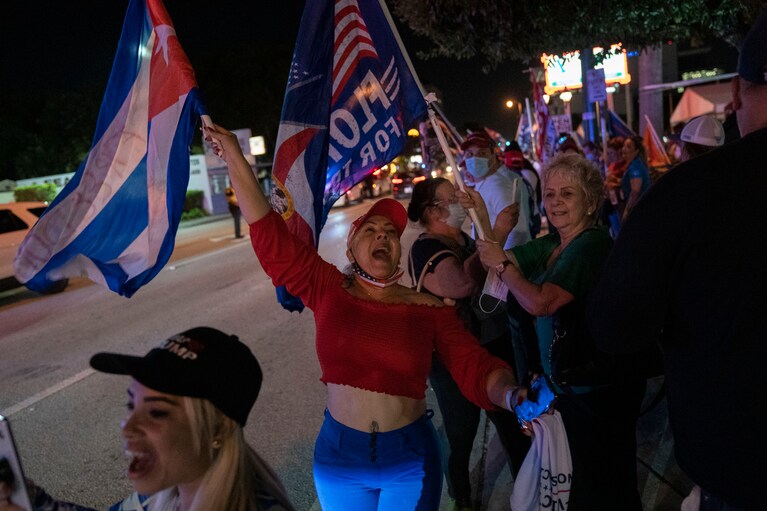
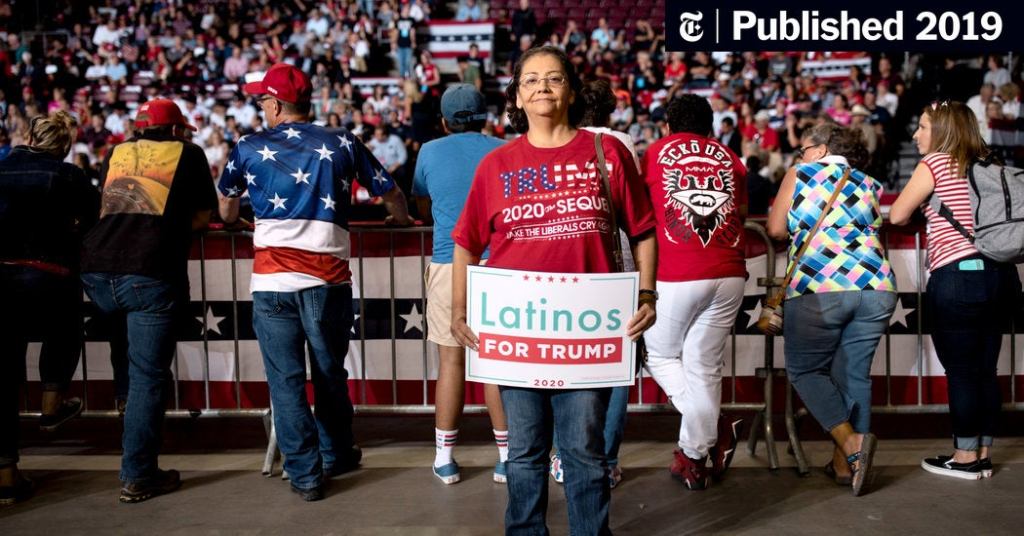
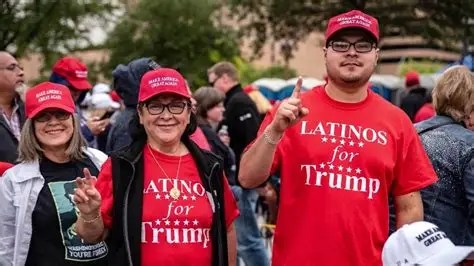
In the political arena, the decision by segments of the Hispanic community, notably Puerto Ricans, Dominicans, and Cubans, to align with candidates like Trump speaks volumes about the complexities of race relations in America. Many chose to support a figure who explicitly promised policies detrimental to Black lives, demonstrating a willingness to overlook the ramifications of their choices for the sake of perceived self-interest. When the consequences of those political decisions became apparent—rampant ICE raids, deportations, and a crackdown on immigrant rights—calls for solidarity towards Black individuals suddenly emerged. However, this raises profound questions: Why not reach out to influential figures within their own community like Jennifer Lopez, Gloria Estefan, and Eva Longoria? These figures, often championed for their success, remain conspicuously silent when it comes to the struggles faced by the broader community, especially Black individuals.

The Call for Unity and Accountability

As we stand firmly in our identity, it is crucial to confront this divide honestly. We must ask: How can healing occur from wounds inflicted by political choices and cultural theft? What message does it send when communities do not support their own representatives, leaving those in dire situations seeking help from groups they once turned their backs on? In moving forward, understanding and trust must be rebuilt on both sides. The Black community has been more than willing to support others in their struggles, but we need to have honest conversations about accountability and the reckoning that comes with shared space.

Conclusion: Can We Make it Make Sense?

This post serves as an invitation for dialogue—a chance to clarify misunderstandings and foster genuine connections. Together, we can address the historical wounds and work towards a future that celebrates diversity without appropriation, solidarity without betrayal. Let’s engage, respond, and reflect on how we can move from division to unity. The time for honest conversations is now; the future of our communities depends on it. Black Lives Matter, and so does the truth of our culture. Let’s make it count.

America’s Decline: A Nation at a Crossroads

Once heralded as the world’s leading superpower, America now finds itself at a crossroads—its global standing diminished, its principles abandoned, and its leadership failing to uphold the values it once championed. The country that once set the standard for democracy and influence has become a cautionary tale, a nation unraveling under the weight of its own contradictions.

The Betrayal of Founding Principles

America was built on ideals of freedom, equality, and opportunity, yet its history tells a different story—one of slavery, systemic oppression, and economic exploitation. While the nation classified itself as a beacon of conservatism, its actions have veered toward autocracy, with policies that increasingly resemble the authoritarian rule of regimes it once opposed. The shift toward extreme nationalism and suppression of dissent has left the country fractured, unable to reconcile its past with its present.

The Political Class and Their Obsession with Power

Many of America’s leaders—particularly those who align themselves with far-right ideologies—have openly admired authoritarian governments, seeking to mold the U.S. into a system that prioritizes control over democracy. The erosion of checks and balances, the targeting of truth-tellers, and the concentration of power in the hands of a few have created an environment where corruption thrives and accountability is nonexistent.

The Root of America’s Struggles: Hatred and Division

At the heart of America’s decline is its unwillingness to confront its deep-seated racial injustices. The hatred of Black people, the erasure of historical truths, and the refusal to acknowledge the contributions of marginalized communities have left the country in turmoil. Rather than addressing these issues, those in power have chosen to double down on oppression, ensuring that the cycle of inequality continues.

Yet, despite centuries of adversity, Black Americans have persevered, standing as a testament to resilience and strength. While others crumble under hardship, Black communities have faced struggle head-on, proving time and again that survival is not about privilege—it is about perseverance.

The Illusion of Entitlement

For generations, white entitlement has shielded many from the realities of struggle. The reliance on stolen wealth, systemic advantages, and historical manipulation has created a false sense of superiority—one that is now being challenged as the country faces economic instability, political unrest, and global ridicule. The inability to adapt, to work through hardship, and to build rather than take has exposed a fundamental weakness: survival requires resilience, not privilege.

The Higher Reckoning

As America teeters on the edge of collapse, the higher forces at play are calling for a reckoning. The lies, theft, and violence that have shaped the nation’s history can no longer be ignored. The time for change is now—whether through collective action, political awakening, or divine intervention, the old guard is being challenged, and a new era is on the horizon.

The question remains: Will America rise to meet this challenge, or will it continue down the path of destruction? The answer lies in the hands of those willing to fight for truth, justice, and the future of a nation that has lost its way.

Addressing Key Issues in the Black Community

The Black community, like any other, faces a unique set of challenges and dynamics. Among these are the tensions between Black men and Black women, the lack of support for Black businesses, and the broader issue of supporting other ethnicities over their own. Understanding these issues and working towards unity is crucial for the community’s growth and prosperity.

The Feud Between Black Men and Black Women

One of the most pressing issues is the perceived feud between Black men and Black women. This tension often manifests in negative stereotypes, mutual distrust, and a lack of support for one another. Several factors contribute to this discord:

  1. Historical Trauma: The legacy of slavery, segregation, and systemic racism has left deep scars. These historical traumas have disrupted family structures and created a cycle of mistrust and resentment.
  2. Media Representation: Negative portrayals of Black men and women in the media perpetuate harmful stereotypes. These portrayals can influence how individuals perceive and interact with each other.
  3. Economic Pressures: Economic disparities and job insecurity can strain relationships. When individuals are struggling to make ends meet, it can lead to frustration and conflict within the community.

To address these issues, it’s essential to foster open and honest communication, promote positive representations, and support economic empowerment initiatives that benefit both Black men and women.

Lack of Support for Black Businesses

Another significant issue is the lack of support for Black-owned businesses. Despite the growing number of Black entrepreneurs, many Black businesses struggle to thrive due to limited patronage from their own community. Several reasons contribute to this phenomenon:

  1. Awareness: Many people are simply unaware of the Black-owned businesses in their area. Increasing visibility through social media, community events, and directories can help.
  2. Trust: There may be a lack of trust in the quality or reliability of Black-owned businesses. Building a reputation for excellence and reliability is crucial.
  3. Economic Barriers: Black-owned businesses often face challenges in accessing capital and resources. Supporting initiatives that provide financial assistance and mentorship can make a significant difference.

Encouraging the community to prioritize supporting Black-owned businesses can lead to economic growth and self-sufficiency.

Supporting Other Ethnicities Over Their Own

It’s not uncommon to see members of the Black community supporting businesses and initiatives from other ethnicities more than their own. This can be attributed to several factors:

  1. Perceived Quality: There may be a perception that businesses from other ethnicities offer better quality or value. Addressing this requires Black-owned businesses to consistently deliver high-quality products and services.
  2. Cultural Influence: The influence of other cultures through media and marketing can sway consumer preferences. Promoting and celebrating Black culture can help shift this dynamic.
  3. Accessibility: Sometimes, businesses from other ethnicities are more accessible or convenient. Ensuring that Black-owned businesses are easily accessible and well-marketed is essential.

Moving Forward Together

To overcome these challenges and foster unity within the Black community, several steps can be taken:

  1. Promote Positive Representation: Highlighting positive stories and role models within the community can help combat negative stereotypes and build mutual respect.
  2. Support Economic Empowerment: Investing in Black-owned businesses and encouraging entrepreneurship can create economic opportunities and reduce disparities.
  3. Foster Open Dialogue: Creating spaces for open and honest conversations about the issues facing the community can lead to greater understanding and collaboration.
  4. Celebrate Black Culture: Embracing and celebrating Black culture through events, media, and education can strengthen community bonds and pride.

By addressing these issues and working together, the Black community can build a stronger, more united future. It’s a collective effort that requires commitment, empathy, and a shared vision for progress.

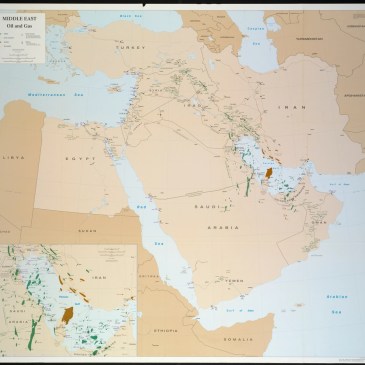
Middle East or East Africa?

The term “Middle East” is a relatively modern construct, coined by Western powers to describe a region that has long been a crossroads of civilizations. Historically, this area was often referred to as part of Africa, particularly the northeastern part of the continent. The name “Middle East” itself is a Eurocentric term that reflects the geopolitical interests of colonial powers rather than the cultural and historical realities of the region.

The people who have historically inhabited this land are diverse, with rich and varied cultures that have evolved over millennia. However, the arrival of European colonial powers in the 19th and 20th centuries brought significant changes. These powers imposed new borders, often disregarding the existing ethnic, cultural, and historical ties of the indigenous populations.

The colonial era saw the displacement of many indigenous peoples and the imposition of foreign rule. European settlers and administrators often claimed the land as their own, disregarding the rights and histories of the original inhabitants. This led to a loss of cultural heritage, as colonial powers sought to impose their own values and systems of governance.

In many cases, the occupiers appropriated the cultural symbols and practices of the indigenous peoples, often without acknowledgment or respect. This cultural theft has had lasting impacts, as the original cultures have been marginalized and their contributions to the region’s history and identity have been overlooked.

Today, the legacy of colonialism continues to shape the Middle East. The borders drawn by colonial powers have led to ongoing conflicts and tensions, as different groups struggle for recognition and autonomy. The cultural heritage of the region’s original inhabitants is still at risk, as modern political and social dynamics continue to marginalize their voices.

In conclusion, the term “Middle East” is a misnomer that reflects a colonial perspective rather than the true history and identity of the region. The people who have historically lived in this land have a rich and diverse cultural heritage that has been overshadowed by the legacy of colonialism. It is important to recognize and honor the contributions of these original inhabitants and to work towards a more inclusive and accurate understanding of the region’s history.

The Danger of False Premises: Understanding the Consequences of Misinformed Influence

In today’s world, misinformation and false premises have become powerful tools that can shape public opinion and influence behavior. People who have been influenced under false premises often fail to grasp the gravity of living in a country where representatives sell secrets, unlawfully change the structure of government, and pit people against each other. This blog post explores why this lack of understanding is dangerous and the potential consequences for society.

The Power of Misinformation

Misinformation can spread rapidly, especially in the age of social media. When people are influenced by false premises, they may develop skewed perceptions of reality. This can lead to misguided beliefs and actions that undermine the principles of democracy and the rule of law.

Selling Secrets: A Breach of Trust

When representatives sell secrets, it constitutes a severe breach of trust. The public relies on elected officials to act in the best interest of the country, and selling secrets compromises national security and erodes public confidence. People influenced by false premises may not fully understand the implications of such actions, leading to a lack of accountability for those in power.

Unlawful Changes to Government Structure

Unlawfully changing the structure of government undermines the democratic process and the checks and balances that are essential for a functioning democracy. When people are misinformed, they may support or tolerate these changes without realizing the long-term consequences. This can lead to the erosion of democratic institutions and the concentration of power in the hands of a few.

Pitting People Against Each Other

Divisive rhetoric and actions that pit people against each other can create a deeply polarized society. When individuals are influenced by false premises, they may become more susceptible to manipulation and less likely to engage in constructive dialogue. This can lead to increased social unrest and a breakdown of community cohesion.

The Consequences for Society

The consequences of living in a country where representatives sell secrets, unlawfully change the structure of government, and pit people against each other are profound. It can lead to:

  • Erosion of Trust: Public trust in government and institutions is eroded, making it difficult to achieve consensus on important issues.
  • Political Instability: Unlawful changes to government structure can create political instability and undermine the rule of law.
  • Social Division: Divisive rhetoric can deepen social divisions and lead to increased conflict and violence.
  • Economic Impact: Political instability and lack of trust can negatively impact the economy, leading to reduced investment and economic growth.

Moving Forward

To address these challenges, it is essential to promote media literacy and critical thinking skills. People need to be equipped with the tools to discern fact from fiction and to hold their representatives accountable. Additionally, fostering open and respectful dialogue can help bridge divides and build a more cohesive society.

Your Thoughts

We want to hear from you. How do you feel about the impact of misinformation and false premises on society? What steps do you think are necessary to address these issues and protect the principles of democracy? Share your thoughts and solutions in the comments below.

By understanding the dangers of misinformation and the consequences of being influenced by false premises, we can work towards creating a more informed and resilient society. Let’s continue the conversation and work together to build a better future.

The Unyielding Grip of Systemic Racism: A Barrier to America’s Progress

From its inception, the United States has grappled with the pervasive issue of systemic racism. This deeply entrenched problem has not only hindered the nation’s progress but has also perpetuated the mistreatment of Black people, proving that the country will struggle to heal and move forward unless significant changes are made.

Historical Context and Ongoing Impact

Systemic racism in America dates back to the era of slavery, where Black people were forcibly brought to the country and subjected to inhumane treatment. The abolition of slavery did not mark the end of racial discrimination; instead, it evolved into new forms such as Jim Crow laws, segregation, and redlining. These practices systematically marginalized Black communities, denying them access to quality education, employment opportunities, and housing.

Even today, the remnants of these discriminatory practices are evident in various aspects of society. Black individuals are disproportionately affected by poverty, unemployment, and inadequate healthcare. The criminal justice system, too, reflects these disparities, with Black people being more likely to be arrested, convicted, and receive harsher sentences compared to their white counterparts.

The Proof of Persistent Mistreatment

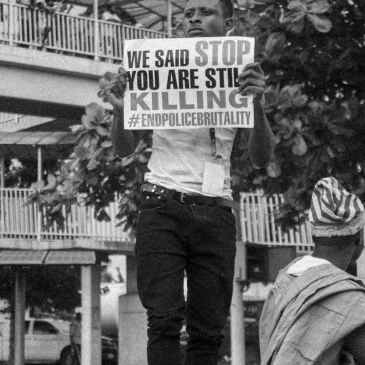
The mistreatment of Black people is a stark reminder that systemic racism continues to plague the nation. High-profile cases of police brutality, such as the deaths of George Floyd and Breonna Taylor, have sparked nationwide protests and brought attention to the urgent need for reform. These incidents are not isolated; they are part of a broader pattern of racial violence and discrimination that Black communities face daily.

The economic disparities are equally troubling. Black families, on average, have significantly less wealth compared to white families. This wealth gap is a direct result of historical and ongoing discrimination in employment, education, and housing. The lack of economic opportunities perpetuates a cycle of poverty and limits the ability of Black individuals to achieve upward mobility.

What Needs to Happen

To address systemic racism and move towards a more equitable society, several key actions are necessary:

  1. Comprehensive Criminal Justice Reform: Implementing policies that address racial disparities in policing, sentencing, and incarceration is crucial. This includes banning practices like racial profiling and ensuring accountability for law enforcement officers.
  2. Economic Empowerment: Providing equal access to economic opportunities through initiatives such as affordable housing, quality education, and job training programs can help bridge the wealth gap and promote financial stability for Black communities.
  3. Healthcare Equity: Ensuring that Black individuals have access to quality healthcare is essential for addressing health disparities. This includes expanding healthcare coverage and addressing social determinants of health.
  4. Educational Reform: Investing in education and providing resources to underserved schools can help close the achievement gap and create pathways to success for Black students.
  5. Community Engagement: Encouraging dialogue and collaboration between communities, policymakers, and organizations can foster understanding and drive meaningful change.

Your Thoughts and Solutions

As we reflect on the impact of systemic racism and the steps needed to address it, it’s important to hear from you, the readers. How do you feel about the current state of racial inequality in America? What actions do you believe are necessary to create a more just and equitable society? Share your thoughts and solutions in the comments below.

By acknowledging the deep-rooted issue of systemic racism and taking concrete steps to address it, we can work towards healing the nation and creating a future where everyone has the opportunity to thrive. Let’s continue the conversation and work together to build a better America.

The Case for a New Political Party: Why African Americans Need to Forge Their Own Path

In the landscape of American politics, African Americans have historically aligned with the Democratic Party, believing it to be the champion of civil rights and social justice. However, the reality of unfulfilled promises and systemic neglect has led many to question whether this allegiance is still beneficial. As we confront the myriad challenges facing the African American community, it may be time to consider the establishment of a new political party that truly represents our interests and aspirations.

The Democratic Party: A Track Record of Unmet Promises

While the Democratic Party has made significant strides in advocating for civil rights, the effectiveness of these efforts has often fallen short. Here are several reasons why many African Americans feel let down by the party:

  • Failure to Address Systemic Inequities: Despite the Democratic Party’s claims to support racial equity, systemic issues like police brutality, housing discrimination, and economic inequality remain pervasive. The lack of concrete policy changes to address these problems fosters skepticism about their commitment to the African American community.
  • Unfulfilled Promises on Voting Rights: The Democratic Party has continuously campaigned on promises to safeguard and expand voting rights. Nevertheless, with critical legislation like the John Lewis Voting Rights Advancement Act stalled in Congress, many feel that their voices are being suppressed rather than protected.
  • Inadequate Economic Support: The economic fallout from the COVID-19 pandemic disproportionately impacted African Americans, yet the Democratic response has been perceived as insufficient. Promises of increased support for small businesses, job creation, and economic empowerment have not materialized in meaningful ways.
  • Neglecting Educational Equity: Education is a cornerstone for upward mobility, yet many predominantly Black schools remain underfunded. The Democratic Party has not prioritized policies that would ensure equitable funding and resources for these schools, leaving many children behind.
  • Health Disparities: African Americans continue to face significant health disparities, but initiatives to expand access to affordable healthcare have been lackluster. The Democratic Party’s inability to advocate for comprehensive healthcare reforms that specifically address these disparities is a glaring omission.

The Republican Party: A Divisive Alternative

While some may argue that the Republican Party offers an alternative, the reality is that this party often perpetuates racial divides and promotes rhetoric that is harmful to African Americans:

  • Promotion of Racial Divisiveness: The Republican Party has often used racially charged language and policies to rally their base. This approach not only alienates African Americans but also perpetuates systemic racism within the political landscape.
  • False Promises and Disillusionment: Republican leaders often present themselves as champions of opportunity and empowerment for African Americans. However, their policies, like tax cuts and deregulation, disproportionately benefit the wealthy and corporations while neglecting the needs of marginalized communities.
  • Tokenism and Lack of Genuine Representation: While some African Americans have found a place within the Republican Party, their representation often feels more like tokenism than a genuine commitment to addressing the concerns of the broader community. This superficial inclusion fails to result in substantive change.
  • Focus on Culture Wars: The Republican Party often centers its platform around culture wars that distract from the economic and social issues that truly affect African Americans. These distractions serve to divide rather than unite, leaving critical problems unaddressed.

The Need for an Independent African American Political Party

Given the shortcomings of both major parties, there is a growing sentiment that African Americans need to establish their own political party. Here are key reasons why this is essential:

  • Authentic Representation: An independent party can prioritize the voices, needs, and aspirations of the African American community, ensuring that policies are tailored to address systemic inequities.
  • Focused Policy Agenda: A new party could advocate for a clear and targeted policy agenda, including robust voting rights protections, equitable education funding, criminal justice reform, and economic empowerment initiatives.
  • Empowerment through Unity: A dedicated political party would encourage greater civic engagement and unity within the African American community, fostering collective action toward shared goals.
  • Breaking the Cycle of Dependency: By forming an independent party, African Americans can break free from the cycle of reliance on the Democratic Party, demanding accountability and tangible results from any political affiliation.
  • Building Strategic Alliances: An independent party could collaborate with other marginalized groups and movements to amplify voices and create a more inclusive coalition for social justice.

Conclusion: A Call to Action

As the political landscape continues to evolve, African Americans must reflect on the efficacy of their current affiliations and consider the potential of establishing an independent party that genuinely champions their interests. In a time when both major parties have failed to deliver on critical promises, the formation of a new political entity could provide a path toward empowerment, accountability, and authentic representation. The time has come for African Americans to take control of their political destiny. By uniting under a party that prioritizes their needs and aspirations, they can forge a more equitable future for themselves and generations to come.

The Lingering Shadow of Racial Violence: Hangings in the US in 2024

In 2024, the United States witnessed a series of tragic hangings that have once again brought to light the deep-seated racial animosity towards Black people in America. These incidents are not just isolated acts of violence but are reflective of a broader, systemic issue that continues to plague the nation. The names of the victims and the circumstances surrounding their deaths serve as a stark reminder of the work that still needs to be done to achieve true racial equality.

Victims of 2024

Among the victims of these heinous acts were:

  • Willie James Pye: Executed on March 20, 2024, in Georgia.
  • Keith Edmund Gavin: Executed on July 18, 2024, in Alabama.
  • Freddie Eugene Owens: Executed on September 20, 2024, in South Carolina.
  • Emmanuel Antonio Littlejohn: Executed on September 26, 2024, in Oklahoma.
  • Garcia Glen White: Executed on October 1, 2024, in Texas.
  • Richard Bernard Moore: Executed on November 1, 2024, in South Carolina.

These individuals were among the 21 people executed in the United States in 2024, with a significant number being Black men. The racial disparities in the application of the death penalty are glaring, with Black individuals disproportionately represented on death row and among those executed.

Racial Animosity and Its Impact

The racial animosity towards Black people in America is not a new phenomenon. It is deeply rooted in the country’s history, from the era of slavery to the Jim Crow laws, and continues to manifest in various forms today. The hangings of 2024 are a grim reminder of this ongoing issue. These acts of violence are not just about the individuals who were executed but are indicative of a broader societal problem.

The impact of such racial violence on the Black community is profound. It perpetuates a cycle of fear, trauma, and mistrust towards the justice system and society at large. The emotional and psychological toll on the families and communities of the victims is immeasurable. Moreover, these incidents highlight the urgent need for systemic reforms to address racial disparities in the criminal justice system.

Statistical Analysis and Future Outlook

The statistics surrounding racial violence and the death penalty in the United States paint a troubling picture. According to data, Black individuals make up approximately 12.47% of the US population but are disproportionately represented among those executed. This disparity is a clear indication of the racial biases that exist within the justice system.

Looking ahead to 2025, the likelihood of continued racial violence remains high unless significant changes are made. The systemic issues that contribute to racial disparities in the application of the death penalty and other forms of violence must be addressed. This includes comprehensive reforms in policing, sentencing, and the overall criminal justice system.

Conclusion

The hangings of 2024 serve as a stark reminder of the racial animosity that continues to exist in America. The names of the victims and the circumstances of their deaths highlight the urgent need for systemic reforms to address racial disparities and ensure justice for all. As we move forward, it is crucial to acknowledge these issues and work towards creating a society where racial violence is no longer a reality.

Georgia election board votes to require ballots be hand-counted in November

The pro-Trump majority on the battleground state’s election board approved the move, which critics from both parties warn could lead to delays in reporting results.

By Charlie Gile, Dareh Gregorian and Jane C. Timm

The Georgia State Election Board on Friday voted 3-2 to require counties to hand-count ballots cast on Election Day, a move that could drastically lengthen the amount of time to tally results in a critical battleground state.

The move, which will require poll workers to open up ballot boxes and count the number of ballots by hand at the end of the night, was approved by three board members who’ve been praised by former President Donald Trump, and was opposed by Democrats in the state, as well as by the Republican secretary of state and attorney general.

“I want to make on the record that we’ll be going against the advice of our legal counsel by voting in the affirmative,” the Georgia election board’s chair, John Fervier, said before the motion passed. Fervier, who was appointed by Georgia GOP Gov. Brian Kemp, and Sara Tindall Ghazal, the lone Democratic appointee on the panel, voted against the new rules.

Secretary of State Brad Raffensperger had previously warned the new rule could cause “chaos.”

“We consider these major changes to the election process,” Raffensperger told NBC News on Thursday. “I guess we have several concerns. Number one is the actual counting of the number of ballots that you have at the precinct. That’s going to take time. Everything that we’ve done for the last six years has to speed up the process to give the voters the results quicker, and all of a sudden now they’re adding an element that it’s actually going to take longer.”

In a statement after Friday’s vote, Raffensperger said, “Attorney General Chris Carr has stated that these rules would not withstand a legal challenge, and I have worked every day to strengthen Georgia’s election law to ensure our elections remain safe, secure, and free.”

In a letter to the board Friday ahead of the vote, Senior Assistant Attorney General Elizabeth Young said her office doesn’t typically weigh in on amendments to election administration, but was making an exception because “the proposed rules, if passed, very likely exceed the Board’s statutory authority and in some instances appear to conflict with the statutes governing the conduct of elections.”

She also argued, “As a general matter, the passage of any rules concerning the conduct of elections are disfavored when implemented as close to an election as the rules on the September 20 agenda.”

One of the board members who voted in favor of the new rule, Janelle King, suggested Raffensperger’s concerns were overblown.

“I do not have those concerns at all,” King told NBC News.

“I think it’s actually going to be the reverse,” she said, because “we won’t have a situation where we have any candidates saying that they think the count is off or they want an audit because something went wrong. We would have caught it at an early stage.”

Hand-counting ballots has captured the attention of many on the right in recent years in response to baseless claims about hacked voting machines, despite ample evidence that counting by hand is more expensive and less accurate than using ballot tabulators.

Last year, officials in Mohave County, Arizona, tested out hand-counting the votes. They found it took staffers three minutes to count a single ballot, and that the staffers made routine errors.

Georgia’s rule only requires election workers to count the number of ballots — not every vote on the ballot — but election officials are still worried about the impact.

Charlotte Sosebee, the elections director in Clarke County, Georgia, said counting ballots late at night could pose unforeseen problems, such as poll workers not agreeing on the number of ballots during a count.

“If we do this, are they really going to trust the process? I mean, what’s next?” she told NBC News.

Anticipating that the rule would pass, Sosebee said she had already trained her poll workers on it. But the additional working hours needed to pay the poll workers wasn’t in the budget, so the county needs to spend more to cover the costs.

In August, the same Georgia board members passed other new rules that would allow county election board members to conduct “reasonable” inquiries before they certify results. Critics say that could throw the election into chaos because “reasonable inquiry” isn’t defined, and an individual board member could block certification for any reason.

The Democratic National Committee, the Democratic Party of Georgia and several individuals filed suit challenging those rules last month.

Speaking of the trio of board members who voted for them at a rally last month, Trump said, “They’re on fire. They’re doing a great job.”

“Janice Johnston, Rick Jeffares and Janelle King, three people are all pit bulls fighting for honesty, transparency and victory,” he said then.

I found this story interesting because there are so many people that are not following this election. There are some that are and realize that this election is life or death. Of all places Georgia is trying to buck the system and breach the trust of the people. They are purposefully trying to hold up the results and steal the election. Please let me know what you think and please follow and subscribe to my Blog