Jason Collins: Courage Beyond the Court, Resilience Against Glioblastoma

Jason Collins has always been a trailblazer. In 2013, he became the first openly gay active NBA player, shattering barriers and inspiring countless athletes and fans. Today, he faces another battle, Stage 4 glioblastoma, one of the most aggressive brain cancers known to medicine.

Collins first experienced symptoms in August 2025: confusion, memory lapses, and difficulty focusing. By September, his family announced he had a brain tumor. On December 11, Collins himself revealed the diagnosis in an ESPN essay, describing the cancer as a “monster with tentacles” spreading across his brain.

Despite the grim prognosis, median survival of 12–18 months, Collins has chosen to fight with the same toughness that defined his NBA career. Supported by his husband, Brunson Green, and buoyed by the love of his community, Collins is undergoing radiation, chemotherapy, and experimental therapies in Singapore.

Beyond basketball, Collins has always loved mentoring young athletes, advocating for LGBTQ rights, and building community. His resilience now reminds us that health is not guaranteed, and vigilance is essential.

Treatment Options

While there is no cure, treatments aim to slow tumor growth and improve quality of life:

  • Surgery: Removal of as much tumor as safely possible (not always feasible).
  • Radiation therapy: Often daily sessions over several weeks.
  • Chemotherapy: Typically combined with radiation.
  • Targeted therapy: Drugs that attack specific cancer cell mutations.
  • Tumor treating fields (TTF): Low-intensity electrical fields applied via scalp electrodes.
  • Experimental approaches: Immunotherapy, laser therapy, and clinical trials my.clevelandclinic.org mayoclinic.org mdanderson.org.

Prognosis

  • Median survival: 12–18 months after diagnosis, even with treatment.
  • Five-year survival rate: Only about 5–10% my.clevelandclinic.org mdanderson.org.
  • Challenge: Tumors almost always recur because microscopic branches spread throughout the brain, making complete removal impossible mdanderson.org.

Risks & Challenges

  • Glioblastoma affects critical brain functions (speech, movement, memory).
  • Treatments often cause side effects like fatigue, cognitive decline, or mood changes.
  • Delivering drugs is difficult because of the blood-brain barrier, which blocks many medications from reaching the tumor mdanderson.org.

In summary: Glioblastoma is one of the deadliest brain cancers, with rapid progression and limited treatment options. Jason Collins’ diagnosis highlights both the personal toll and the urgent need for continued research into more effective therapies.

Sources: my.clevelandclinic.orgCleveland Clinic mayoclinic.orgMayo Clinic mdanderson.orgMD Anderson Cancer Center

Call to Action:
We must stay on top of our health. Screenings save lives. Early detection matters. And for the LGBTQ community, rallying around Jason and his family is more than solidarity, it is a continuation of the movement he helped ignite.

Career Highlights:

  • 13-year NBA career, playing for teams including the New Jersey Nets, Atlanta Hawks, and Washington Wizards.
  • Known for his defensive grit and leadership on and off the court.
  • In 2013, became the first openly gay active NBA player.

Post-retirement: advocate for LGBTQ rights, mentor, and public speaker.

Healthcare on the Brink: Subsidies, Equity, and the Cost of Inaction

Introduction
The Affordable Care Act (ACA) was designed to expand access to health coverage for millions of Americans. Enhanced subsidies, first enacted during the pandemic, have kept premiums affordable for over 22 million people. But now, as Congress fails to extend these subsidies, the future of affordable healthcare hangs in the balance.

What’s at Stake

  • 22 million Americans currently benefit from ACA subsidies.
  • Without extension, premiums will rise by an average of 114% in 2026.
  • Families earning $75,000 could see costs increase by $3,368 annually.
  • The Congressional Budget Office estimates 4 million people may drop coverage.

 
If Congress does not extend the ACA subsidies, premiums will more than double in 2026 (average +114%), with the steepest impacts in Southern states (like Georgia, Florida, Texas, Alabama, Mississippi) and in states that did not expand Medicaid. States with their own reinsurance or supplemental subsidies (like Vermont, California, New York) will see smaller increases factually.co NBC News factually.co Peterson-KFF Health System Tracker.

Timeline of ACA Subsidies and Expiration

YearPolicy ChangeImpact
2010ACA enactedSubsidies tied to income, capped at 400% FPL.
2021American Rescue PlanEnhanced subsidies, removed “subsidy cliff.”
2022Inflation Reduction ActExtended subsidies through 2025.
Dec 2025Senate rejects extensionSubsidies set to expire Jan 1, 2026.
2026ExpirationPremiums rise ~114%; 2–4 million lose coverage.

States Most Affected

Analyses show uneven impacts across the country:

  • Southern States (highest increases):
    • Georgia, Florida, Texas, Alabama, Mississippi → Premiums projected to rise 25–30%+ beyond national average.
    • Many of these states did not expand Medicaid, leaving middle-income households most exposed.
  • High Premium States (older enrollees hit hardest):
    • West Virginia, Alaska, Connecticut, Vermont → Older adults (50–64) face catastrophic jumps, sometimes $8,000+ more annually factually.co.
  • States with Supplemental Subsidies/Reinsurance (smaller increases):

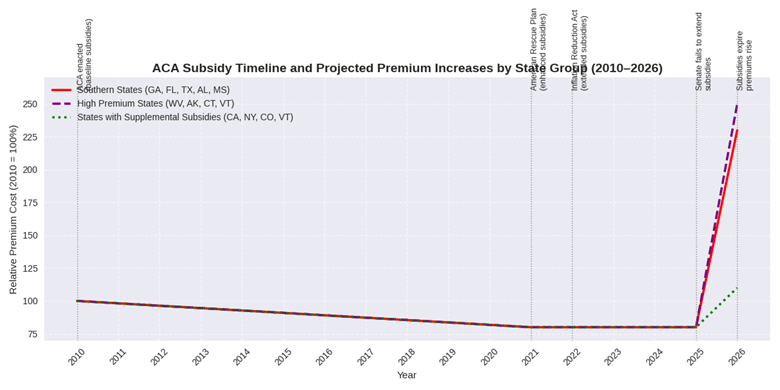
How to Read This Chart

  • Vertical markers: Key policy milestones (ACA enactment, American Rescue Plan, Inflation Reduction Act, Senate failure, subsidy expiration).
  • Red line: Southern states (GA, FL, TX, AL, MS)  projected +130% premium increase.
  • Purple dashed line: High‑premium states (WV, AK, CT, VT) projected +150% increase, especially for older adults.
  • Green dotted line: States with supplemental subsidies (CA, NY, CO, VT) limited to +10% increase.

Advocacy Angle

  • This visualization makes clear that Southern states and high‑premium states will be hit hardest, while states with their own protections blunt the impact.

Key Takeaways

  • 22 million people currently benefit from subsidies; 92% of ACA enrollees receive them.
  • Without extension, average premiums double (from ~$888 to ~$1,904 annually).
  • Middle-income families just above 400% FPL face the steepest hikes,e.g., a 60-year-old earning $64,000 could pay $14,900/year vs. $6,200 for someone earning slightly less Moneywise.
  • Coverage losses: CBO projects 2.2–4 million uninsured in 2026.

Advocacy Angle

This is not just about numbers, it’s about equity and justice. The expiration disproportionately harms Southern states and marginalized communities, widening racial and economic health gaps. The subsidies made healthcare affordable for millions; their loss reveals how political gridlock can dismantle progress.

Sources: factually.co NBC News Lawyer Monthly factually.co Peterson-KFF Health System Tracker Moneywise

The Politics of Healthcare

  • Democrats pushed for a three‑year extension of subsidies.
  • Republicans countered with health savings accounts, rejecting subsidies as “too costly.”
  • Both proposals failed in the Senate, leaving millions at risk.
  • The House has yet to act, with leadership resisting temporary extensions.

Equity and Accountability

Healthcare is not just policy,it’s justice. Subsidies have allowed working families, small business owners, and gig workers to access care. Ending them disproportionately harms marginalized communities, widening racial and economic health gaps.

This is not simply about budgets. It’s about whether America values the health of its people or the politics of obstruction.

Call to Action

The fight over ACA subsidies is a test of our national priorities. Will we protect affordable healthcare, or will we allow millions to be priced out? Advocacy must demand accountability: healthcare equity is non‑negotiable.

Lenacapavir: A Breakthrough HIV Prevention Tool Held Back by Global Funding Cuts

Adapted from reporting by Rachel Schraer, The Independent (Rethinking Global Aid Project)

The closest thing we have to an HIV vaccine has finally arrived. Lenacapavir, a long-acting injectable medication that can prevent nearly 100% of HIV infections when administered twice yearly, is being hailed as revolutionary. Yet despite its promise, only a fraction of the people who need it will gain access.

The Numbers Behind the Breakthrough

  • Current plans by Gilead and international funders will provide lenacapavir to 2 million people over three years, about 666,000 annually.
  • Research by Dr. Andrew Hill (University of Liverpool) shows this rollout could avert 165,000 infections, but scaling up to 10 million people annually could prevent half a million infections and put us on track to ending HIV transmission.
  • The challenge: funding cuts, particularly from the U.S. under President Donald Trump, have left prevention efforts severely under-resourced.

The Cost and Access Challenge

  • In the U.S., a course of lenacapavir costs $28,000.
  • Thanks to advocacy and licensing agreements, the drug will be sold at no profit in low-income countries, with costs reduced to around $40 per person per year.
  • Gilead’s plan to reach 2 million people by 2028 is described as an “initial step,” with hopes that generic manufacturers will expand access further.

Why This Matters Globally

Anne Aslett, CEO of the Elton John AIDS Foundation, called the rollout “unprecedented,” noting that doses are arriving in Eswatini at the same time as in the U.S., a sharp contrast to the early AIDS crisis, when African nations waited more than a decade for antiretroviral drugs.

Still, she warns that funding gaps threaten progress. Vulnerable populations, young women, LGBTQ communities, sex workers, and people who use drugs, are often excluded from prevention services. Without reaching these groups, the epidemic cannot be contained.

Innovation in Delivery

  • Foundations are experimenting with drone deliveries of drugs and testing kits.
  • Digital pilots in London are making PrEP accessible directly to consumers, by passing traditional clinics.
  • Sub-Saharan Africa is now pioneering models of care that are more advanced than those in parts of the Global North.

🇬🇧 The UK’s Role

Mike Podmore, CEO of STOPAIDS, emphasizes that UK contributions are not just charity, they fuel domestic research and innovation. Agencies like Unitaid have invested £250m into UK universities over the past decade, strengthening both global and local HIV responses.

The UK has set a goal to end new HIV transmissions by 2030, and expanding access to lenacapavir will be critical to achieving it.

The Call to Action

Ending HIV is within reach, but only if global leaders step up. Dr. Hill and advocates worldwide are urging wealthy nations to contribute to a proposed $400m fund to expand access without undermining existing HIV programs.

This is a pivotal moment: decades of research and advocacy have brought us closer than ever to a cure. But without adequate funding, only 7% of those who need lenacapavir will receive it.

What you can do:

  • Sign petitions demanding governments protect and expand HIV funding.
  • Share this story widely to raise awareness.
  • Pressure policymakers to prioritize vulnerable populations in prevention programs.

Together, we can ensure that this breakthrough doesn’t stall at the starting line. Let’s end HIV and make life better for all.

Original reporting by Rachel Schraer, The Independent, as part of the “Rethinking Global Aid” project.

World AIDS Day is more than a commemoration, it is a call to action, reflection, and hope. Observed every year on December 1, it reminds us of the lives lost, the progress made, and the work still ahead in ending HIV/AIDS.

The Meaning of World AIDS Day

World AIDS Day was first established in 1988 by the World Health Organization (WHO) and UNAIDS, making it the first-ever global health day Wikipedia Britannica. Its purpose is to raise awareness about HIV/AIDS, show solidarity with people living with HIV, and honor the millions who have died from AIDS-related illnesses. The red ribbon, adopted in 1991, remains the universal symbol of support and remembrance Britannica.

Each year, the day carries a theme. In 2025, the theme is “Overcoming disruption, transforming the AIDS response”, a reminder that funding cuts, stigma, and inequality threaten decades of progress Moneycontrol.

Historical Context and Data

  • In the 1980s and 1990s, HIV/AIDS was a rapidly escalating crisis. By 1997, new infections peaked at 3.3 million annually, and AIDS-related deaths peaked in 2004 at 2.1 million per year Britannica.
  • Since then, antiretroviral therapy (ART) transformed HIV from a fatal disease into a manageable chronic condition, reducing deaths by more than 64% since 2004 Wikipedia.
  • As of 2024, an estimated 40.8 million people worldwide were living with HIV, with 1.3 million new infections and 630,000 AIDS-related deaths that year Business Standard Moneycontrol.
  • In the U.S., about 1.2 million people live with HIV, with ongoing disparities in testing and treatment Las Vegas Sun.

Strides in Treatment and Prevention

The fight against HIV/AIDS has seen remarkable progress:

  • ART advancements: From early AZT in 1987 to today’s single-pill regimens and long-acting injectables, treatment now allows near-normal lifespans Las Vegas Sun.
  • Prevention tools: Pre-exposure prophylaxis (PrEP) and post-exposure prophylaxis (PEP) have proven highly effective in preventing infection Business Standard.
  • U=U (Undetectable = Untransmittable): People on effective ART who maintain undetectable viral loads cannot sexually transmit HIV Business Standard.
  • Mother-to-child transmission: Once a major concern, it has been drastically reduced through targeted interventions Las Vegas Sun.

The Future Outlook

While progress is undeniable, challenges remain:

  • Funding cuts and inequality threaten to reverse gains, especially in vulnerable communities Moneycontrol.
  • Late diagnoses continue to hinder progress, with over half of new cases in Europe detected too late for optimal treatment News-Medical.Net.
  • Research breakthroughs offer hope: trials with engineered antibodies, CRISPR gene editing, and long-acting injectables like lenacapavir suggest that a functional cure may be within reach Smithsonian Magazine AIDS.ORG.
  • The global goal remains clear: end AIDS as a public health threat by 2030, a target set by UNAIDS and the UN Sustainable Development Goals Britannica UNAIDS.

Closing Reflection

World AIDS Day is not just about remembrance, it is about renewed commitment. We have turned HIV from a death sentence into a chronic condition, but stigma, inequity, and funding gaps still stand in the way of ending the epidemic. The future depends on global solidarity, scientific innovation, and community-led action.

Ending AIDS is possible but only if we choose compassion, equity, and sustained investment.

Sources: Wikipedia Britannica Business Standard Las Vegas Sun Smithsonian Magazine AIDS.ORG UNAIDS Moneycontrol

Norovirus cases are surging across the U.S., with test positivity nearly doubling since late summer. States most impacted include Alabama, Nebraska, Oklahoma, Texas, Wyoming, Louisiana, Michigan, and Indiana. The CDC stresses that prevention hinges on thorough handwashing with soap and water, safe food handling, and disinfecting contaminated surfaces. NBC News CBS News ABC News CDC

Norovirus: America’s “Winter Vomiting Disease” on the Rise

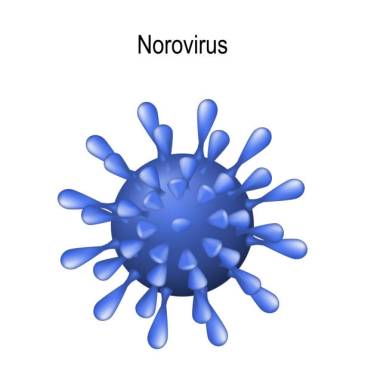
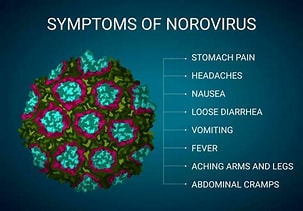
Norovirus, often called the “winter vomiting disease”, is once again sweeping across the country. Unlike other viruses with a fat-based envelope that alcohol sanitizers can break down, norovirus is encased in a rugged protein shell called a capsid, making it resistant to hand sanitizers. That means soap and water for at least 20 seconds is the most effective defense.

Current Trends and Data

  • CDC data shows nearly 14% of tests were positive for norovirus during the week ending Nov. 15, 2025, compared to just 7% three months earlier CBS News ABC News.
  • Last December saw a record-breaking 25% positivity rate, and experts warn this winter could bring another harsh season Gizmodo.
  • Epic Research and WastewaterSCAN data highlight the hardest-hit states: Alabama, Nebraska, Oklahoma, Texas, Wyoming, Louisiana, Michigan, and Indiana NBC News ABC News Gizmodo.
  • Outbreaks are being reported in schools, cruise ships, and communities nationwide, with more than 200 passengers sickened aboard a luxury cruise ship this fall CBS News.

CDC Recommendations for Prevention

The CDC emphasizes several key steps to stop norovirus from spreading CDC CDC:

  • Wash hands thoroughly with soap and water for 20 seconds, especially after using the bathroom, changing diapers, or before preparing food.
  • Do not rely on hand sanitizer alone, it does not kill norovirus.
  • Avoid preparing food or caring for others while sick, and wait at least 48 hours after symptoms stop before resuming these activities.
  • Cook shellfish thoroughly to at least 145°F and wash fruits and vegetables well.
  • Clean and disinfect contaminated surfaces using bleach-based solutions or EPA-approved disinfectants effective against norovirus.
  • Wash contaminated laundry with hot water and detergent, then machine dry at high heat.

Why This Matters

Norovirus is the leading cause of foodborne illness in the U.S., responsible for 20 million infections annually, over 100,000 hospitalizations, and nearly 900 deaths each year CBS News. It spreads easily through contaminated food, water, surfaces, and person-to-person contact. Symptoms, nausea, vomiting, diarrhea, and stomach cramps, can appear within 12–48 hours and last 1–3 days. Vulnerable groups include young children, older adults, and those with weakened immune systems.

Community Call to Action

This surge is not just a public health issue, it’s a matter of community responsibility. By practicing rigorous hygiene, safe food handling, and responsible caregiving, we can protect ourselves and those most at risk. Norovirus thrives in close-contact environments, but prevention is in our hands, literally.

Sources: NBC News CBS News ABC News Gizmodo CDC CDC

The Rise of Chagas: Why ‘Kissing Bug’ Disease May Be America’s Next Endemic

By Charles Zackary King | Inspired by reporting from Julia Gomez & Greta Cross, USA TODAY

For decades, Chagas disease, also known as “kissing bug” disease, was considered a threat confined to Latin America. But new research is challenging that assumption, urging the Centers for Disease Control and Prevention (CDC) to declare it endemic in the United States.

Since 2013, over 10,000 sightings of triatomine bugs (the blood-feeding insects that carry the parasite Trypanosoma cruzi) have been reported across 31 states. These bugs, nicknamed “kissing bugs” for their tendency to bite near the mouth, are more than a nuisance, they’re potential carriers of a deadly parasite. Alarmingly, 55% of the bugs tested in a nationwide Texas A&M University program were found to carry T. cruzi, the parasite responsible for Chagas disease.

What makes this moment urgent is the shift from imported cases to domestic transmission. In eight states, California, Texas, Arizona, Louisiana, Mississippi, Arkansas, Missouri, and Tennessee, humans have contracted Chagas disease locally, without international travel. That’s a seismic shift in how we understand vector-borne disease in America.

Chagas disease unfolds in two stages: acute and chronic. Early symptoms include fever, diarrhea, and swollen eyelids (known as Romaña’s sign). But the chronic phase can be far more devastating, leading to heart failure, digestive complications, and even sudden death. The CDC estimates that 20–30% of infected individuals will develop serious complications.

Despite this, Chagas remains underreported. It’s not a nationally notifiable disease, meaning healthcare providers aren’t required to report cases. This lack of surveillance leaves vulnerable communities, especially in the rural South, at risk and under-informed.

Animals, particularly dogs, are also susceptible. Cases have been documented in 18 states, including Georgia, Alabama, Florida, and the Carolinas. The parasite’s reach is expanding, and so must our awareness.

This isn’t just a health story, it’s a justice story. It’s about who gets protected, who gets ignored, and how we respond when the invisible becomes undeniable. As we confront the realities of climate change, migration, and neglected diseases, Chagas is a wake-up call.

It’s time to ask: What else is hiding in plain sight?

📝 Original reporting by Julia Gomez and Greta Cross, USA TODAY. Published September 25, 2025. Read the full article on NewsBreak.

FDA Issues Urgent Recall: Radioactive Shrimp Sold at Walmart: Here’s What You Need to Know

In a disturbing development, the U.S. Food and Drug Administration (FDA) has issued a public health warning about radioactive contamination in frozen shrimp sold under Walmart’s Great Value brand. The culprit? Cesium-137—a radioactive isotope linked to nuclear fission and long-term cancer risk.

This isn’t just a food recall. It’s a wake-up call.

What’s Happening?

On August 19, the FDA confirmed Cesium-137 contamination in frozen shrimp processed by PT. Bahari Makmur Sejati (BMS Foods) of Indonesia. The radioactive material was first detected by U.S. Customs & Border Protection at ports in Los Angeles, Houston, Savannah, and Miami. Subsequent FDA testing revealed Cs-137 in one sample of breaded shrimp.

While the FDA states the contamination doesn’t pose an immediate hazard, repeated exposure could damage DNA and increase cancer risk over time. That’s not a risk anyone should take lightly.

Products Recalled

If you’ve purchased frozen shrimp from Walmart recently, check your freezer immediately. The following products are part of the recall:

BrandProduct TypeLot CodeBest By Date
Great ValueFrozen Raw Shrimp8005540-13/15/2027
Great ValueFrozen Raw Shrimp8005538-13/15/2027
Great ValueFrozen Raw Shrimp8005539-13/15/2027

States Affected

These products were sold in Walmart stores across 13 states:

  • Alabama
  • Arkansas
  • Florida
  • Georgia
  • Kentucky
  • Louisiana
  • Missouri
  • Mississippi
  • Ohio
  • Oklahoma
  • Pennsylvania
  • Texas
  • West Virginia

If you live in one of these states, please take this warning seriously.

Why This Matters

The FDA noted that the shrimp may have been “prepared, packed, or held under insanitary conditions.” That alone is cause for concern but the presence of Cesium-137 elevates this to a public health emergency.

This radioactive isotope is not naturally found in food. Its presence signals contamination from human activity, likely linked to nuclear processes. Even trace exposure over time can lead to serious health consequences.

What You Should Do

  • Check your freezer immediately.
  • If you find any of the recalled shrimp, throw it away.
  • Do NOT eat or serve it.
  • Share this information with your family, friends, and community.

Call to Action

We must protect our communities from hidden dangers. Food safety is not optional, it’s a right. If you’ve purchased Great Value frozen shrimp recently, act now. Don’t wait for symptoms. Don’t assume it’s safe. Spread the word.

Share this post. Alert your neighbors. Contact your local Walmart. Demand accountability.

Stratus Is Here: The New COVID Variant Sweeping the Nation

By Charles Zackary King

We’ve entered a new chapter in the COVID-19 story and it’s moving fast.

The latest variant, XFG nicknamed “Stratus” is now the dominant strain in the United States. In just a few short months, it’s gone from zero reported cases to accounting for nearly half of all infections nationwide. And while the headlines may feel familiar, the threat is real, and the timing couldn’t be worse.

A Surge We Can’t Ignore

Stratus has been confirmed in wastewater across 30 states, but the CDC believes cases are rising in 45 and not declining anywhere. Emergency room visits are up across all age groups, just as schools reopen and families return to crowded routines.

This isn’t a drill. It’s a late summer surge with serious implications.

What Makes Stratus Different?

Stratus is a hybrid of variants F.7 and LP.8.1.2, and it’s spreading globally. Scientists say it’s more transmissible than previous strains including the earlier Nimbus variant. It carries unique mutations in its spike protein that help it evade antibodies from prior infections and vaccinations.

That means even if you’ve had COVID before or are vaccinated you’re not immune to infection. The good news? Vaccines still help reduce the risk of severe illness. But prevention is key.

Where It’s Hitting Hard

While the national viral level is considered “moderate,” 14 states are seeing high or very high activity. California, Nevada, Utah, Colorado, Texas, Hawaii, and Louisiana are among the hardest hit and surrounding states aren’t far behind.

This isn’t isolated. It’s widespread. And it’s accelerating.

Symptoms to Watch For

Stratus symptoms mirror previous variants, but with a twist:

  • Less frequent loss of taste or smell
  • More common sore throat and hoarseness
  • Fatigue, congestion, and fever remain typical

If you feel “off,” don’t brush it off. Get tested. Mask up. Protect your circle.

Why This Matters

We’ve been here before. But complacency is dangerous. Lower reporting levels mean we’re flying blind in many areas. The virus is adapting. And we must respond with urgency, not indifference.

This is about protecting our elders, our children, our communities. It’s about staying informed, staying vigilant, and staying united.

What You Can Do Right Now

  • Get vaccinated or boosted if you haven’t already
  • Wear a mask in crowded or indoor spaces
  • Stay home if you’re sick even mildly
  • Check local health updates and CDC wastewater data
  • Support vulnerable neighbors with resources and care

We don’t need panic. We need preparation.

Final Word

Stratus is not just another variant it’s a reminder. A reminder that COVID-19 is still evolving. That our response must evolve with it. That our communities especially the most vulnerable deserve truth, protection, and action.

Let’s not wait for the numbers to spike. Let’s move now.

Because when we act together, we save lives.

Bill Gates Says Goodbye to Smartphones—Hello to Electronic Tattoos?


In a tech twist that feels straight out of science fiction, Bill Gates has declared the smartphone era is on its way out. The replacement? Not foldable screens or augmented reality glasses—but electronic tattoos.

Yes, tattoos. Not the inked kind that express your personality, but smart, skin-integrated tech that could revolutionize how we communicate, monitor health, and interact with the digital world.

The End of an Era

Smartphones have been our digital lifelines for over a decade. They’ve shaped our routines, relationships, and even our identities. But Gates believes their reign is nearing its end. According to reports, he’s betting on electronic tattoos, developed by Chaotic Moon and acquired by Accenture, as the next leap in personal tech.

These tattoos aren’t just wearable—they’re embeddable. Imagine a device that lives on your skin, powered by nanocapacitors, requiring no bulky batteries or screens. You could send messages, browse the web, unlock doors, or monitor your heart rate—all with a gesture.

How Do They Work?

Electronic tattoos use smart ink filled with nanocapacitors. They’re temporary, invisible, and interactive. Think of them as ultra-thin, skin-level sensors that communicate with nearby devices. They can track vital signs, detect health anomalies, and even serve as biometric keys.

In theory, they could eliminate the need for:

  • Passwords
  • Credit cards
  • Physical keys
  • Fitness trackers

It’s seamless, sleek, and deeply integrated. But is it too much integration?

The Ethical Dilemma

Here’s where things get murky. These tattoos would collect intimate data—location, health metrics, biometric identifiers. Who owns that data? How is it protected? Could it be hacked?

The idea of biometric tech embedded in your skin raises serious questions:

  • Could someone clone your identity through your tattoo?
  • What happens if the tech malfunctions?
  • Will governments or corporations use it for surveillance?

The promise of convenience comes with a potential cost to privacy and autonomy.

A Wellness Revolution—or a Digital Divide?

On the upside, these tattoos could transform wellness. Real-time health tracking could catch issues before they escalate. And without screens, we might finally break free from digital addiction.

But there’s a catch: accessibility. Will this tech be affordable? Or will it deepen the digital divide, giving only the privileged access to next-gen health and security?

Final Thoughts

Bill Gates’s vision is bold, and it’s already stirring debate. Are electronic tattoos the future of tech—or a dystopian detour? Will they empower us or expose us?

One thing’s clear: the conversation is just beginning.


Are the USDA and FDA Failing Us? A Growing Concern Over Food Safety in America

In recent months, the safety of the food supply in the United States has come under increasing scrutiny, particularly regarding egg recalls. Alarmingly, June has already seen three major recalls of eggs, with each incident becoming larger in scope. The most recent recall involved a distributor—whose name will remain anonymous for now—that sold eggs to multiple retailers, including Walmart, during the critical time frame of February 3rd to May 15th. It begs the question: How is it possible that in just a few months, the USDA and the FDA—the agencies tasked with protecting American consumers—seem to be dropping the ball on food safety?

Egg Recall Targets

The eggs in question have sell-by dates ranging from March 4th to June 4th, and one recall even includes dates as late as June 19th. These recalls are attributed to the presence of Salmonella, a bacteria that can be life-threatening, especially for vulnerable populations such as children, the elderly, and those with compromised immune systems. Alarmingly, this is the third major egg recall within the first half of the year. Despite the escalating risk, there has been no equivalent focus on recalls for chicken, even though birds are often the source of salmonella infections. How can it be that eggs have tested positive for Salmonella, yet there is no parallel investigation or recall concerning potentially infected chicken? This raises concerns about the oversight of poultry safety standards and the health risks posed to consumers.

A Pattern of Recalls and Inaction

The sheer volume of recalls presents a troubling pattern that makes one wonder about the current state of food safety in America. Walmart’s name has cropped up more than once in major food recalls, which raises eyebrows. While this article is not accusing Walmart or any retailer of intentional wrongdoing, the frequency of these incidents begs for scrutiny. In addition to the egg recalls, a slew of other food safety alerts have appeared. Just recently, Bornstein Seafoods issued a recall for 45,000 pounds of cooked and peeled shrimp meat due to potential Listeria contamination. This particular bacteria can also lead to serious infections, particularly in at-risk populations. Meanwhile, Coca-Cola’s Topo Chico Mineral Water was recalled for possible contamination with Pseudomonas, a bacterium naturally found in water sources that has the potential to cause serious infections.

A Call for Accountability

So, what is happening with the USDA and the FDA? Once regarded as the frontline defenders against foodborne illnesses and unsafe food practices, both agencies appear to be struggling with enforcement and rapid response to these issues. The question arises: Are regulatory standards being sufficiently upheld, or have they been diluted under the pressures of economic interests? The current administration brings back memories of the last time we saw significant regulatory rollbacks, which many believe have made the American public more vulnerable to foodborne illnesses. As recalls pile up, it is puzzling that the regulatory agencies haven’t taken visible, decisive actions to ensure consumer safety.

Trust in Our Food Supply

For consumers, the implications of these food recalls are nothing short of alarming. It raises trust issues surrounding the very systems put in place to ensure our food is safe. As we read about these recalls, it’s easy to feel overwhelmed or exposed to risks that should have been managed by authorities. Questions must be raised: Why are recalls happening at such a frequent pace? What can be done to bolster consumer protection? Where are the calls for regulatory reform to bring the USDA and FDA back to their original mandate of protecting the public? As the landscape of food safety continues to evolve, it is paramount that consumers remain vigilant, proactive, and informed. The time has come for a serious examination of our food safety regulations and for agencies to reassert their commitment to public health. The health and well-being of American consumers depend on it.