
Healthcare on the Brink: Subsidies, Equity, and the Cost of Inaction

Introduction
The Affordable Care Act (ACA) was designed to expand access to health coverage for millions of Americans. Enhanced subsidies, first enacted during the pandemic, have kept premiums affordable for over 22 million people. But now, as Congress fails to extend these subsidies, the future of affordable healthcare hangs in the balance.

What’s at Stake

  • 22 million Americans currently benefit from ACA subsidies.
  • Without extension, premiums will rise by an average of 114% in 2026.
  • Families earning $75,000 could see costs increase by $3,368 annually.
  • The Congressional Budget Office estimates 4 million people may drop coverage.

 
If Congress does not extend the ACA subsidies, premiums will more than double in 2026 (average +114%), with the steepest impacts in Southern states (like Georgia, Florida, Texas, Alabama, Mississippi) and in states that did not expand Medicaid. States with their own reinsurance or supplemental subsidies (like Vermont, California, New York) will see smaller increases factually.co NBC News factually.co Peterson-KFF Health System Tracker.
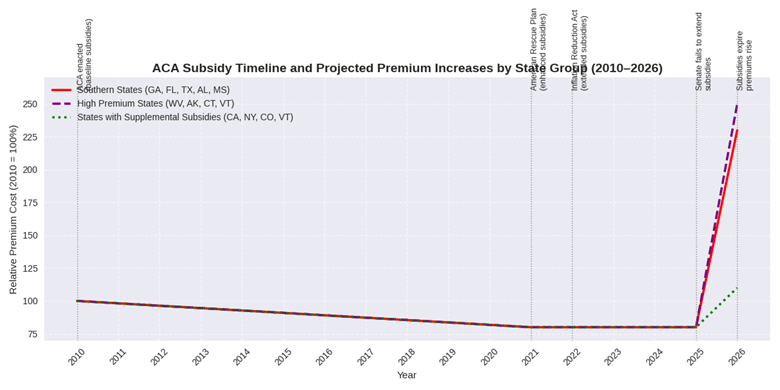
Timeline of ACA Subsidies and Expiration

YearPolicy ChangeImpact
2010ACA enactedSubsidies tied to income, capped at 400% FPL.
2021American Rescue PlanEnhanced subsidies, removed “subsidy cliff.”
2022Inflation Reduction ActExtended subsidies through 2025.
Dec 2025Senate rejects extensionSubsidies set to expire Jan 1, 2026.
2026ExpirationPremiums rise ~114%; 2–4 million lose coverage.

States Most Affected

Analyses show uneven impacts across the country:

  • Southern States (highest increases):
    • Georgia, Florida, Texas, Alabama, Mississippi → Premiums projected to rise 25–30%+ beyond national average.
    • Many of these states did not expand Medicaid, leaving middle-income households most exposed.
  • High Premium States (older enrollees hit hardest):
    • West Virginia, Alaska, Connecticut, Vermont → Older adults (50–64) face catastrophic jumps, sometimes $8,000+ more annually factually.co.
  • States with Supplemental Subsidies/Reinsurance (smaller increases):

How to Read This Chart

  • Vertical markers: Key policy milestones (ACA enactment, American Rescue Plan, Inflation Reduction Act, Senate failure, subsidy expiration).
  • Red line: Southern states (GA, FL, TX, AL, MS)  projected +130% premium increase.
  • Purple dashed line: High‑premium states (WV, AK, CT, VT) projected +150% increase, especially for older adults.
  • Green dotted line: States with supplemental subsidies (CA, NY, CO, VT) limited to +10% increase.

Advocacy Angle

  • This visualization makes clear that Southern states and high‑premium states will be hit hardest, while states with their own protections blunt the impact.

Key Takeaways

  • 22 million people currently benefit from subsidies; 92% of ACA enrollees receive them.
  • Without extension, average premiums double (from ~$888 to ~$1,904 annually).
  • Middle-income families just above 400% FPL face the steepest hikes,e.g., a 60-year-old earning $64,000 could pay $14,900/year vs. $6,200 for someone earning slightly less Moneywise.
  • Coverage losses: CBO projects 2.2–4 million uninsured in 2026.

Advocacy Angle

This is not just about numbers, it’s about equity and justice. The expiration disproportionately harms Southern states and marginalized communities, widening racial and economic health gaps. The subsidies made healthcare affordable for millions; their loss reveals how political gridlock can dismantle progress.

Sources: factually.co NBC News Lawyer Monthly factually.co Peterson-KFF Health System Tracker Moneywise

The Politics of Healthcare

  • Democrats pushed for a three‑year extension of subsidies.
  • Republicans countered with health savings accounts, rejecting subsidies as “too costly.”
  • Both proposals failed in the Senate, leaving millions at risk.
  • The House has yet to act, with leadership resisting temporary extensions.

Equity and Accountability

Healthcare is not just policy,it’s justice. Subsidies have allowed working families, small business owners, and gig workers to access care. Ending them disproportionately harms marginalized communities, widening racial and economic health gaps.

This is not simply about budgets. It’s about whether America values the health of its people or the politics of obstruction.

Call to Action

The fight over ACA subsidies is a test of our national priorities. Will we protect affordable healthcare, or will we allow millions to be priced out? Advocacy must demand accountability: healthcare equity is non‑negotiable.
The “Big Beautiful” Bill Is a Devastating Blow to Everyday Americans

By Charles Zackary King | AMIBW Magazine Blog


On July 4, 2025, while fireworks lit the sky, the United States quietly enacted one of the most sweeping cuts to its social safety net in decades. Dubbed the “One Big Beautiful Bill,” this legislation has a name that evokes hope — but its true impact could be catastrophic for millions of Americans. Seniors, working-class families, and impoverished communities now face an uncertain future as Medicaid, Medicare, and SNAP undergo deep structural reductions.

As headlines celebrate “economic discipline” and “government efficiency,” communities on the margins brace for what may become a humanitarian crisis. This blog post explores what’s at stake, who is most vulnerable, and what steps we must take to protect our neighbors and our nation.


What’s Being Cut — and Who Pays the Price

Medicaid

  • Cuts totaling $930 billion over the next decade
  • Imposed work requirements of 80 hours/month for adults aged 19–64
  • Heightened eligibility reviews and reduced state flexibility
  • Strained provider budgets, risking access to care

Medicare

  • $533 billion slashed due to automatic PAYGO reductions
  • Shrinking provider reimbursements and higher out-of-pocket costs
  • Seniors may struggle to maintain critical care and medication regimens

SNAP (Supplemental Nutrition Assistance Program)

  • Reductions of $295 billion
  • New work rules apply to recipients up to age 64
  • States now must partially fund SNAP, risking coverage gaps
  • School meal programs also face uncertainty

Real-Life Consequences: Health, Hunger, and Homelessness

For seniors living on fixed incomes, these cuts aren’t just policy shifts — they’re life-altering.

  • Over 17 million older adults rely on Medicaid
  • Nearly 11 million use SNAP to combat food insecurity
  • Thousands of veterans, disabled individuals, and rural residents depend on these programs for survival

With fewer protections:

  • Mental health and substance abuse services will disappear
  • Food banks will become overwhelmed
  • Families will face impossible choices — rent or medicine, dinner or doctor’s appointments
  • A spike in homelessness and medical emergencies is likely

How You Can Prepare

While lawmakers battle in Washington, communities must mobilize on the ground:

For Individuals

  • Organize your documents: Health records, work hours, income proofs — they’ll be critical for eligibility reviews
  • Tap into local aid: Visit food banks, free clinics, and legal aid organizations
  • Explore ACA alternatives: The Health Insurance Marketplace may still offer options

For Communities

  • Churches and nonprofits: Provide meals, shelter, and spiritual care
  • Local clinics: Prepare to see increased demand — support their expansion efforts
  • Advocacy networks: Share resources and unite across racial, generational, and economic divides

How We Can Prevent This Disaster

It’s not too late — but it demands collective action.

Policy Remedies

  • Congress can repeal or delay the bill’s harshest provisions
  • State governors may apply for waivers to protect their residents
  • Litigation by civil rights and health advocacy groups may challenge legality

Civic Activism

  • Call and write your representatives. Let them know you’re watching.
  • Support organizations defending seniors, children, and marginalized groups
  • Mobilize voters ahead of the 2026 midterm elections

Final Thoughts: Will We Stand Up for One Another?

What’s beautiful about America isn’t austerity — it’s compassion, community, and care. The “Big Beautiful Bill” may claim to balance budgets, but it does so on the backs of those least able to bear it. This blog isn’t just a warning — it’s a rallying cry.

History will ask: when the most vulnerable were under attack, did we speak out? Did we organize? Did we rise?

Let’s answer with action.


America Without the ACA: A Grim Reality

The Affordable Care Act (ACA), often referred to as Obamacare, has been a cornerstone of American healthcare since its inception. It has provided millions of Americans with access to affordable health insurance, significantly reducing the number of uninsured individuals. But what would happen if the ACA were suddenly repealed, leaving over 30 million people without healthcare coverage? The consequences would be dire and far-reaching.

The Immediate Impact: 30+ Million Without Healthcare

If the ACA were repealed, more than 30 million Americans would lose their health insurance overnight1. This would include individuals who gained coverage through Medicaid expansion, those who purchased insurance through the ACA marketplaces, and young adults who remain on their parents’ plans until age 26. The loss of coverage would be catastrophic for these individuals and their families.

Without insurance, many would be unable to afford necessary medical care. Routine check-ups, preventive services, and treatments for chronic conditions would become financially out of reach. This would lead to a significant increase in untreated illnesses and preventable deaths. Hospitals and clinics would see a surge in emergency room visits, as uninsured individuals seek care for conditions that could have been managed with regular medical attention1.

The Financial Burden: Unaffordable Medical Bills

For those without insurance, medical bills can quickly become overwhelming. A single hospital visit or a major surgery can cost tens of thousands of dollars. Without the ACA, many families would face financial ruin due to medical debt. This would not only affect their ability to pay for healthcare but also impact their overall financial stability, leading to increased rates of bankruptcy and poverty2.

The ripple effects would be felt across the economy. As more people struggle with medical debt, consumer spending would decrease, affecting businesses and slowing economic growth. The healthcare system itself would be strained, with hospitals and clinics facing financial challenges due to an increase in uncompensated care2.

The Importance of State Participation in the ACA Exchange

One of the key components of the ACA is the health insurance exchange, where individuals can purchase affordable health plans. However, not all states have fully embraced the exchange, leaving many residents without access to affordable coverage. It is crucial for every state to participate in the ACA exchange to ensure that all Americans have access to healthcare.

States that do not participate in the exchange are still paying into the system through federal taxes. By not taking advantage of the exchange, these states are essentially leaving money on the table that could be used to provide their residents with affordable health insurance. Participation in the exchange would not only benefit individuals but also strengthen the overall healthcare system by spreading risk and reducing costs3.

A Call to Action

The potential repeal of the ACA highlights the importance of maintaining and expanding access to healthcare. It is essential for policymakers to recognize the devastating impact that losing the ACA would have on millions of Americans. Ensuring that every state participates in the ACA exchange is a critical step in providing comprehensive healthcare coverage for all.

Healthcare is a fundamental human right, and it is the responsibility of our leaders to protect and expand access to it. By working together, we can ensure that no American is left without the care they need and deserve.


What are your thoughts on the potential repeal of the ACA? How do you think it would impact your community? Share your thoughts and join the conversation.

The Impact of Health Care Inequities on Black People: Quality of Life, Economic Loss, and Life Expectancy

Health care inequities have long been a significant issue affecting the Black community in the United States. These disparities not only impact the quality of life but also lead to substantial economic losses and a shorter life expectancy for Black individuals. This blog post delves into the multifaceted effects of these inequities, supported by statistical data and historical context.

Quality of Life

The quality of life for Black people is profoundly affected by health care disparities. Black individuals are more likely to experience chronic conditions such as hypertension, diabetes, and asthma at higher rates than their White counterparts1. These conditions often go untreated or are poorly managed due to barriers in accessing quality health care. For instance, Black people are more likely to be uninsured or underinsured, which limits their access to necessary medical services2.

Moreover, the historical mistreatment of Black people in the medical profession has fostered a deep mistrust in the health care system. This mistrust is rooted in events such as the Tuskegee Syphilis Study, where Black men were left untreated for syphilis to study the disease’s progression3. Such instances contribute to a reluctance to seek medical care, further exacerbating health issues.

Economic Loss

Health care inequities also translate into significant economic losses for the Black community. The cost of untreated or poorly managed chronic conditions can be staggering. Black families often face higher medical expenses and lost income due to illness. Additionally, the lack of access to preventive care means that diseases are often diagnosed at more advanced stages, requiring more expensive and extensive treatments4.

The economic impact extends beyond individual families. The broader economy suffers as well, with increased health care costs and lost productivity. According to a study by the W.K. Kellogg Foundation, health disparities cost the U.S. economy approximately $93 billion in excess medical costs and $42 billion in lost productivity per year5.

Life Expectancy

One of the most stark indicators of health care inequities is the difference in life expectancy between Black and White individuals. On average, Black people live nearly five years less than their White counterparts (72.8 years vs. 77.5 years). This gap is a direct result of the cumulative effects of health disparities, including higher rates of infant mortality, maternal mortality, and chronic diseases.

For example, Black infants have a mortality rate more than twice that of White infants (10.6 per 1,000 live births vs. 4.4 per 1,000 live births). Additionally, Black women are nearly three times more likely to die from pregnancy-related causes than White women (39.9 vs. 14.1 per 100,000 live births). These statistics highlight the urgent need for systemic changes in the health care system to address these disparities.

Conclusion

The impact of health care inequities on Black people is profound and far-reaching. These disparities affect the quality of life, lead to significant economic losses, and result in a shorter life expectancy. Addressing these issues requires a concerted effort to dismantle systemic racism in the health care system, improve access to quality care, and rebuild trust within the Black community. Only through such efforts can we hope to achieve health equity and improve the overall well-being of Black individuals.


1KFF – How Present-Day Health Disparities for Black People Are Linked to Past Policies and Events 2Pew Research Center – Black Americans’ Views about Health Disparities, Experiences with Health Care 3KFF – How Present-Day Health Disparities for Black People Are Linked to Past Policies and Events 4Commonwealth Fund – Achieving Racial and Ethnic Equity in U.S. Health Care 5: W.K. Kellogg Foundation – The Business Case for Racial Equity : Pew Research Center – Black Americans’ Views about Health Disparities, Experiences with Health Care : KFF – How Present-Day Health Disparities for Black People Are Linked to Past Policies and Events : KFF – How Present-Day Health Disparities for Black People Are Linked to Past Policies and Events : KFF – How Present-Day Health Disparities for Black People Are Linked to Past Policies and Events

Your comments are welcomed and wanted so please stay engaged