Healthcare on the Brink: Subsidies, Equity, and the Cost of Inaction

Introduction
The Affordable Care Act (ACA) was designed to expand access to health coverage for millions of Americans. Enhanced subsidies, first enacted during the pandemic, have kept premiums affordable for over 22 million people. But now, as Congress fails to extend these subsidies, the future of affordable healthcare hangs in the balance.

What’s at Stake

  • 22 million Americans currently benefit from ACA subsidies.
  • Without extension, premiums will rise by an average of 114% in 2026.
  • Families earning $75,000 could see costs increase by $3,368 annually.
  • The Congressional Budget Office estimates 4 million people may drop coverage.

 
If Congress does not extend the ACA subsidies, premiums will more than double in 2026 (average +114%), with the steepest impacts in Southern states (like Georgia, Florida, Texas, Alabama, Mississippi) and in states that did not expand Medicaid. States with their own reinsurance or supplemental subsidies (like Vermont, California, New York) will see smaller increases factually.co NBC News factually.co Peterson-KFF Health System Tracker.
Timeline of ACA Subsidies and Expiration

YearPolicy ChangeImpact
2010ACA enactedSubsidies tied to income, capped at 400% FPL.
2021American Rescue PlanEnhanced subsidies, removed “subsidy cliff.”
2022Inflation Reduction ActExtended subsidies through 2025.
Dec 2025Senate rejects extensionSubsidies set to expire Jan 1, 2026.
2026ExpirationPremiums rise ~114%; 2–4 million lose coverage.

States Most Affected

Analyses show uneven impacts across the country:

  • Southern States (highest increases):
    • Georgia, Florida, Texas, Alabama, Mississippi → Premiums projected to rise 25–30%+ beyond national average.
    • Many of these states did not expand Medicaid, leaving middle-income households most exposed.
  • High Premium States (older enrollees hit hardest):
    • West Virginia, Alaska, Connecticut, Vermont → Older adults (50–64) face catastrophic jumps, sometimes $8,000+ more annually factually.co.
  • States with Supplemental Subsidies/Reinsurance (smaller increases):

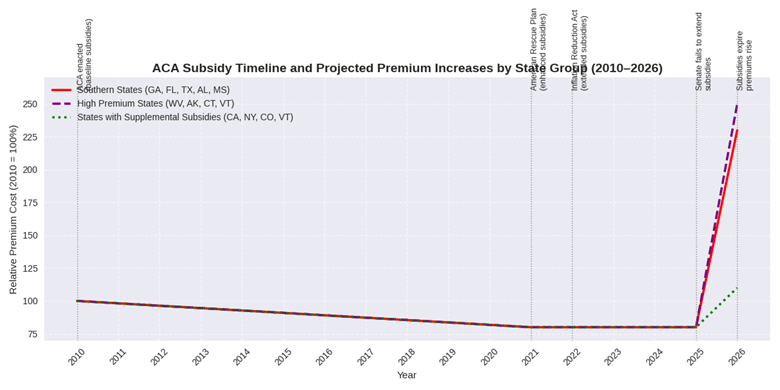
How to Read This Chart

  • Vertical markers: Key policy milestones (ACA enactment, American Rescue Plan, Inflation Reduction Act, Senate failure, subsidy expiration).
  • Red line: Southern states (GA, FL, TX, AL, MS)  projected +130% premium increase.
  • Purple dashed line: High‑premium states (WV, AK, CT, VT) projected +150% increase, especially for older adults.
  • Green dotted line: States with supplemental subsidies (CA, NY, CO, VT) limited to +10% increase.

Advocacy Angle

  • This visualization makes clear that Southern states and high‑premium states will be hit hardest, while states with their own protections blunt the impact.

Key Takeaways

  • 22 million people currently benefit from subsidies; 92% of ACA enrollees receive them.
  • Without extension, average premiums double (from ~$888 to ~$1,904 annually).
  • Middle-income families just above 400% FPL face the steepest hikes,e.g., a 60-year-old earning $64,000 could pay $14,900/year vs. $6,200 for someone earning slightly less Moneywise.
  • Coverage losses: CBO projects 2.2–4 million uninsured in 2026.

Advocacy Angle

This is not just about numbers, it’s about equity and justice. The expiration disproportionately harms Southern states and marginalized communities, widening racial and economic health gaps. The subsidies made healthcare affordable for millions; their loss reveals how political gridlock can dismantle progress.

Sources: factually.co NBC News Lawyer Monthly factually.co Peterson-KFF Health System Tracker Moneywise

The Politics of Healthcare

  • Democrats pushed for a three‑year extension of subsidies.
  • Republicans countered with health savings accounts, rejecting subsidies as “too costly.”
  • Both proposals failed in the Senate, leaving millions at risk.
  • The House has yet to act, with leadership resisting temporary extensions.

Equity and Accountability

Healthcare is not just policy,it’s justice. Subsidies have allowed working families, small business owners, and gig workers to access care. Ending them disproportionately harms marginalized communities, widening racial and economic health gaps.

This is not simply about budgets. It’s about whether America values the health of its people or the politics of obstruction.

Call to Action

The fight over ACA subsidies is a test of our national priorities. Will we protect affordable healthcare, or will we allow millions to be priced out? Advocacy must demand accountability: healthcare equity is non‑negotiable.
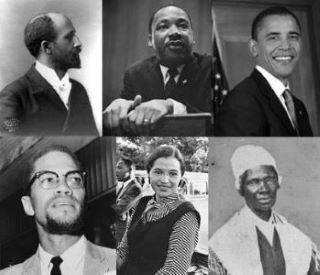
Black America: The Blueprint of Global Culture and Opportunity

Introduction

Black America has always been the heartbeat of democracy, culture, and progress. Yet, too often, our contributions are overlooked, minimized, or outright stolen. From the Civil Rights Movement to the African Diaspora, Black Americans have paved the way for immigrant communities, global liberation movements, and cultural revolutions. It is time to reclaim that truth.

Civil Rights Legacy and Immigration

The Civil Rights Movement, led by Malcolm X, Dr. Martin Luther King Jr., and countless others, did more than secure rights for Black Americans. It opened doors for immigrant communities. The Immigration and Nationality Act of 1965 was born out of the Civil Rights struggle, allowing Cubans, Latinos, Caribbeans, Nigerians, Asians, Somalians, and others to enter the U.S. in greater numbers. Without Black America, those opportunities would not exist.

Identity and Assimilation

Yet, many of these groups distance themselves from Blackness, seeking acceptance by aligning with whiteness. Statements like “I’m not Black, I’m Jamaican” or “I’m Nigerian, not African American” fracture solidarity. Assimilation for survival may be understandable, but denial of identity undermines collective power.

The Diaspora and World Culture

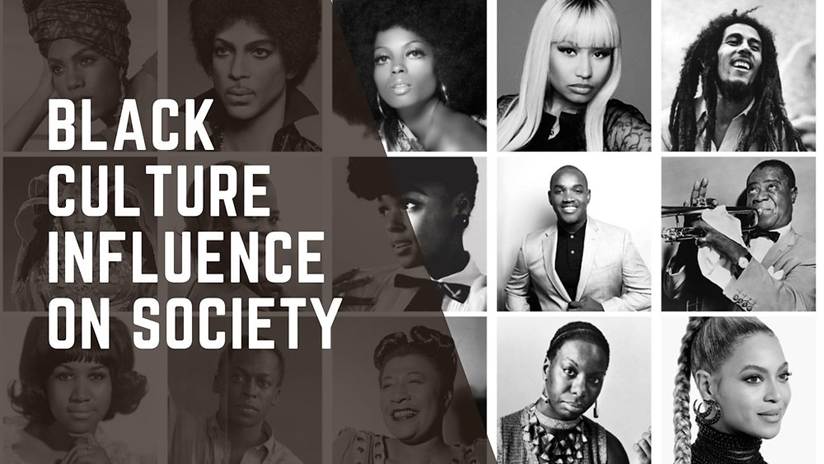
The African Diaspora is not just about migration, it is about influence. Black America is the epicenter of global culture. Hip-hop, born in the Bronx, is now the most consumed music genre worldwide. Jazz, gospel, and R&B shaped entire industries. Fashion trends rooted in Black creativity dominate global markets. Even social justice movements abroad borrow language and tactics from the Civil Rights Movement.

Cultural Appropriation vs. Scrutiny

Black culture is celebrated globally but often stolen and repackaged by others. TikTok dances created by Black teens go viral, but influencers from other groups profit. Streetwear, rooted in Black creativity, is now a billion-dollar industry. Meanwhile, Black youth are stereotyped as “criminals” for the same creativity. The hypocrisy is undeniable: the world profits from Black culture while vilifying Black people.

Politics and Immigration

Many immigrant groups supported Donald Trump, believing his promises. Yet, his administration deported thousands from Latin America, Africa, and Asia. The irony is sharp: communities that distanced themselves from Black solidarity were targeted by the same system they empowered.

Global Impact of Black America

Black America is not just a cultural force, it is a political and social catalyst. Civil rights victories inspired global liberation movements, from South Africa to the Caribbean. Marcus Garvey’s Pan-African vision, Dr. King’s dream of justice, and Malcolm X’s call for dignity continue to resonate worldwide.

Conclusion

Black America is the foundation, the heartbeat, and the blueprint. We are not just culture, we are culture. We paved the way for the world politically, socially, and culturally. It is time for the world to recognize, respect, and honor that legacy.

White Supremacy Threatens South Africa’s Sovereignty, But What About America?

By Tim Cocks (Reuters)
Blog Commentary & Call to Action

South African President Cyril Ramaphosa recently sounded the alarm: ideas of white racial superiority are not only a threat to South Africa’s post-apartheid unity, but also to its sovereignty and international relations. Speaking at an ANC conference, Ramaphosa condemned false narratives of “white persecution” that continue to circulate in far-right spaces globally. These myths, he warned, have real consequences for diplomacy and national security.

Yet while Ramaphosa calls for global efforts to debunk these lies, U.S. President Donald Trump has chosen to amplify them. Trump boycotted the G20 summit in Johannesburg, alleging without evidence that South Africa mistreats its white minority. He claimed white farmers were being “slaughtered” and their land “illegally confiscated.” These claims have been widely debunked, but they continue to fuel white supremacist rhetoric worldwide.

Here’s the hypocrisy: Trump accuses South Africa of racism against whites yet remains silent on the systemic racism and repression of Black people in America. In South Africa, a wrong was made right, apartheid was dismantled, and the nation continues to strive for unity. In America, however, racism remains deeply entrenched. Black men are killed at alarming rates, the justice system turns a blind eye, and the trauma of racial injustice grows worse every day.

Before the pot calls the kettle black, America must look inward. Stop throwing stones when you live in a glass house. The U.S. government cannot credibly lecture others on racial justice while ignoring the oppression within its own borders.

Black people in America continue to face systemic racism and deadly police violence at rates far higher than other groups, making Donald Trump’s accusations against South Africa not only hypocritical but deeply offensive.

Police Violence Against Black Americans

  • In 2024 alone, U.S. police killed 1,365 people — the deadliest year on record campaignzero.org.
  • Of those, 248 were Black, despite Black Americans making up only about 13% of the population Statista.
  • The rate of fatal police shootings among Black Americans stood at 6.1 per million per year (2015–2024), more than double that of white Americans Statista.
  • Even after the global outcry following George Floyd’s murder in 2020, police killings of Black people have actually increased in recent years NBC News.
  • Data shows that unarmed Black men are disproportionately killed by police, highlighting systemic bias in law enforcement factually.co.

Examples of Systemic Racism in America

Systemic racism is not limited to policing, it permeates nearly every aspect of American life:

  • Education: Black students are more likely to attend underfunded schools and face harsher disciplinary actions Human Rights Careers.
  • Housing: Redlining and discriminatory lending practices have left Black families with far less generational wealth Human Rights Careers.
  • Employment: Black workers earn less on average and face higher unemployment rates than white counterparts Robert F. Smith News.
  • Healthcare: Black Americans experience worse health outcomes, higher maternal mortality rates, and less access to quality care Human Rights Careers.
  • Criminal Justice: Black people are incarcerated at nearly five times the rate of white people, often for similar offenses Human Rights Careers.

Taken together, these examples show that racism in America is not incidental, it is systemic, structural, and ongoing.

Blog Post Framing

South Africa, under Ramaphosa, is working to dismantle the legacy of apartheid and build unity. Meanwhile, America continues to deny or downplay its own racial injustices. For Donald Trump to accuse South Africa of racism against whites while ignoring the daily trauma of Black Americans is the ultimate hypocrisy.

Before the pot calls the kettle black, America must confront its own house of glass. Stop throwing stones abroad while ignoring the shattered lives at home.

Sources: Statista factually.co NBC News campaignzero.org Human Rights Careers Robert F. Smith News

Call to Action

It’s time to:

  • Expose and dismantle white supremacist lies globally.
  • Hold U.S. leaders accountable for systemic racism and police violence.
  • Unite Black communities worldwide in solidarity and resistance.

So I ask again: Should Donald Trump and the U.S. government be called out for this hypocrisy? The answer seems clear, yes, loudly and globally.

Rallying Cry

No more silence, no more lies, 

We see the truth with open eyes. 

From Soweto to Harlem streets, 

Black voices rise, we won’t retreat. 

Justice delayed is justice denied, 

Too many brothers have already died. 

Glass houses crack when stones are thrown, 

America fix the rot in your own. 

Unite the people, across the land, 

Together in strength, we take a stand. 

From Cape Town’s shore to Detroit’s fight, 

Black power united will set things right. 

Georgia’s Taxpayers May Soon Bankroll Trump’s Defense

Georgia recently passed a law that could force Fulton County taxpayers to reimburse Donald Trump and his co-defendants for millions in legal fees after the election-interference case was dismissed. Estimates suggest claims could reach $10 million or more, though no payouts have been finalized yet CBS News The Hill san.com.

Case Collapse, Costly Consequences

Fulton County’s election‑interference case against Donald Trump and 18 co‑defendants was dismissed after DA Fani Willis was disqualified. That dismissal triggered Georgia’s new SB 244 law, which allows defendants to demand reimbursement of “reasonable attorney’s fees and costs.”

What’s Happening

  • Case dismissed: The sprawling Georgia election-interference case against Trump and 18 co-defendants was dropped in late November 2025 after Fulton County DA Fani Willis was disqualified due to a conflict of interest san.com.
  • New law (SB 244 / GA Code §17-11-6): Passed earlier this year, it allows defendants to seek reimbursement of “reasonable attorney’s fees and costs” if a prosecutor is disqualified and charges are dismissed The Hill san.com.
  • Potential claims: Trump’s legal team alone spent more than $5.5 million in Georgia since 2021. Co-defendants collectively spent millions more, with some raising funds through crowdfunding CBS News.
  • Taxpayer impact: Fulton County could be liable for millions, possibly tens of millions, depending on how many defendants file claims and what a judge approves CBS News The Hill.

The Price Tag

  • Trump: $5.5M+ in Georgia legal fees
  • GOP “fake electors”: $2.3M
  • Harrison Floyd: $363K (crowdfunded)
  • John Eastman: $937K (crowdfunded)
  • Jeff Clark: $153K (crowdfunded)
  • Total exposure: $10M+ and counting

Taxpayer Impact

Defendants have 45 days to file claims. Judge Scott McAfee will decide payouts. While Trump’s attorney insists reimbursements come from the DA’s budget, critics argue taxpayers ultimately foot the bill.

Risks & Fallout

  • Unprecedented precedent: Rarely are criminal defendants reimbursed.
  • Political fallout: Though bipartisan, the law is widely seen as Trump‑specific.
  • Budget strain: Fulton County faces millions in potential payouts.

Risks & Considerations

  • Unprecedented law: Reimbursing criminal defendants is rare in U.S. law, raising questions about fairness and precedent san.com.
  • Political fallout: The measure was passed with bipartisan support but is widely seen as tailored to Trump’s case The Hill san.com.
  • Uncertain totals: No official accounting yet of Fulton County’s own prosecution costs, which could add significantly to taxpayer exposure CBS News.

In short: Georgia’s dismissal of the Trump case has opened the door for Trump and co-defendants to demand millions back in legal fees. Whether taxpayers ultimately foot the bill depends on how judges interpret the new law and the claims filed in the coming weeks.

Sources: CBS News The Hill san.com

Advocacy Framing

This is more than a budget issue, it’s a democracy issue. Georgia’s taxpayers may soon bankroll the defense of those accused of undermining democratic institutions. Communities must mobilize to demand transparency, fiscal responsibility, and ethical leadership.

Call to Action:
Share this story. Demand accountability. Ask why public funds should defend those accused of attacking democracy.

Lenacapavir: A Breakthrough HIV Prevention Tool Held Back by Global Funding Cuts

Adapted from reporting by Rachel Schraer, The Independent (Rethinking Global Aid Project)

The closest thing we have to an HIV vaccine has finally arrived. Lenacapavir, a long-acting injectable medication that can prevent nearly 100% of HIV infections when administered twice yearly, is being hailed as revolutionary. Yet despite its promise, only a fraction of the people who need it will gain access.

The Numbers Behind the Breakthrough

  • Current plans by Gilead and international funders will provide lenacapavir to 2 million people over three years, about 666,000 annually.
  • Research by Dr. Andrew Hill (University of Liverpool) shows this rollout could avert 165,000 infections, but scaling up to 10 million people annually could prevent half a million infections and put us on track to ending HIV transmission.
  • The challenge: funding cuts, particularly from the U.S. under President Donald Trump, have left prevention efforts severely under-resourced.

The Cost and Access Challenge

  • In the U.S., a course of lenacapavir costs $28,000.
  • Thanks to advocacy and licensing agreements, the drug will be sold at no profit in low-income countries, with costs reduced to around $40 per person per year.
  • Gilead’s plan to reach 2 million people by 2028 is described as an “initial step,” with hopes that generic manufacturers will expand access further.

Why This Matters Globally

Anne Aslett, CEO of the Elton John AIDS Foundation, called the rollout “unprecedented,” noting that doses are arriving in Eswatini at the same time as in the U.S., a sharp contrast to the early AIDS crisis, when African nations waited more than a decade for antiretroviral drugs.

Still, she warns that funding gaps threaten progress. Vulnerable populations, young women, LGBTQ communities, sex workers, and people who use drugs, are often excluded from prevention services. Without reaching these groups, the epidemic cannot be contained.

Innovation in Delivery

  • Foundations are experimenting with drone deliveries of drugs and testing kits.
  • Digital pilots in London are making PrEP accessible directly to consumers, by passing traditional clinics.
  • Sub-Saharan Africa is now pioneering models of care that are more advanced than those in parts of the Global North.

🇬🇧 The UK’s Role

Mike Podmore, CEO of STOPAIDS, emphasizes that UK contributions are not just charity, they fuel domestic research and innovation. Agencies like Unitaid have invested £250m into UK universities over the past decade, strengthening both global and local HIV responses.

The UK has set a goal to end new HIV transmissions by 2030, and expanding access to lenacapavir will be critical to achieving it.

The Call to Action

Ending HIV is within reach, but only if global leaders step up. Dr. Hill and advocates worldwide are urging wealthy nations to contribute to a proposed $400m fund to expand access without undermining existing HIV programs.

This is a pivotal moment: decades of research and advocacy have brought us closer than ever to a cure. But without adequate funding, only 7% of those who need lenacapavir will receive it.

What you can do:

  • Sign petitions demanding governments protect and expand HIV funding.
  • Share this story widely to raise awareness.
  • Pressure policymakers to prioritize vulnerable populations in prevention programs.

Together, we can ensure that this breakthrough doesn’t stall at the starting line. Let’s end HIV and make life better for all.

Original reporting by Rachel Schraer, The Independent, as part of the “Rethinking Global Aid” project.

World AIDS Day is more than a commemoration, it is a call to action, reflection, and hope. Observed every year on December 1, it reminds us of the lives lost, the progress made, and the work still ahead in ending HIV/AIDS.

The Meaning of World AIDS Day

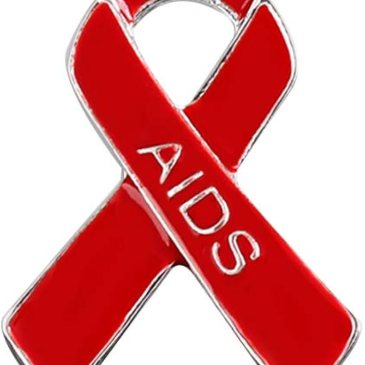
World AIDS Day was first established in 1988 by the World Health Organization (WHO) and UNAIDS, making it the first-ever global health day Wikipedia Britannica. Its purpose is to raise awareness about HIV/AIDS, show solidarity with people living with HIV, and honor the millions who have died from AIDS-related illnesses. The red ribbon, adopted in 1991, remains the universal symbol of support and remembrance Britannica.

Each year, the day carries a theme. In 2025, the theme is “Overcoming disruption, transforming the AIDS response”, a reminder that funding cuts, stigma, and inequality threaten decades of progress Moneycontrol.

Historical Context and Data

  • In the 1980s and 1990s, HIV/AIDS was a rapidly escalating crisis. By 1997, new infections peaked at 3.3 million annually, and AIDS-related deaths peaked in 2004 at 2.1 million per year Britannica.
  • Since then, antiretroviral therapy (ART) transformed HIV from a fatal disease into a manageable chronic condition, reducing deaths by more than 64% since 2004 Wikipedia.
  • As of 2024, an estimated 40.8 million people worldwide were living with HIV, with 1.3 million new infections and 630,000 AIDS-related deaths that year Business Standard Moneycontrol.
  • In the U.S., about 1.2 million people live with HIV, with ongoing disparities in testing and treatment Las Vegas Sun.

Strides in Treatment and Prevention

The fight against HIV/AIDS has seen remarkable progress:

  • ART advancements: From early AZT in 1987 to today’s single-pill regimens and long-acting injectables, treatment now allows near-normal lifespans Las Vegas Sun.
  • Prevention tools: Pre-exposure prophylaxis (PrEP) and post-exposure prophylaxis (PEP) have proven highly effective in preventing infection Business Standard.
  • U=U (Undetectable = Untransmittable): People on effective ART who maintain undetectable viral loads cannot sexually transmit HIV Business Standard.
  • Mother-to-child transmission: Once a major concern, it has been drastically reduced through targeted interventions Las Vegas Sun.

The Future Outlook

While progress is undeniable, challenges remain:

  • Funding cuts and inequality threaten to reverse gains, especially in vulnerable communities Moneycontrol.
  • Late diagnoses continue to hinder progress, with over half of new cases in Europe detected too late for optimal treatment News-Medical.Net.
  • Research breakthroughs offer hope: trials with engineered antibodies, CRISPR gene editing, and long-acting injectables like lenacapavir suggest that a functional cure may be within reach Smithsonian Magazine AIDS.ORG.
  • The global goal remains clear: end AIDS as a public health threat by 2030, a target set by UNAIDS and the UN Sustainable Development Goals Britannica UNAIDS.

Closing Reflection

World AIDS Day is not just about remembrance, it is about renewed commitment. We have turned HIV from a death sentence into a chronic condition, but stigma, inequity, and funding gaps still stand in the way of ending the epidemic. The future depends on global solidarity, scientific innovation, and community-led action.

Ending AIDS is possible but only if we choose compassion, equity, and sustained investment.

Sources: Wikipedia Britannica Business Standard Las Vegas Sun Smithsonian Magazine AIDS.ORG UNAIDS Moneycontrol

Norovirus cases are surging across the U.S., with test positivity nearly doubling since late summer. States most impacted include Alabama, Nebraska, Oklahoma, Texas, Wyoming, Louisiana, Michigan, and Indiana. The CDC stresses that prevention hinges on thorough handwashing with soap and water, safe food handling, and disinfecting contaminated surfaces. NBC News CBS News ABC News CDC

Norovirus: America’s “Winter Vomiting Disease” on the Rise

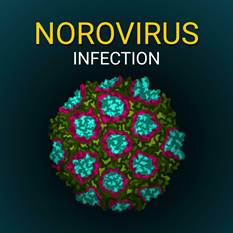
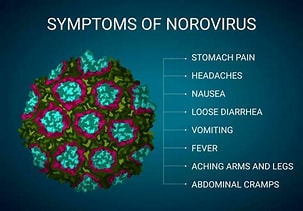
Norovirus, often called the “winter vomiting disease”, is once again sweeping across the country. Unlike other viruses with a fat-based envelope that alcohol sanitizers can break down, norovirus is encased in a rugged protein shell called a capsid, making it resistant to hand sanitizers. That means soap and water for at least 20 seconds is the most effective defense.

Current Trends and Data

  • CDC data shows nearly 14% of tests were positive for norovirus during the week ending Nov. 15, 2025, compared to just 7% three months earlier CBS News ABC News.
  • Last December saw a record-breaking 25% positivity rate, and experts warn this winter could bring another harsh season Gizmodo.
  • Epic Research and WastewaterSCAN data highlight the hardest-hit states: Alabama, Nebraska, Oklahoma, Texas, Wyoming, Louisiana, Michigan, and Indiana NBC News ABC News Gizmodo.
  • Outbreaks are being reported in schools, cruise ships, and communities nationwide, with more than 200 passengers sickened aboard a luxury cruise ship this fall CBS News.

CDC Recommendations for Prevention

The CDC emphasizes several key steps to stop norovirus from spreading CDC CDC:

  • Wash hands thoroughly with soap and water for 20 seconds, especially after using the bathroom, changing diapers, or before preparing food.
  • Do not rely on hand sanitizer alone, it does not kill norovirus.
  • Avoid preparing food or caring for others while sick, and wait at least 48 hours after symptoms stop before resuming these activities.
  • Cook shellfish thoroughly to at least 145°F and wash fruits and vegetables well.
  • Clean and disinfect contaminated surfaces using bleach-based solutions or EPA-approved disinfectants effective against norovirus.
  • Wash contaminated laundry with hot water and detergent, then machine dry at high heat.

Why This Matters

Norovirus is the leading cause of foodborne illness in the U.S., responsible for 20 million infections annually, over 100,000 hospitalizations, and nearly 900 deaths each year CBS News. It spreads easily through contaminated food, water, surfaces, and person-to-person contact. Symptoms, nausea, vomiting, diarrhea, and stomach cramps, can appear within 12–48 hours and last 1–3 days. Vulnerable groups include young children, older adults, and those with weakened immune systems.

Community Call to Action

This surge is not just a public health issue, it’s a matter of community responsibility. By practicing rigorous hygiene, safe food handling, and responsible caregiving, we can protect ourselves and those most at risk. Norovirus thrives in close-contact environments, but prevention is in our hands, literally.

Sources: NBC News CBS News ABC News Gizmodo CDC CDC

Jellybean Johnson, a Pioneer of the Minneapolis Sound, Remembered

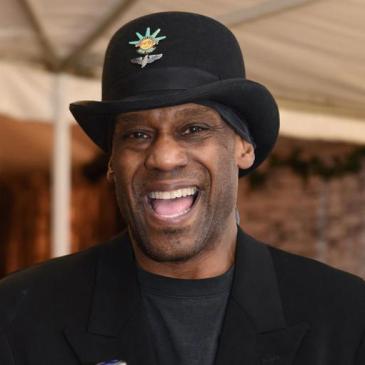
Garry George “Jellybean” Johnson, legendary drummer, guitarist, producer, and founding member of The Time, has passed away at the age of 69, just two days after celebrating his birthday. His sudden death marks the loss of one of the architects of the Minneapolis Sound, a genre-defining fusion of funk, rock, R&B, and new wave that continues to influence music today Rolling Stone FOX 9 Minneapolis-St. Paul Wikipedia Bring Me The News.

Honoring His Legacy

Jellybean Johnson was born in Chicago in 1956 and moved to Minneapolis at age 13. It was there that he befriended future icons like Prince, Morris Day, Jimmy Jam, and Terry Lewis, forming the creative nucleus that would shape an entire era of music Rolling Stone FOX 9 Minneapolis-St. Paul.

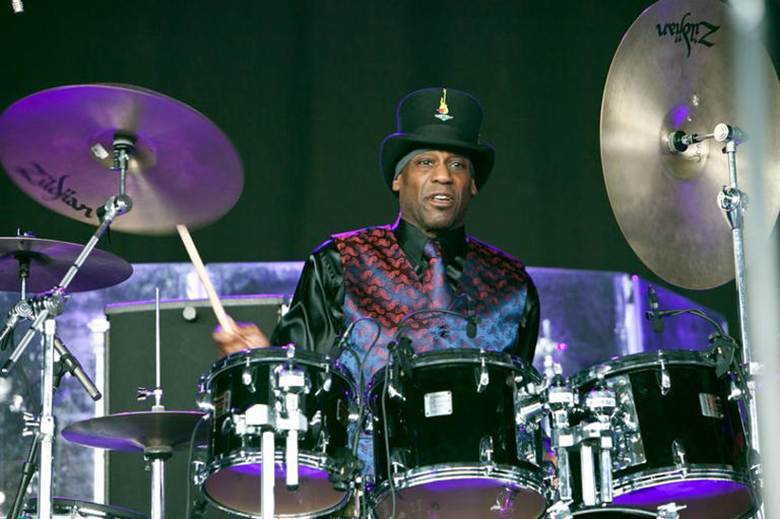
  • The Time (1981–1984): Johnson was the original and only drummer for Prince’s band The Time, appearing in Purple Rain and helping deliver hits like 777-9311, Jungle Love, and The Bird. His drumming style became a cornerstone of the Minneapolis Sound Rolling Stone Yahoo Wikipedia.
  • The Family (1985): After The Time split, Johnson joined Prince’s short-lived project The Family, which released the original version of Nothing Compares 2 U AOL Wikipedia.
  • Graffiti Bridge & Pandemonium (1990): Johnson reunited with The Time for Prince’s film Graffiti Bridge and their album Pandemonium, which included the chart-topping single Jerk Out AOL Wikipedia.
  • Collaborations & Production: Beyond Prince, Johnson worked with Janet Jackson (Black Cat), New Edition (Crucial), Alexander O’Neal (Criticize), Mint Condition (Breakin’ My Heart), and Nona Hendryx (Why Should I Cry) Wikipedia Discogs. His versatility as both drummer and guitarist made him an in-demand session musician and producer.
  • Solo Work: In 2021, he released his long-awaited solo album Get Experienced: The Jellybean Johnson Experience, showcasing his guitar artistry Wikipedia Bring Me The News.
  • Later Performances: Johnson performed with The Time and Rihanna at the 2008 Grammys, and returned for Prince tributes in 2017 and 2020 Billboard Wikipedia.

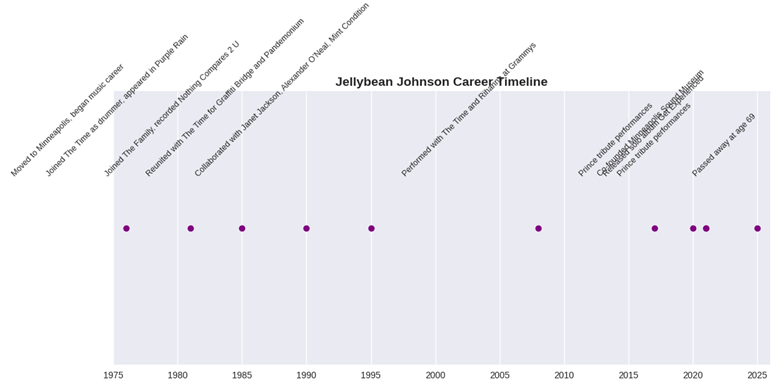
Visual Timeline of His Career

Here’s a timeline chart capturing his milestones from 1976 to 2025:

Preserving the Minneapolis Sound

Johnson’s vision extended beyond performance. In 2021, he co-founded the Minneapolis Sound Museum, dedicated to preserving the history and cultural impact of the genre he helped pioneer Bring Me The News. His final reflections on legacy emphasized community, mentorship, and ensuring future generations had access to creative spaces like those that shaped him North News Bring Me The News.

Tributes

Musicians and fans alike have poured out tributes. Morris Day called him “more like a brother than a bandmate,” while Sheila E. remembered him as “a kind human being, extremely talented and funny.” Susannah Melvoin described him as “the master of loving you like no brother could” Rolling Stone Yahoo International Business Times UK.

Closing Thoughts

Jellybean Johnson’s artistry was not confined to the stage—it was embedded in the DNA of modern pop and R&B. His drumming, guitar work, and production shaped hits across decades, while his mentorship and museum project ensured the Minneapolis Sound will live on.

Credit: This blog post is based on reporting by Daniel Bird and expanded with details from Rolling Stone, Billboard, Fox9, and other sources Rolling Stone FOX 9 Minneapolis-St. Paul Yahoo Billboard Wikipedia Bring Me The News Discogs.

A Sheriff with a Mission: The Story of Charlotte’s Unyielding Protector

*This piece is inspired by the original reporting of Lauren Mascarenhas for CNN.*

In a time when the debate over immigration and law enforcement remains as heated as ever, one figure stands out in the community of Charlotte, North Carolina. Sheriff Garry McFadden, a former homicide detective and a recognizable face from the television screen, is not just any sheriff; he is a guardian aiming to protect his citizens while navigating the complexities of immigration enforcement.

A Robust Background

Garry McFadden’s journey to becoming a sheriff is one marked by resilience and dedication. Before stepping into his role as the sheriff, McFadden served as a homicide detective for over 20 years. This experience armed him with a deep understanding of criminal justice, empathy for victims, and an eye for the broader implications of crime in society. His work in law enforcement was complemented by his appearances on the A&E network’s “The First 48,” where he showcased his investigative skills and humanity as he handled sensitive cases.

This unique combination of experience behind the badge and in front of the camera has endeared McFadden to citizens and given him a platform to address issues affecting the community. His tenure in law enforcement has shaped his perspective, particularly towards the immigrant population.

Standing Firm Against ICE

Sheriff McFadden has made headlines for his staunch opposition to the practices of U.S. Immigration and Customs Enforcement (ICE). His approach centers around the belief that local law enforcement should not act as an extension of federal immigration authorities. This stance is not merely a political statement; it is a reflection of his commitment to protecting all citizens, regardless of their immigration status. He understands that fear of deportation can prevent crime victims and witnesses from coming forward, ultimately putting the entire community at risk.

McFadden’s advocacy extends beyond rhetoric; he actively seeks to build bridges between the sheriff’s department and marginalized communities. He often emphasizes the importance of community trust in law enforcement. By not cooperating with ICE on low-level offenses, he aims to nurture an environment where all residents feel safe reporting crimes.

A Community Focus

The strength of Sheriff McFadden lies not only in his dedication to fair policing but also in his community involvement. He frequently attends local events, engages with residents, and tackles various issues affecting Charlotte’s neighborhoods. From youth mentorship programs to initiatives aimed at curbing domestic violence, McFadden’s leadership goes beyond traditional law enforcement.

His command is marked by transparency, as he is unafraid to discuss the complexities of policing in public forums. He listens to constituents’ concerns, making residents feel heard and valued, thereby strengthening the ties between citizens and their sheriff’s office.

Embracing A New Era of Leadership

Sheriff Garry McFadden’s approach to leadership represents a new era in law enforcement where community protection and civil rights intersect. By standing firm against ICE, he not only protects vulnerable populations but also fosters a culture of inclusivity and trust. In a world often divided by policy and opinion, McFadden stands as an emblem of a law enforcement official who is not just about enforcing the law but about serving the community.

With a commitment to transparency and community engagement, McFadden continues to impact Charlotte positively. His background as a detective, his experience in the spotlight, and his unwavering dedication to protecting all citizens have come together to form a sheriff who embodies strength, compassion, and resolve.

As we witness the evolving landscape of immigration enforcement and community relations, Sheriff McFadden serves as an inspiring example of how one individual’s leadership can make a profound difference.

17 Shots in the Back, When Will Justice Come?

Credit: Original reporting by Joe Walker (@joewalkr, The Independent)

Atlanta rapper B Green, born Linton Blackwell, was shot and killed on October 11th outside Five Paces Inn in Buckhead. The autopsy revealed a chilling truth: he was shot 17 times in the back by off-duty police officer Gerald Walker, who was working security at the bar.

Police claim Walker was responding to reports of a “disruptive person.” They allege that Green attempted to re-enter the bar through a rear entrance and later placed an item in the small of his back. Commands were issued “in reference to a gun,” and moments later, Green was gunned down. Investigators later found a firearm, but the autopsy makes clear: every single bullet entered his back.

Green’s manager and friend, Timothy Coleman, expressed disbelief: “I just couldn’t believe it was 17 times in the back. There’s not one shot in the front. If he wasn’t pointing a gun at you or doing anything, what does that have to do with shooting him in the back 17 times? That means he wasn’t facing you. He wasn’t a threat.”

Green was a father of twin girls, a family man, and an artist who left behind a legacy, including his final album PTSD: Vietnam Vet released in 2020.

The Larger Issue

This is not just about one man. This is about a system that continues to allow police officers, sworn to protect, to kill Black men with impunity.

  • Seventeen shots in the back is not self-defense. It is execution.
  • When officers fire this many times, it reveals not fear, but intent.
  • The justice system has repeatedly failed to hold officers accountable, creating what feels like a license to kill.

And what makes this even more painful is the reality that Black officers, too, have participated in this cycle of violence against their own communities. The badge, in too many cases, has become a shield for abuse rather than a symbol of protection.

The Questions We Must Confront

  • What will make a person shoot another human being 17 times in the back?
  • How can the justice system continue to justify these killings?
  • Why are Black men still being killed, while the officers responsible walk free?
  • When will police departments stop operating like mafia hit squads, taking lives whenever they feel like it?

A Call for Accountability

It is long past time to demand change. Calls to “defund” are not about chaos, they are about redirecting resources away from militarized policing and toward community safety, mental health, education, and opportunity.

Every time another Black man is killed, we are reminded that reform alone is not enough. Accountability must be real. Justice must be enforced. And communities must be empowered to protect themselves from the very institutions that claim to serve them.

Timeline of Police Killings of Black Men (2014–2025)

2014 – Michael Brown (Ferguson, Missouri)

  • Shot and killed by Officer Darren Wilson.
  • His death sparked nationwide protests and helped ignite the Black Lives Matter movement Statista.

2015 – Walter Scott (North Charleston, South Carolina)

  • Shot five times in the back while fleeing a traffic stop.
  • Officer Michael Slager was eventually sentenced to 20 years in prison CBC.

2016 – Alton Sterling (Baton Rouge, Louisiana)

  • Shot outside a convenience store while pinned to the ground.
  • Federal prosecutors declined to charge the officers involved CBC.

2016 – Philando Castile (Falcon Heights, Minnesota)

  • Shot during a traffic stop after informing the officer he was legally carrying a firearm.
  • The aftermath was streamed live on Facebook by his girlfriend. Officer Jeronimo Yanez was acquitted CBC.

2016 – Terence Crutcher (Tulsa, Oklahoma)

  • Shot while his hands were raised near his stalled vehicle.
  • Officer Betty Shelby was acquitted of manslaughter CBC.

2020 – George Floyd (Minneapolis, Minnesota)

  • Murdered when Officer Derek Chauvin knelt on his neck for over nine minutes.
  • His death sparked global protests against police brutality Wikipedia.

2020 – Rayshard Brooks (Atlanta, Georgia)

  • Shot in the back by police after being found asleep in his car at a Wendy’s drive-thru.
  • His killing reignited protests in Atlanta Wikipedia.

2022 – Patrick Lyoya (Grand Rapids, Michigan)

  • Shot in the back of the head during a traffic stop.
  • Officer Christopher Schurr was charged with second-degree murder Wikipedia.

2025 – Linton “B Green” Blackwell (Atlanta, Georgia)

  • Shot 17 times in the back by off-duty officer Gerald Walker outside Five Paces Inn.
  • His autopsy confirmed no shots to the front, raising questions of execution rather than defense mappingpoliceviolence.us.

https://www.statista.com/statistics/585152/people-shot-to-death-by-us-police-by-race/

https://www.cbc.ca/news/world/list-police-related-deaths-usa-1.4438618

https://mappingpoliceviolence.us/

What This Timeline Shows

  • Pattern of excessive force: From Ferguson to Atlanta, Black men are disproportionately killed by police.
  • Lack of accountability: Many officers are acquitted or never charged, reinforcing systemic impunity.
  • Escalation of violence: Shooting someone 17 times in the back, as in B Green’s case, is not policing — it is execution.
  • Community impact: Each killing leaves families devastated and communities traumatized, fueling mistrust of law enforcement.

Closing Thought

This timeline makes clear: B Green’s killing is not an isolated tragedy. It is part of a decades-long crisis of police violence against Black men. Until accountability is real and systemic change is enforced, these killings will continue.

Sources: Wikipedia CBC Statista mappingpoliceviolence.us

Closing Thought

B Green’s death is not just a tragedy, it is a symptom of a system that continues to devalue Black lives. Seventeen shots in the back is not policing. It is murder.

The question remains: When will justice finally come?