When Moderates Break Ranks: Shutdown Politics and the Eight Senators Who Crossed the Aisle

Shutdown Politics: Eight Senators, One Decision, and the Fallout for Millions

On November 10th, 2025, history was written in the most painful way. Eight Democratic-aligned senators broke ranks, joined Republicans, and ended a 40-day government shutdown, but in doing so, they may have jeopardized healthcare for more than 60 million Americans. For weeks, people believed Democrats were fighting for them, holding the line until the Midterms. Instead, what unfolded was a compromise that restored paychecks and food assistance but sacrificed the Affordable Care Act subsidies that millions depend on. This post lays out the facts, the charts, the history, and the names, so you can see for yourself, make your own assessment, and decide what this moment means for our future.

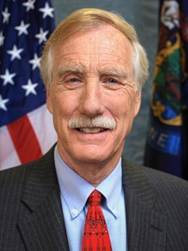
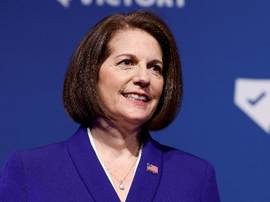
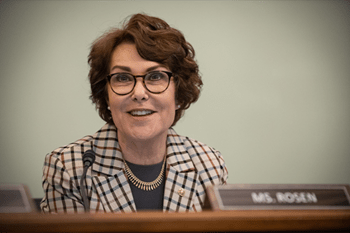
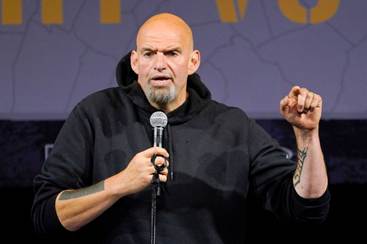
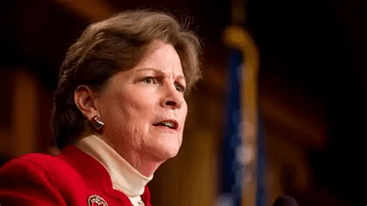
The 8 Democratic Senators that Defected and caused Millions to lose Healthcare:
The Context

In November 2025, eight Democratic-aligned senators joined Republicans to end a 40-day government shutdown. Their decision reopened government services, restored pay for federal workers, and ensured SNAP food assistance continued, but it came at the cost of losing guaranteed leverage on Affordable Care Act (ACA) subsidies.

Context of the Vote

  • The Senate voted 60–40 to advance a short-term funding bill that reopened the government through January 30, 2026.
  • The compromise included full funding for SNAP food assistance, reversal of federal worker layoffs, and back pay for affected employees.
  • However, it did not guarantee an extension of Affordable Care Act (ACA) subsidies, which had been a major demand of Democratic leadership.

Who They Were

SenatorStateJustificationPolitical Reaction
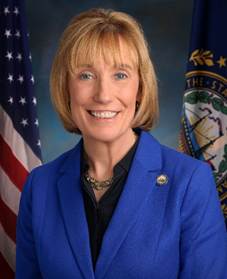
Jeanne ShaheenNHUrgency of reopening services; pragmatic choiceProgressives criticized; Republicans praised
Maggie HassanNHEconomic disruption in NH; compromise to protect jobsModerate pragmatism; progressive backlash
Catherine Cortez MastoNVProtecting SNAP recipients and familiesLocal praise; national criticism
Jacky RosenNVFamilies shouldn’t be collateral damageModerate approval; progressive disappointment
Dick DurbinILImperfect deal but reopening was prioritySeen as statesmanlike exit
John FettermanPA“Stop playing games with paychecks”Worker focus respected, but seen as cave-in
Tim KaineVAShutdown devastating for federal workforceConstituents relieved; progressives frustrated
Angus King (I)MEShutdown “senseless”; pragmatism over leverageConsistent with independent brand
SenatorStatus 2026Outlook
ShaheenRetiringLegacy-driven pragmatism
HassanVulnerablePurple-state risk
Cortez MastoSafe until 2028No immediate risk
RosenVulnerableNevada swing state
DurbinRetiringStatesmanlike exit
FettermanSafe until 2028Worker-first shield
KaineVulnerableFederal workforce priority
KingVulnerableIndependent pragmatism

Here’s a breakdown of the eight senators:

  • Jeanne Shaheen (D-NH) – Retiring; helped lead negotiations.
  • Maggie Hassan (D-NH) – Former governor, moderate voice.
  • Catherine Cortez Masto (D-NV) – Consistently opposed shutdowns, emphasized working families.
  • Jacky Rosen (D-NV) – Moderate Democrat, joined compromise.
  • Dick Durbin (D-IL) – Senate Democratic Whip, announced retirement in 2026.
  • John Fetterman (D-PA) – Vocal about ending shutdown harm to workers.
  • Tim Kaine (D-VA) – Stressed SNAP funding and guaranteed vote on ACA subsidies.
  • Angus King (I-ME) – Independent caucusing with Democrats, pragmatic stance.

Why They Did It

  • Motivation: To stop the harm caused by the shutdown, unpaid federal workers, SNAP recipients at risk, and disruptions to air travel and public services.
  • Concession: They accepted only a promise of a future vote on ACA subsidies, not a guaranteed extension.
  • Political Positioning: Most of these senators are moderates, former governors, or retiring, meaning they faced less electoral pressure in 2026.

Reaction

  • Democratic Leadership: Criticized the move as a betrayal of leverage on health care subsidies.
  • Progressives: Figures like Sen. Bernie Sanders and Rep. Ro Khanna condemned the vote as “pathetic” and called for stronger resistance.
  • Republicans: Praised the defectors for “putting principle over politics”.

Sources:

NBC News

Senate passes bill to reopen the government as 8 Democrats join with Republicans to send it to the House

 Individual Justifications

  • Jeanne Shaheen (NH) – Emphasized the urgency of reopening government services for families and federal workers in New Hampshire. She framed it as a pragmatic choice to stop harm immediately.
  • Maggie Hassan (NH) – Pointed to the economic disruption in her state, especially for airports and federal contractors. She argued that compromise was necessary to protect jobs.
  • Catherine Cortez Masto (NV) – Highlighted the impact on working families and SNAP recipients in Nevada. She said ending the shutdown was about “keeping food on the table.”
  • Jacky Rosen (NV) – Echoed Masto’s concerns, stressing that families shouldn’t be collateral damage in partisan fights.
  • Dick Durbin (IL) – As Democratic Whip, he acknowledged the deal was imperfect but insisted that reopening government was the priority. He noted his retirement gave him freedom to act pragmatically.
  • John Fetterman (PA) – Spoke bluntly about the harm to federal workers and the need to “stop playing games with people’s paychecks.” He wanted to end the pain quickly.
  • Tim Kaine (VA) – Representing a state with a huge federal workforce, he argued that the shutdown was devastating for Virginians. He accepted the promise of a future ACA subsidy vote as a workable compromise.
  • Angus King (ME, Independent) – True to his independent streak, he said the shutdown was “senseless” and that ending it was more important than partisan leverage.

Common Themes

  • Immediate harm prevention: All eight cited the damage to federal workers, SNAP recipients, and public services.
  • Pragmatism over leverage: They accepted a weaker deal (no guaranteed ACA subsidy extension) in exchange for reopening government.
  • Moderate/independent positioning: Most are moderates, former governors, or retiring  less bound by progressive pressure.

Political Fallout

  • Progressives blasted them for giving up leverage, calling it a “pathetic cave-in.”
  • Republicans praised them for “putting country over party.”

Leadership tension: Their votes exposed a rift between pragmatists and progressives

SenatorStateJustification for VotePolitical Reaction
Jeanne ShaheenNHUrgency of reopening services for families and federal workers; pragmatic choiceProgressives criticized as surrender; Republicans praised pragmatism
Maggie HassanNHEconomic disruption in NH (airports, contractors); compromise needed to protect jobsSeen as moderate pragmatism; backlash from progressive activists
Catherine Cortez MastoNVProtecting SNAP recipients and working families; “keeping food on the table”Praised locally for family focus; criticized nationally for weakening leverage
Jacky RosenNVFamilies shouldn’t be collateral damage in partisan fightsSimilar to Masto; moderate approval, progressive disappointment
Dick DurbinILImperfect deal but reopening government was priority; retirement gave freedomLeadership tension noted; Republicans welcomed his pragmatism
John FettermanPAFederal workers’ paychecks at risk; blunt call to “stop playing games”Progressives split (some respected his worker focus, others saw cave-in)
Tim KaineVAShutdown devastating for federal workforce in VA; accepted promise of ACA voteConstituents appreciated relief; progressives saw weak bargaining
Angus King (I)MEShutdown “senseless”; ending it more important than partisan leverageConsistent with independent streak; Republicans praised, progressives frustrated

Key Takeaways

  • Shared Theme: All eight emphasized immediate harm prevention (workers, SNAP, public services).
  • Political Positioning: Moderates, independents, or retiring senators less bound by progressive pressure.
  • Fallout: Progressives condemned the move as weakening leverage; Republicans praised it as bipartisan pragmatism.

Here’s a 2026 electoral outlook table for the eight senators who broke ranks, showing whether they’re retiring, safe, or vulnerable in reelection:

SenatorStateStatus for 2026Electoral Outlook
Jeanne ShaheenNHRetiringNo reelection pressure; vote seen as legacy-driven pragmatism
Maggie HassanNHUp for reelectionNH is purple; could face GOP challenge, but incumbency helps. Vulnerable if progressives stay cold
Catherine Cortez MastoNVNot up until 2028Safe for now; Nevada is swingy, but no immediate electoral risk
Jacky RosenNVUp for reelectionVulnerable; Nevada is competitive. Her pragmatism may appeal to moderates but risks progressive backlash
Dick DurbinILRetiring in 2026No reelection pressure; vote framed as statesmanlike exit
John FettermanPANot up until 2028Safe for now; Pennsylvania is swingy, but his blunt worker-first justification shields him
Tim KaineVAUp for reelectionVirginia leans blue but has large federal workforce; his vote may resonate locally. Moderate vulnerability
Angus King (I)MEUp for reelectionIndependent brand helps; Maine voters value pragmatism. Moderate but not high vulnerability

Key Insights

  • Retiring Senators (Shaheen, Durbin): Free to vote pragmatically without electoral consequences.
  • Safe Senators (Cortez Masto, Fetterman): Not facing voters until 2028, so little immediate risk.
  • Vulnerable Senators (Hassan, Rosen, Kaine, King): Facing reelection in 2026. Their votes could be framed as bipartisan pragmatism or as betrayal, depending on the narrative in their states.

Political Calculus

  • Moderates in swing states (Hassan, Rosen, Kaine, King) likely judged that ending the shutdown would resonate with independents and moderates, even if progressives were upset.
  • Retirees (Shaheen, Durbin) acted with legacy in mind, prioritizing governance over party leverage.
  • Safe-term senators (Cortez Masto, Fetterman) could afford to take the hit, betting that the immediate worker relief would outweigh progressive anger by 2028.

This shows how electoral timing shaped their willingness to break ranks. Those not facing voters soon or retiring had more freedom, while those up in 2026 took calculated risks.

political identities alongside electoral timing so you can see how ideology + reelection pressure shaped their decisions:

SenatorStateIdeological Identity2026 StatusHow Identity + Timing Shaped Vote
Jeanne ShaheenNHModerate Democrat, pragmatic dealmakerRetiringFree to act pragmatically without electoral risk; legacy-driven choice
Maggie HassanNHCentrist, former governor, consensus-builderUp for reelectionPurple-state vulnerability pushed her toward bipartisan pragmatism to appeal to independents
Catherine Cortez MastoNVModerate liberal, strong on family/economic issuesSafe until 2028Could afford to prioritize immediate harm prevention without fear of electoral backlash
Jacky RosenNVCentrist, business-friendly DemocratUp for reelectionNevada swing state forced her to balance progressive anger with moderate appeal
Dick DurbinILEstablishment Democrat, leadership figureRetiringLegacy vote; framed as statesmanlike pragmatism, no reelection pressure
John FettermanPAPopulist-progressive style, blunt worker-first messagingSafe until 2028His worker-centered justification shielded him from progressive anger despite breaking ranks
Tim KaineVAModerate Democrat, pragmatic, federal workforce advocateUp for reelectionVirginia’s large federal workforce made ending shutdown a local priority; moderate positioning helped
Angus King (I)MEIndependent centrist, pragmatic problem-solverUp for reelectionMaine voters value independence; his brand made bipartisan pragmatism consistent with identity

Patterns

  • Moderates & centrists (Hassan, Rosen, Kaine, King): Their votes aligned with their brand of pragmatism, but electoral timing made them more vulnerable to progressive backlash.
  • Retirees (Shaheen, Durbin): Legacy-driven, free to act without electoral consequences.
  • Safe-term senators (Cortez Masto, Fetterman): Could afford to take the hit, betting that worker/family justification would resonate long-term.

Big Picture

This wasn’t just about ending the shutdown, it was a collision of ideology and timing:

  • Moderates leaned into pragmatism to appeal to swing voters.
  • Progressives saw it as surrender.
  • Retirees and safe-term senators had freedom to prioritize governance over leverage.

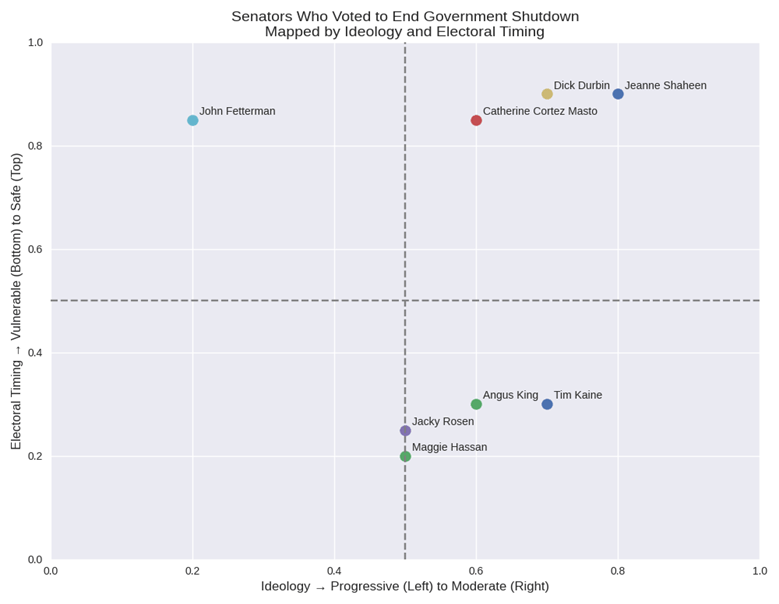
quadrant chart maps the eight senators by ideology (Progressive ↔ Moderate) and electoral timing (Safe ↔ Vulnerable).
How to Read the Chart

  • Horizontal Axis (Ideology): Progressive voices are on the left, moderates on the right.
  • Vertical Axis (Electoral Timing): Senators safe from reelection pressure are toward the top, while those vulnerable in 2026 are toward the bottom.

Key Observations

  • Safe Progressives: John Fetterman sits in the upper-left quadrant — progressive style, but safe until 2028.
  • Safe Moderates: Shaheen and Durbin (both retiring) plus Cortez Masto (safe until 2028) cluster in the upper-right quadrant. They had freedom to act pragmatically.
  • Vulnerable Moderates: Hassan, Rosen, Kaine, and King fall into the lower-right quadrant. Their centrist identities plus reelection pressure pushed them toward compromise, but they risk progressive backlash.

Big Picture

This visualization shows the collision of ideology and timing:

  • Retirees and safe-term senators had freedom to prioritize governance.
  • Vulnerable moderates leaned into pragmatism to appeal to swing voters, even at the cost of party unity.
  • Progressives safe from reelection could afford to take risks without immediate electoral consequences.

quadrant chart visualization it maps the eight senators by Ideology (Progressive ↔ Moderate) and Electoral Timing (Safe ↔ Vulnerable).

Quadrant Chart: Senators by Ideology & Timing

QuadrantSenatorsWhy They’re Here
Safe + ProgressiveJohn Fetterman (PA)Populist-progressive style, safe until 2028. His worker-first justification shields him from backlash.
Safe + ModerateJeanne Shaheen (NH), Dick Durbin (IL), Catherine Cortez Masto (NV)Retirees (Shaheen, Durbin) free to act pragmatically; Cortez Masto safe until 2028, moderate liberal.
Vulnerable + ModerateMaggie Hassan (NH), Jacky Rosen (NV), Tim Kaine (VA), Angus King (ME, I)Facing reelection in 2026. Centrist identities pushed them toward compromise, but risked progressive backlash.
Vulnerable + Progressive(None)No progressive senators broke ranks; only moderates and independents did.

Insights

  • Retirees & Safe-term senators had freedom to prioritize governance over leverage.
  • Vulnerable moderates leaned into pragmatism to appeal to swing voters, even at the cost of party unity.
  • Progressives safe from reelection (Fetterman) could afford to take risks without immediate electoral consequences.

 historical comparison: moderates breaking ranks in shutdown votes has been a recurring theme, in 2013, 2018, and now 2025.

Historical Parallels

2013 Shutdown (Affordable Care Act fight)

  • Context: Republicans demanded defunding of the ACA; Democrats resisted.
  • Defections: A handful of moderate Democrats signaled willingness to negotiate, though most stayed unified.
  • Pattern: Even then, moderates in purple states emphasized ending harm to workers and families over holding firm on leverage.

2018 Shutdown (Immigration/DACA fight)

  • Context: The shutdown centered on immigration and DACA protections.
  • Defections: Several centrist Democrats joined Republicans to reopen government after just three days.
  • Justification: They argued that prolonged shutdowns hurt federal workers and services, and promised to fight immigration battles separately.
  • Reaction: Progressives accused them of “caving” and weakening bargaining power.

2025 Shutdown (ACA subsidies fight)

  • Context: Democrats demanded extension of ACA subsidies; Republicans resisted.
  • Defections: Eight Democratic-aligned senators (Shaheen, Hassan, Cortez Masto, Rosen, Durbin, Fetterman, Kaine, King) broke ranks to end the 40-day shutdown.
  • Justification: Immediate harm prevention (SNAP, federal workers, air travel).
  • Reaction: Progressives furious, Republicans praised them as pragmatic.

Big Picture

Across 2013, 2018, and 2025, the same pattern repeats:

  • Moderates in swing states or retiring senators are most likely to defect.
  • Justification is always pragmatic: ending harm to workers, families, and services.
  • Progressive backlash is consistent: defectors are accused of weakening leverage.
  • Republican praise is consistent: defectors are hailed as bipartisan problem-solvers.

Why This Matters

  • Shutdowns create immediate pain (workers unpaid, SNAP disrupted, air travel chaos).
  • Moderates calculate that voters will reward them for ending pain quickly, even if their party base is angry.
  • Progressives calculate that leverage is lost once defectors break ranks, weakening long-term bargaining power.

chart these three shutdowns side-by-side in a timeline graphic, showing the issue, defectors, and fallout

Sources:

Fox News

Eight Senate Democrats break ranks with party leadership to end historic government shutdown

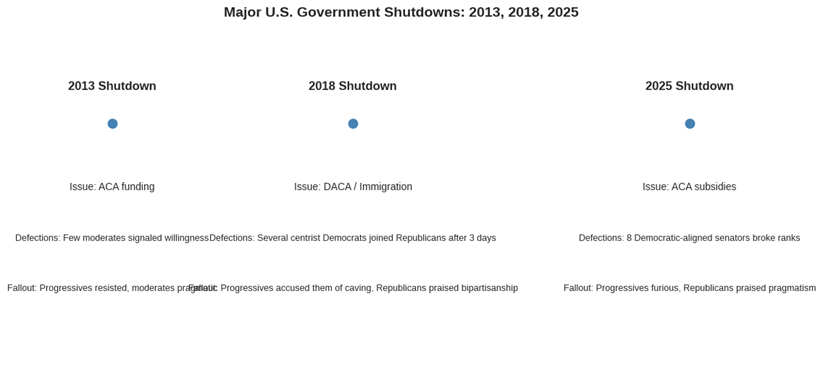
 visualization comparing the 2013, 2018, and 2025 shutdowns — showing the issues, defections, and fallout.
Timeline Highlights

  • 2013 Shutdown (ACA funding):
    • Issue: Republicans demanded ACA defunding.
    • Defections: A few moderates signaled willingness to negotiate.
    • Fallout: Progressives resisted; moderates framed as pragmatic.
  • 2018 Shutdown (DACA/Immigration):
    • Issue: Immigration and DACA protections.
    • Defections: Several centrist Democrats joined Republicans after 3 days.
    • Fallout: Progressives accused them of caving; Republicans praised bipartisanship.
  • 2025 Shutdown (ACA subsidies):
    • Issue: Extension of ACA subsidies.
    • Defections: Eight Democratic-aligned senators broke ranks.
    • Fallout: Progressives furious; Republicans praised pragmatism.

Big Picture

This timeline shows a recurring pattern:

  • Moderates under electoral pressure or with freedom (retiring/safe) consistently defect to end shutdowns.
  • Progressives condemn these moves as weakening leverage.
  • Republicans consistently praise defectors as bipartisan problem-solvers.

Timeline of Democratic Defections in Shutdowns

YearIssue at StakeDemocratic DefectionsPolitical Fallout
2013Funding for the Affordable Care Act (ACA)A few moderates signaled willingness to negotiate, though most stayed unifiedProgressives resisted compromise; moderates framed as pragmatic voices
2018Immigration & DACA protectionsSeveral centrist Democrats joined Republicans after 3 days to reopen governmentProgressives accused them of “caving”; Republicans praised bipartisanship
2025Extension of ACA subsidiesEight Democratic-aligned senators (Shaheen, Hassan, Cortez Masto, Rosen, Durbin, Fetterman, Kaine, King) broke ranksProgressives furious at loss of leverage; Republicans praised pragmatism

Patterns Across Eras

  • Moderates under pressure consistently defect to end shutdowns.
  • Justification repeats: ending harm to workers, families, and services.
  • Fallout is consistent: progressives condemn, Republicans praise.
  • Retirees or safe-term senators have freedom to act pragmatically.

Forward-Looking Projection

Based on these parallels, Democratic leadership may:

  • Tighten discipline in future shutdowns, trying to prevent defections by offering stronger internal incentives.
  • Accept defections as inevitable, focusing instead on shaping the narrative so moderates are seen as protecting families rather than weakening leverage.
  • Strategically plan messaging so progressives maintain pressure while moderates provide cover for ending shutdown harm.

Strategic Playbook for Shutdown Politics (For Democrats)

1. Pre‑Shutdown Discipline

  • Unified Messaging: Leadership should set clear red lines early (e.g., ACA subsidies, DACA, SNAP) so moderates know the stakes.
  • Whip Team Engagement: Assign senior figures (like the Whip or retiring senators) to privately reassure moderates that their concerns will be addressed.
  • Constituent Framing: Provide moderates with talking points that emphasize protecting families and workers while still holding firm on leverage.

2. During the Shutdown

  • Dual Track Strategy:
    • Progressives: Apply maximum pressure, frame the fight as moral and urgent.
    • Moderates: Emphasize harm prevention, but stay aligned with leadership until a compromise is truly necessary.
  • Visible Unity: Publicly, Democrats should appear unified. Internal debates should be kept behind closed doors to avoid signaling weakness.
  • Targeted Relief Messaging: Highlight the real-world impact (workers unpaid, SNAP disruption, air travel chaos) to build public support for ending the shutdown on Democratic terms.

3. Managing Defections

  • Controlled Breaks: If moderates defect, leadership should frame it as part of a broader strategy rather than betrayal.
  • Narrative Control: Position defectors as “protecting families” rather than “weakening leverage.”
  • Progressive Counterbalance: Progressives should continue pushing for long-term gains, ensuring the party base sees resistance even if moderates compromise.

4. Post‑Shutdown Strategy

  • Leverage Wins: Even if concessions are lost, highlight what was gained (worker pay restored, SNAP funded).
  • Promise Future Fights: Assure progressives that unresolved issues (like ACA subsidies) will be revisited in standalone legislation.
  • Electoral Shielding: Provide vulnerable moderates with campaign support to protect them from GOP attacks and progressive primary challenges.

Big Picture

This playbook balances progressive leverage (to keep pressure on Republicans) with moderate pragmatism (to end harm quickly). The key is framing defections as family-first pragmatism while ensuring progressives maintain momentum for long-term goals.

Your Turn

So what do you think?

  • Were these senators protecting families or weakening leverage?
  • Should Democrats tighten discipline next time, or accept defections as inevitable?
  • How should progressives and moderates balance each other in future fights?

Drop your thoughts in the comments. Let’s make this a conversation.
California’s Proposition 50: Redistricting as a Defense of Democracy

By Charles Zackary King
Source: Reporting from The Associated Press

Why Proposition 50 Matters

On Election Day 2025, California voters approved Proposition 50, a measure that redraws congressional district boundaries in favor of Democrats. This wasn’t just about maps, it was about the future of American democracy.

The measure gives Democrats a chance to win as many as five additional House seats in 2026, directly countering Republican-led gerrymandering efforts in Texas. With Republicans currently holding a slim majority (219–213), those seats could determine control of the U.S. House, and with it, the ability to advance or block President Donald Trump’s agenda.

The Reason and the Why

Redistricting is often seen as a technical process, but in reality, it’s about power and representation. Texas Republicans, at Trump’s urging, moved to redraw their maps to secure five new GOP seats. California’s Proposition 50 was a direct response, a way to blunt that move and ensure Democrats remain competitive in the fight for the House.

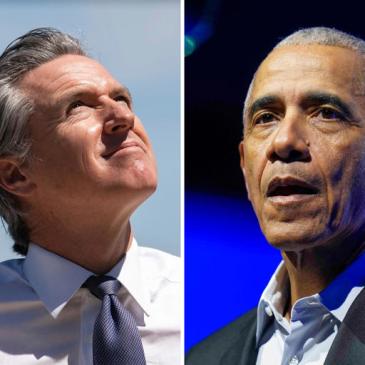
Governor Gavin Newsom framed the measure as essential to saving democracy. He argued that without action, Trump and his allies would continue to manipulate electoral maps to entrench their power. Newsom’s words were clear: “If Democrats win the House majority, they can end Donald Trump’s presidency as we know it. It is all on the line, a bright line, in 2026.”

The Who

  • Governor Gavin Newsom spearheaded the campaign, throwing the full weight of his political operation behind it. His leadership made the measure possible, and his success here is seen as a test of his national viability ahead of a potential 2028 presidential run.
  • Former President Barack Obama lent his voice, urging Californians to stop Republicans “in their tracks” and warning against unchecked power.
  • California voters themselves made the decisive choice, approving the measure despite criticism that it undermines the independent commission created in 2008.

Critics like former Governor Arnold Schwarzenegger argued that fighting Trump by adopting partisan maps “takes the power away from the people.” But supporters countered that failing to act would allow Trump and GOP-led states to rig the system unchecked.

Why This Was Possible

California is deeply blue, with strong Democratic infrastructure and voter turnout. Opponents of Proposition 50 struggled to raise money in one of the nation’s most expensive media markets, leaving Newsom and his allies to dominate the airwaves. Republican congressmen whose districts will be reshaped largely stayed silent, further weakening opposition.

The result was a lopsided campaign that foreshadowed the vote: a decisive victory for Democrats and a symbolic rejection of Trump’s attempts to manipulate democracy.

Saving Democracy

Proposition 50 is more than a state-level measure. It represents a broader national rejection of Trumpism and a commitment to protecting democratic institutions. Newsom appears to be one of the few governors willing to take bold, structural action to stop Trump from bending the rules to his advantage.

This fight is not over. The 2026 midterms will determine whether Democrats can seize control of the House and block Trump’s agenda. California’s move shows that when leaders act decisively, and when voters recognize the stakes, democracy can be defended.

Call to Action

This is a moment for reflection and action. Are we ready to defend democracy from manipulation? Are we ready to support leaders who take bold steps to protect fairness and representation?

 Subscribe to the blog for updates.
 Comment below to share your perspective.
 Let it be known: America can and will come together when people think, organize, and vote.

The Blue Wave is rising. Let’s make sure it carries us into 2026 and beyond.

Timeline Concept: Defending Democracy

Stage 1: Texas Redraw (2025)
Republicans, at Trump’s urging, redraw maps to secure 5 new GOP seats.
Theme: Manipulation of democracy.

Stage 2: California Response (2025)
Voters approve Proposition 50, giving Democrats a chance to win 5 seats.
Theme: Counteraction, protecting representation.

Stage 3: 2026 Midterms
Control of the U.S. House is on the line.
Theme: Choice between democracy and authoritarianism.

Stage 4: House Control
Democrats can seize majority, block Trump’s agenda, and restore balance.
Theme: Power shifts toward accountability.

Stage 5: Democracy at Stake
The fight is bigger than maps — it’s about saving democracy itself.
Theme: The Blue Wave rising.

Zohran Mamdani, BDS, and the Fight for Accountability

By Charles Zackary King
Source: Reporting by Gabriel Hays, Fox News

Mamdani’s Stand on BDS

In a recent interview on MSNBC’s Morning Joe, New York City mayor-elect Zohran Mamdani defended his support for the Boycott, Divestment, and Sanctions (BDS) movement. Mamdani explained that his support is rooted in the belief that BDS is a non-violent way to pressure Israel to comply with international law.

“I support BDS because this is a movement that is looking for that kind of compliance. We haven’t seen it,” Mamdani said.

When asked how he could reconcile his support for BDS with his promise to represent Jewish New Yorkers, Mamdani clarified: “Critiques of the state of Israel are critiques of a government, as opposed to critiques of a people and of a faith. My job is to represent every single New Yorker.”

The Debate Over Accountability

Jewish leaders in New York, including Rabbi Elliot Cosgrove of Park Avenue Synagogue, have expressed concern that Mamdani’s positions pose a threat to the city’s Jewish community. His opponents, Andrew Cuomo and Curtis Sliwa, echoed those concerns during the campaign.

But Mamdani’s supporters argue that his stance is about holding governments accountable, not targeting communities. They see his position as part of a broader call to end displacement, violence, and policies that perpetuate inequality.

This debate reflects a larger tension: communities want protection and safety, but there must also be space to question policies that contribute to suffering in places like Gaza. Mamdani’s insistence on representing all New Yorkers, regardless of their views on Israel and Palestine, is a reminder that leadership requires nuance, courage, and a commitment to fairness.

A Larger Context

The controversy surrounding Mamdani is not just about New York City politics. It’s about how America engages with global issues of justice, displacement, and human rights. Critics argue that U.S. support for Israeli policies has enabled ongoing harm in Gaza. Supporters of BDS see it as a way to demand accountability without violence.

Mamdani’s election signals that many New Yorkers are ready for leadership that challenges entrenched interests and gatekeepers. His open-minded approach is exactly what democracy needs: a willingness to confront uncomfortable truths while promising to serve every constituent.

Call to Action

This is a moment for reflection. Are we ready to hold governments accountable for displacement and violence? Are we ready to support leaders who promise to represent everyone — even when their positions challenge powerful interests?

 Subscribe to the blog for updates.
 Comment below to share your perspective.
 Let’s keep the conversation alive about justice, accountability, and democracy.

The Blue Wave Begins: Election Day 2025 as a Rebuke of Trump

By Charles Zackary King
Sources: Reporting by Caitlin Yilek, Joe Walsh, and Kathryn Watson for CBS News

Sources

  • Caitlin Yilek, Joe Walsh, Kathryn Watson, CBS News Election Day 2025 Coverage

A Night of Sweeping Democratic Victories

On November 5, 2025, voters across the country delivered a powerful message. Democrats swept four major races:

  • New York City Mayoral Race – Democratic socialist Zohran Mamdani defeated former governor Andrew Cuomo, who ran as an independent after losing the primary.
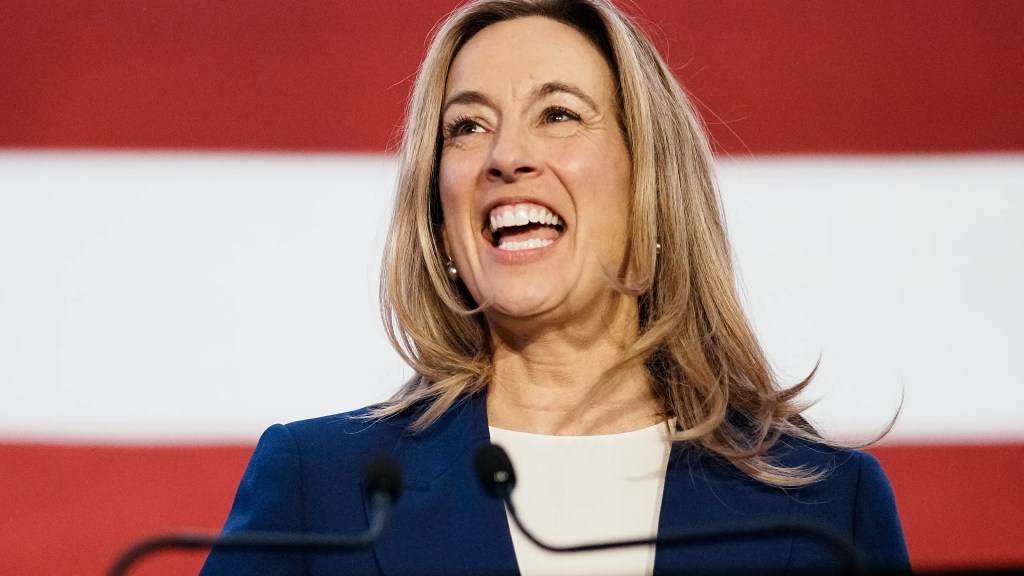
  • New Jersey Governor’s Race – Moderate Democrat Mikie Sherrill prevailed over Republican Jack Ciattarelli.
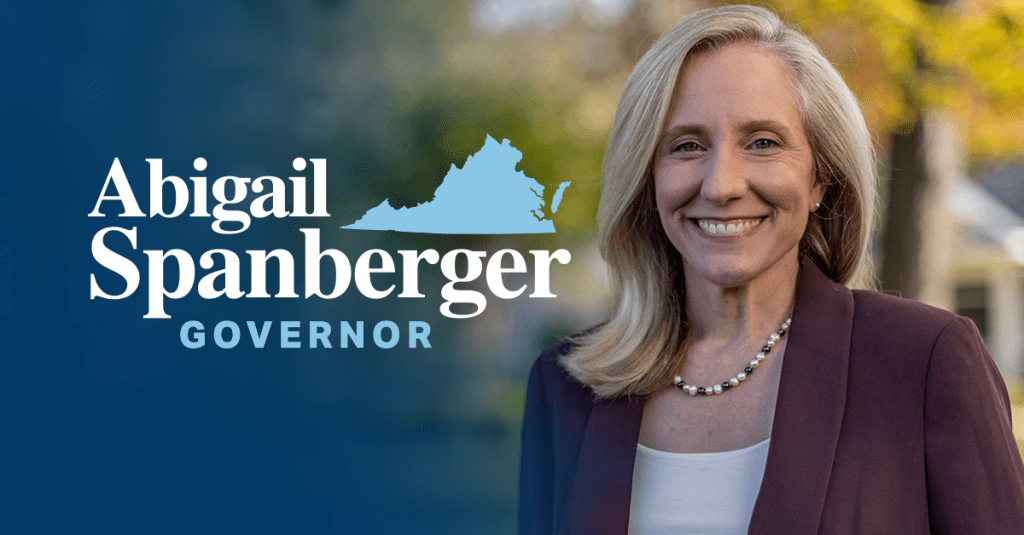
  • Virginia Governor’s Race – Moderate Democrat Abigail Spanberger defeated GOP candidate Winsome Earle-Sears.
  • California Proposition 50 – Voters approved a redistricting measure designed to counter GOP-led gerrymandering.

Exit polls revealed that voters were motivated by concerns about the economy and a broader discontent with the state of the nation. Yet beneath those concerns lay a deeper sentiment: a rejection of Donald Trump’s influence and his contribution to the erosion of democratic norms.

Trump’s Response: Defensiveness and Denial

In the aftermath, President Trump attempted to spin the losses. He told Fox News that Republicans “have to talk about” their successes, particularly on affordability and energy prices. He lamented Ciattarelli’s loss in New Jersey, noting that his endorsement “means a lot,” while distancing himself from Earle-Sears in Virginia.

Trump also lashed out at Mamdani, calling his victory speech “very angry” and warning that the new mayor should “be very nice to me.” He even suggested withholding federal funding from New York City, labeling Mamdani a “communist” despite his self-identification as a democratic socialist.

At the America Business Forum in Miami, Trump escalated his rhetoric, framing the 2026 midterms as a “choice between communism and common sense.” His words underscored the stark divide he seeks to create, one rooted in fear, division, and distortion.

What This Election Means

The victories of Sherrill, Spanberger, Mamdani, and the passage of Prop 50 represent more than just electoral wins. They symbolize a rebuke of Trumpism and a rejection of politics that “abandons the many and answers only to the few,” as Mamdani declared in his victory speech.

This moment is a reminder that when people think critically, organize, and vote, they can push back against the forces that strain our democracy. The results show that Americans are ready to rid themselves of the cancer that has weakened our institutions and divided our communities.

Historical Echoes

History teaches us that moments of democratic renewal often come after periods of deep division. Just as the Civil Rights Movement pushed back against segregation, and just as past waves of reform challenged corruption and inequality, Election Day 2025 signals a new chapter.

The parallels are clear: when citizens unite around shared values of justice, equity, and opportunity, they can overcome even the most entrenched forces of division. This election is not just about candidates, it is about reclaiming the soul of the nation.

The Coming Blue Wave

If Election Day 2025 is any indication, the Blue Wave is building momentum for the 2026 midterms. Voters are signaling that they want leaders who prioritize equity, justice, and opportunity, not fearmongering and authoritarianism.

This is a chance for the country to come together, to reflect on the damage done, and to chart a new path forward. The tide is turning, and the people are ready to save democracy from those who seek to dismantle it.

Call to Action

This blog is more than commentary; it’s a call to action. If you believe in saving our country, if you believe in democracy, equity, and justice, then join the conversation.

 Subscribe to the blog for updates.
 Comment below to share your thoughts.
 Let it be known: America can and will come together when people think, organize, and vote.

The Blue Wave is rising. Let’s make sure it carries us into 2026 and beyond.

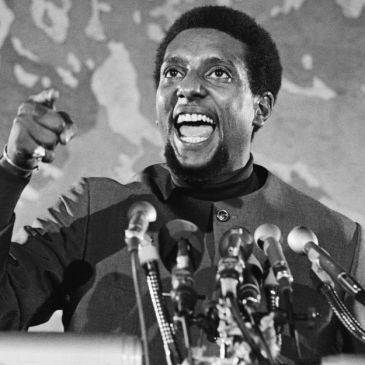
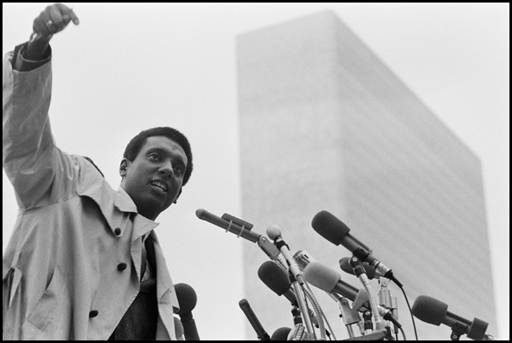
From Stokely to Kwame: The Revolutionary Journey of a Black Power Prophet

By Charles Zackary King
Changing Trends and Times | America in Black and White

In the story of Black liberation, few names echo with as much fire and clarity as Stokely Carmichael, later known as Kwame Ture. His life was a masterclass in transformation: from immigrant child to civil rights warrior, from SNCC chairman to global Pan-Africanist. His journey was not just political, it was spiritual, cultural, and unapologetically Black.

Origins: From Trinidad to the Bronx

Born June 29, 1941, in Port of Spain, Trinidad and Tobago, Stokely Standiford Churchill Carmichael immigrated to Harlem at age 11 to reunite with his parents. Raised by his grandmother and aunts, he arrived in the U.S. with sharp intellect and sharper instincts. He later attended the prestigious Bronx High School of Science, where he began questioning the racial and social structures around him.

Awakening at Howard University

Carmichael enrolled at Howard University in 1960, studying philosophy and absorbing the teachings of professors like Sterling Brown and Toni Morrison. But it was outside the classroom, in the streets and churches of the South, that his activism took root. He joined the Student Nonviolent Coordinating Committee (SNCC) and became a Freedom Rider, risking his life to desegregate interstate travel.

Black Power Rises

By 1966, Carmichael had become chairman of SNCC, succeeding John Lewis. That same year, during a march in Mississippi, he delivered the rallying cry that would define a generation:

“What we want is Black Power.”
This slogan wasn’t just rhetoric, it was a demand for self-determination, racial pride, and political autonomy. Carmichael’s stance marked a shift from integrationist strategies to radical resistance, challenging both white supremacy and liberal complacency.

What Mattered Most: Liberation Over Assimilation

For Carmichael, the Civil Rights fight was never just about access, it was about ownership. He believed that integration, as framed by white society, often meant assimilation into systems that were fundamentally anti-Black. What mattered most to him was:

  • Black control over Black communities—from schools and housing to policing and economics.
  • Political independence—building all-Black political organizations like the Lowndes County Freedom Organization.
  • Economic justice—shaking the foundations of exploitation and demanding reparative systems.
  • Cultural pride—rejecting the notion that whiteness was the standard and embracing African heritage unapologetically.
  • Global solidarity—connecting the Black struggle in America to liberation movements in Africa, the Caribbean, and beyond.

He once wrote:

“For racism to die, a totally different America must be born.”
This wasn’t a call for reform, it was a call for revolution.

The Name Change: Kwame Ture

In 1969, Carmichael left the U.S. and settled in Guinea, West Africa, alongside his then-wife, South African singer Miriam Makeba. There, he adopted the name Kwame Ture—a tribute to Kwame Nkrumah of Ghana and Sékou Touré of Guinea, two titans of Pan-Africanism.
The name change was more than symbolic. It marked a rebirth—a rejection of colonial identity and an embrace of African unity, revolutionary socialism, and global Black consciousness.

Building Pan-African Futures

In Guinea, Ture co-founded the All-African People’s Revolutionary Party (A-APRP), advocating for a united Africa free from imperialism. He traveled extensively, speaking in Cuba, Ghana, and across Europe, always centering the plight of oppressed peoples and the power of collective liberation.

Final Years and Enduring Legacy

Kwame Ture died of prostate cancer on November 15, 1998, in Conakry, Guinea, at age 57. But his voice still reverberates, in classrooms, protests, podcasts, and policy debates. His writings, including Stokely Speaks and Ready for Revolution, remain essential texts for understanding Black resistance and global solidarity.

Why Kwame Ture Still Matters

In today’s climate of racial reckoning and global unrest, Ture’s life offers a roadmap. He taught us that identity is political, that liberation is global, and that Black Power is not a moment, it’s a movement. His transformation from Stokely to Kwame wasn’t just personal, it was prophetic.

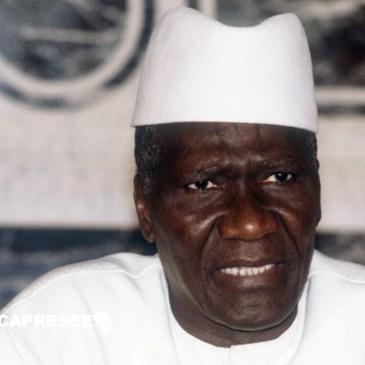
The Fire of Freedom: If Sékou Touré Had His Way

By Charles Zackary King
Changing Trends and Times | America in Black and White

In the pantheon of Black liberation, President Ahmed Sékou Touré stands as both architect and agitator, a man who dared to dream of an Africa unshackled from colonial chains. As Guinea’s first president, Touré didn’t just lead a nation; he attempted to rewire its soul. But what if his vision had fully taken root? What if Guinea had become the model Pan-African republic he imagined?

Let’s step into that alternate reality.

Guinea Reimagined: Touré’s Dream Realized

Imagine a Guinea where African socialism flourished, not as a reaction to colonial abandonment, but as a proactive blueprint for communal prosperity. In this Guinea:

  • Education is free and Afrocentric, with children learning the legacies of Samori Touré, Nkrumah, and Harriet Tubman alongside math and science.
  • Healthcare is universal, rooted in both modern medicine and indigenous healing traditions.
  • Art and culture are sacred, with griots, dancers, and sculptors honored as national treasures.
  • Women lead, not just in homes but in parliament, academia, and diplomacy.
  • Pan-African unity is tangible, with open borders for African nations, shared currencies, and joint infrastructure projects.
  • Guinea becomes a cultural capital, hosting global festivals of Black art, music, and resistance.

In this version of history, Guinea is not isolated, it’s exalted. Touré’s rejection of neocolonialism inspires a domino effect. Senegal, Mali, Ghana, and Congo follow suit, forming a United States of Africa, with Guinea as its moral compass.

The Real Guinea: Courage and Contradiction

Of course, history took a different path. After Guinea’s bold “No” to France in 1958, Touré faced economic sabotage, diplomatic isolation, and internal dissent. His response was fierce: nationalization, cultural revival, and alignment with socialist allies. But his regime also became authoritarian. Dissenters were imprisoned, and Camp Boiro became a symbol of repression.

Touré’s dream was noble, but his methods, at times, were brutal. The Guinea that emerged was proud, but wounded. Independent, but surveilled.

Why Touré Still Matters

Today, as Black communities worldwide fight for autonomy, dignity, and representation, Touré’s legacy offers both inspiration and caution. His vision of self-reliance, cultural pride, and continental unity remains relevant. His flaws remind us that liberation must be paired with compassion and accountability.

For creatives and advocates like Jean-Patrick Guichard, Touré’s influence is personal. His insistence on cultural sovereignty echoes in every curated exhibit, every community dinner, and every act of legacy-building.

Conclusion: The Fire Still Burns

Touré died in 1984, in Cleveland, Ohio, while undergoing heart surgery. But the fire he lit still burns, in classrooms, galleries, protests, and podcasts. His story is not just history, it’s a mirror, a map, and a challenge.

If Touré had his way, Guinea might have become the heartbeat of a liberated Africa. But even in reality, his defiance carved a path that others still walk. And in that, his legacy lives on.

Mansa Musa: The Legacy of the Lion King of Mali

By Charles Zackary King
Founder & CEO, America in Black and White | Blogger, Changing Trends and Times

Introduction

In a world where wealth is often measured by fleeting trends and digital valuations, the story of Mansa Musa stands as a timeless reminder of legacy, leadership, and cultural stewardship. Known as the richest man in recorded history, Musa’s reign over the Mali Empire in the 14th century was not just about gold, it was about vision, education, and the elevation of a people.

The Rise of a Legend

Mansa Musa ascended to power in 1312, inheriting an empire already rich in resources and influence. But under his leadership, Mali expanded its borders, deepened its cultural roots, and became a beacon of prosperity in West Africa. His empire stretched across modern-day Mali, Senegal, Guinea, Mauritania, and parts of Niger—making it one of the largest and most powerful of its time.

Wealth Beyond Imagination

Musa’s wealth was legendary. His empire controlled vast gold mines and taxed trans-Saharan trade routes dealing in salt, ivory, and other commodities. But it was his pilgrimage to Mecca in 1324 that truly stunned the world. Traveling with an entourage of 60,000 people and distributing gold so generously in Cairo that it disrupted the region’s economy for years, Musa’s journey was both a spiritual mission and a global statement.

A Builder of Culture and Faith

Upon returning from Mecca, Mansa Musa invested heavily in Islamic scholarship and architecture. He commissioned the construction of mosques, schools, and libraries—most notably the Djinguereber Mosque in Timbuktu. He invited scholars and architects from across the Muslim world, transforming Timbuktu into a center of learning and culture that would influence generations.

Legacy That Lives On

Mansa Musa died around 1337, but his legacy endures. He proved that African leadership could be visionary, global, and deeply rooted in cultural pride. His story challenges the erasure of African excellence from mainstream narratives and reminds us that wealth is not just material—it’s historical, intellectual, and communal.

Why Mansa Musa Matters Today

In the spirit of America in Black and White and Changing Trends and Times, Mansa Musa’s legacy speaks directly to our mission:

  • Civic education: His governance model emphasized justice, scholarship, and diplomacy.
  • Advocacy: He uplifted his people through infrastructure, faith, and international recognition.
  • Legacy-building: His impact was generational, not transactional.

As we continue to tell stories that empower and enlighten, let Mansa Musa be a reminder: Black history is global history. And legacy is built, not bought.

Derrick Jackson’s Bold Bid for Governor: Legacy, Leadership, and a Vision for Black Georgia

By Charles Zackary King
Founder, America in Black and White | AMIBW The Magazine

The original article titled “Derrick Jackson Discusses Campaign for Governor” was written by Christopher Smith and published on News & Talk WAOK.

Georgia State Representative Derrick Jackson isn’t just running for governor, he’s running on legacy, lived experience, and a moral obligation to serve. With a 42-year career that spans military command, corporate leadership, and legislative advocacy, Jackson’s campaign is rooted in justice, equity, and empowerment for all Georgians, especially Black communities historically left behind.

A Life of Service and Strategy

Jackson is a husband, father of seven, and retired U.S. Navy Lieutenant Commander with 22 years of service, including seven deployments. After a decade in the corporate sector with General Electric, he transitioned into public service, winning election to the Georgia House of Representatives in 2016. He represented District 64 until 2023, and now serves District 68, marking nearly a decade of legislative leadership.

His record includes fighting for voting rights, women’s rights, LGBTQ+ protections, and small business support. But Jackson’s work in underserved communities goes deeper, he’s been a consistent voice for economic justice, healthcare access, and educational equity.

Legislative Impact: Raising the Floor for Black Georgians

Among Jackson’s most impactful legislative efforts is his sponsorship of a bill to raise Georgia’s minimum wage to $27/hour by 2028. The bill proposed a phased increase, starting at $15/hour and rising annually, designed to uplift working-class families, especially Black workers disproportionately affected by wage stagnation and attacks on diversity initiatives.

This legislation, though stalled in committee, remains a cornerstone of his campaign. It directly addresses the economic disparities that have long plagued Black communities in Georgia, where over half a million Black jobs were lost in the past year due to rollbacks in equity programs.

Campaign Agenda: A Georgia That Works for Us

Jackson’s gubernatorial platform is built on eight pillars, each designed to help Georgia families thrive. For Black Georgians, his agenda includes:

  • Medicaid Expansion to close healthcare gaps and prevent rural hospital closures
  • Repealing Harmful Laws like the six-week abortion ban and rent control restrictions
  • Investing in Black Farmers, Small Businesses, and Nonprofits with access to capital and policy inclusion
  • Environmental Justice to protect communities from pollution and neglect
  • Education Reform & Workforce Development with expanded access to trades, apprenticeships, and technical education
  • Reparations Advocacy, proposing 33% of Georgia’s $16B budget be allocated to Black families as a fulfillment of broken promises

Jackson’s message is clear: “We’re not just building a Georgia for business, we’re building a Georgia for families.”

Inspired by Legacy: John Lewis and the Spirit of Service

Jackson cites civil rights icon John Lewis as a moral compass for his campaign. “I have a moral obligation to run for governor,” he said on WAOK, invoking Lewis’s legacy of courage and conscience. His leadership style blends executive discipline with grassroots empathy, qualities he believes make him the only candidate truly qualified to serve as Georgia’s Commander-in-Chief.

A Call to Action

Jackson’s campaign isn’t powered by million-dollar donors, it’s powered by people. He urges Georgians to “Tell 10 to Tell 10,” mobilize their communities, and vote for a future rooted in dignity, equity, and opportunity.

For Black Georgians, this race is more than political, it’s generational. It’s about reclaiming the promise of Georgia and ensuring that every child, every elder, and every entrepreneur has a seat at the table.

“Shutdown Theater: When Government Fails the People It Claims to Serve”

By Charles Zackary King
Founder/CEO of America in Black and White and AMIBW The Magazine

Introduction

As the clock ticks toward midnight on September 30, 2025, the threat of a government shutdown looms large. And while politicians posture, negotiate, and blame each other, everyday Americans brace for impact. This isn’t just about budgets, it’s about broken trust.

Let’s be clear: a shutdown is not a technical glitch. It’s a choice. And it’s the people, not the power brokers who pay the price.

What’s Really at Stake

  • Federal workers face mass layoffs. Over 100,000 jobs could be lost, marking one of the largest federal workforce cuts in history.
  • Essential services will be stretched thin. Law enforcement, air traffic control, and immigration enforcement may continue, but without pay.
  • Healthcare hangs in the balance. Democrats are demanding restoration of $1 trillion in Medicaid cuts and extension of Obamacare subsidies for 3.8 million Americans.
  • Political theater replaces real leadership. Fake videos, partisan tantrums, and stalled negotiations dominate headlines while families worry about food, housing, and safety.

Opinion: This Is Not Governance, It’s Neglect

A government shutdown is not just a failure of policy, it’s a failure of moral responsibility. When elected officials treat funding negotiations like a game of chicken, they forget who’s in the car: teachers, veterans, single parents, federal workers, and vulnerable communities.

This is not about party lines. It’s about lifelines.

And when leadership becomes performance, the people become collateral.

 A Message to the People

We must stop accepting dysfunction as normal. We must demand more than soundbites and blame games. We must hold every elected official accountable, not just for what they say, but for what they do when the cameras are off and the deadlines are real.

Because if the government shuts down, it’s not because we failed. It’s because they did. True this is a dire situation but if we want to preserve our constitution it might be the best thing to shut down the government. Think about this, monies and budgets that have been passed have been abused in a way we have never seen before. The people in charge have proven they cannot govern, and the people are not important. Our government is for sale, and the occupier is working with the top 1% for them to be richer and they cause chaos and disorder at the bottom. What this means is the Occupier of the White House is sewing seeds to underserved/uneducated White People that Black People are stealing resources from them. We are in a climate where resources are scarce for all but creating a race war for those at the bottom makes this a problem for all of us. Point and case, we are all making do with what we have and some of us have found a way to escalate our resources that are putting us in good positions to do much better. Well, with the seeds being sown to cause racial tension makes it bad for us all. The people at the top are continuing to skim and steal from all of us but they have caused us all to think that it is one or the other. We have differences which is normal, but this violence is at a whole new level. This is do to the politicians that refuse to do their jobs. People of both parties are in the pocket of Million Dollar Donors and are controlled by that money. This puts the real light on the Democratic Party to show what they can do to preserve strength. There is no easy way to do this but they have to Shut the Government down. This is the only way to stop the abuse by the people in charge. They have no control of their President who is doing as he pleases. If they negotiate they are going to agree to cut more from the people that need all they can get and allow this man to continue stealing from this country. If they shut this down it means nothing can be done, “NOTHING AT ALL”. Now to be clear we all know that Democrats have Big Donors as well but will they be controlled by them? Must the get permission to save the government. For a lot of us this is not a good thing but is it worth this to keep the democracy in tact? Agreements do not help the common everyday person, just keep that in mind.

Call to Action

  • Contact your representatives. Demand transparency and urgency.
  • Support federal workers. Share resources, offer solidarity, and amplify their voices.
  • Stay informed. Don’t let political spin distract from real consequences.
  • Vote with clarity. Remember who showed up, and who didn’t.

“To Be a Black Man in America: The Weight We Carry, The Truth We Live”

By Charles Zackary King
Founder/CEO of America in Black and White and AMIBW The Magazine

Introduction

To be a Black man in America is to live with a dual reality: one shaped by brilliance, resilience, and legacy, and another shaped by suspicion, exclusion, and systemic violence. It’s not just difficult. It’s deliberate. And yet, we continue to rise.

This post is not a cry for pity. It’s a declaration of truth.

The Burden of Being Seen

  • Criminalized Before We Speak:
    From childhood, we’re labeled “aggressive,” “disruptive,” or “dangerous.” Our tone is policed. Our presence is questioned. Our humanity is often denied.
  • Economic Gatekeeping:
    We are told to “work twice as hard,” but the doors still close. Black men face higher unemployment, lower wages, and fewer opportunities, regardless of education or experience.
  • Policing and Surveillance:
    We are over-policed, over-incarcerated, and under-protected. The justice system was not built to serve us, it was built to control us.
  • Emotional Suppression:
    Vulnerability is seen as weakness. We are expected to be silent, stoic, and strong, even when we’re breaking.

This is the example of being Black. Being Black is what happens when you are always stopped for no reason and then being asked “why are you up set”? “You must be guilty of something”, when you are just coming from work or going home from visiting family. The thing that makes this even worse is that you have other Black People including family that don’t believe you because the brain washing of the media has made them think you are guilty. There is nothing worse than having your Mother, Father, Brother, Sister, Wife/Girlfriend thinking you are guilty and refusing to support you because they can not give you the benefit of the doubt. None of these people can see the stress they are causing you but they want you to protect them and do what they need from you. Our own people can not see the harm they cause you. This adds to all kinds of pain and trauma and they still don’t see that.

When we talk about the Economic Gatekeeping we are talking about ever since the 70s when the PayScale represented the White Man, the White Woman, the Black Woman and then the Black Man. This causes your woman to look down on you and the others to think they can use you for pennies on the dollar and get the milk for free. Being put in this position is a major problem for your household but your wife/girlfriend does not see it that way. When you do what is necessary to please her, she complains but when you are not bringing in enough money she complains. Communication is bad and needs to improve because the wrong people have influenced your way of thinking and your love. What is still not seen is this man is struggling and is feeling trapped. This is the thing that has led to Single Parent Households.

The justice system has a precursor that states if you are a Black Man you must be guilty, and we can plant evidence against you and not worry about it. No one cares for you, and people will back the Blue when it comes to you. The bad part about this is some of the officers look just like you. Again, something that is adding to more stress than you can handle and it causes anxiety and mental health disorders. The question that is always there, “will they be here for me when I need them”? Please think about this.

As a Black Man we have pride and refuse to let anyone see us vulnerable. We cannot be weak, and we refuse to let others know we are hurting. The problem with this is Black Men have been carrying this jug of water for more than 100 years. We are not appreciated but are looked upon to protect and serve, we are not respected but expected to solve the most complex problems, and we are the real professionals with so much knowledge but never get the acknowledgement we deserve.  All along we are the real strong leaders, thinkers and can do men on the earth that make a real difference.

The Truth They Don’t Teach

  • Black men are more likely to die prematurely due to systemic neglect in healthcare, housing, and mental health.
  • We are less likely to receive fair trials, adequate representation, or restorative justice.
  • Our stories are often told by others, flattened, filtered, and stripped of nuance.

Our health always come into play because we have to be involved in the things that happen to our communities, our families and our people in general. Our leadership is needed to work with the others in our communities instead of against them. In todays time it is all about leadership and we have lots of it. We will continue to provide this until the day we die.

We know we will never get a fair shake which is the thing that makes community and family so important to us. It is clear and evident what the justice system has in store for us but what do we do? This is why we have to make sure we build our communities and keep our families together because when there is no male figure in the household outsiders find ways to take advantage of our people.

This is being told from my eyes because it is important that we do what is necessary to work and build together. Outside ramble is just that but we got to continue to show that we are the real leaders of our people. We have to communicate better but met with the same demeanor from those in our community. No on or nothing is perfect and I know we can grow like everything was intended to be for us all.

This is not accidental. It’s structural.

The Legacy We Build Anyway

Despite it all, we lead. We mentor. We create. We heal. We build platforms like America in Black and White and AMIBW The Magazine to tell our stories on our terms.

We are not just survivors, we are architects of truth.

Personal Reflection

As a Black man, I’ve felt the sting of betrayal, the weight of expectation, and the silence of being misunderstood. I’ve been told to “tone it down,” “wait my turn,” and “be grateful.” But I’ve also seen the power of truth-telling, the healing in storytelling, and the strength in community.

I write this not just for myself, but for every Black man who’s been told he’s too loud, too angry, too ambitious, too Black.

Do what is necessary by your wife/Husband and Family and make sure you are documenting and telling your story. Don’t ever give up just keep pushing because as a Black Man you are really viewed as the KING you really are.

Call to Action

  • Listen to Black men. Not just when we’re in pain—but when we’re building.
  • Support Black-led platforms. Subscribe, share, and invest.
  • Challenge stereotypes. In your workplace, your media, your conversations.
  • Honor our humanity. Not just our struggle—but our joy, our creativity, our legacy.

Citations